Resources for
Access
Funding
: Sep 1, 2026
up to $250,000
DEEP CERCLA 128(a) Brownfield Grant Program – Round 4
DEEP was awarded this funding from the EPA under the Infrastructure Investment and Jobs Act (IIJA) to administer to brownfield sites in Connecticut to perform environmental assessment and cleanup activities.
DEEP encourages applicants whose projects will enable the creation, preservation, or addition of park space, greenways or other recreational space, or other property used for nonprofit or municipal purposes, to apply for this pool of funding.
Funding
: Sep 1, 2026
up to $250,000
DEEP CERCLA 128(a) Brownfield Grant Program – Round 4
DEEP was awarded this funding from the EPA under the Infrastructure Investment and Jobs Act (IIJA) to administer to brownfield sites in Connecticut to perform environmental assessment and cleanup activities.
Funding
: Apr 21, 2026
min $50K
Forever Connecticut Fund
CLCC’s Forever Connecticut Fund is a conservation finance tool that provides land trusts with access to immediate, flexible capital to acquire natural and working lands, including fee simple and conservation easements. Beyond financial assistance, the Forever Connecticut Fund strengthens organizations through a new capacity-building program that includes one-on-one coaching from a development expert to help land trusts secure grants and donations, launch capital campaigns, and boost their overall fundraising capacity.
The Forever CT Fund is designed to help land trusts act quickly on conservation opportunities when traditional funding sources are not immediately available. Applications are accepted by invitation only. Email Yaw to discuss your project(s) and eligibility for funding.
Funding
: Apr 21, 2026
min $50K
Forever Connecticut Fund
CLCC’s Forever Connecticut Fund is a conservation finance tool that provides land trusts with access to immediate, flexible capital to acquire natural and working lands, including fee simple and conservation easements. Beyond financial assistance, the Forever Connecticut Fund strengthens organizations through a new capacity-building program that includes one-on-one coaching from a development expert to help land trusts secure grants and donations, launch capital campaigns, and boost their overall fundraising capacity.
Funding
: Apr 21, 2026
min $50K
The Land & Easement Acquisition Program (LEAP)
The Land & Easement Acquisition Program (LEAP) is designed to bridge funding gaps and accelerate the protection of valuable conservation lands. CLCC will prioritize projects that:
- Have a closing time frame of 12 months or less.
- Demonstrate a strong commitment to conservation.
- Align with statewide land conservation goals.
- Have leveraged and/or exhausted other public and private funding sources.
Applications are accepted by invitation only. Potential applicants are required to contact Yaw Darko, CLCC’s Director of Grants and Programs, to discuss their project and determine eligibility.
Funding
: Apr 21, 2026
min $50K
The Land & Easement Acquisition Program (LEAP)
The Land & Easement Acquisition Program (LEAP) is designed to bridge funding gaps and accelerate the protection of valuable conservation lands. CLCC will prioritize projects that:
- Have a closing time frame of 12 months or less.
- Demonstrate a strong commitment to conservation.
- Align with statewide land conservation goals.
- Have leveraged and/or exhausted other public and private funding sources.
Funding
: Dec 31 – Dec 31, 2027
Connecticut Conservation Partnership Program (CCPP)
Administered by the Connecticut Land Conservation Council (CLCC), CCPP has established a coordinated process by which land trust applicants to the Connecticut Department of Energy and Environmental Protection (DEEP) Open Space and Watershed Land Acquisition Grant Program (OSWA) may apply for a federal grant as a source of match funds.
Easements can be held by USDA-NRCS (U.S. Held Easements) or an eligible entity (Entity Held Easements). Priorities are for conservation easements on nonindustrial private forest and watershed lands.
Funding
: Dec 31 – Dec 31, 2027
Connecticut Conservation Partnership Program (CCPP)
Administered by the Connecticut Land Conservation Council (CLCC), CCPP has established a coordinated process by which land trust applicants to the Connecticut Department of Energy and Environmental Protection (DEEP) Open Space and Watershed Land Acquisition Grant Program (OSWA) may apply for a federal grant as a source of match funds.
Funding
: Feb 6 – Mar 17, 2026
$1,000 - $4,000
Grow Grants Program
The New England Grassroots Environment Fund awards small grants in support of grassroots efforts and community-based environmental work in New England. The GROW GRANTS program is actively accepting applications from grassroots groups across New England. These grants fund small, volunteer-driven groups in New England working on issues including food access, immigrant support, climate resilience, youth work, mutual aid, and more. This program is geared toward groups with experience organizing in their community and have at least THREE leaders who are actively involved in group decision-making. Grants support groups to deepen their work by further developing a community vision, lowering barriers to participation, identifying new stakeholders, and working to bring more voices and lived experiences into core decision-making processes.
Grow grants prioritize support for community groups who represent a broad range of voices in their community and who are not being reached by other funders. The Grassroots Fund interprets the word 'environment' broadly and provides funding for a wide range of activities.
Funding
: Feb 6 – Mar 17, 2026
$1,000 - $4,000
Grow Grants Program
The New England Grassroots Environment Fund awards small grants in support of grassroots efforts and community-based environmental work in New England. The GROW GRANTS program is actively accepting applications from grassroots groups across New England. These grants fund small, volunteer-driven groups in New England working on issues including food access, immigrant support, climate resilience, youth work, mutual aid, and more. This program is geared toward groups with experience organizing in their community and have at least THREE leaders who are actively involved in group decision-making. Grants support groups to deepen their work by further developing a community vision, lowering barriers to participation, identifying new stakeholders, and working to bring more voices and lived experiences into core decision-making processes.
Funding
: Sep 2 – Nov 21, 2025
$5K-100K
Long Island Sound Community Impact Fund (LISCIF)
Restore America’s Estuaries is excited to announce the third round of funding for the Long Island Sound Community Impact Fund. Up to $1,200,000 in competitive funding will be awarded to support projects in New York and Connecticut in 2026. The Long Island Sound Community Impact Fund (LISCIF) is a partnership among Restore America’s Estuaries, the U.S. Environmental Protection Agency, and the Long Island Sound Partnership. The purpose of LISCIF is to provide technical and financial assistance to communities for addressing environmental issues and to improve the quality and accessibility of the Long Island Sound.
The Long Island Sound Community Impact Fund aims to build capacity for organizations located in communities affected by environmental and human health risks. The Fund seeks to provide technical assistance for communities and support proposals which ultimately improve access to the Long Island Sound, while reducing overall environmental health risks. Eligible projects and activities will be community-driven and address one of the funding priorities below: 1) Projects that result in quantifiable pollutant prevention or reduction; 2) Restoring habitat within the Important Coastal Habitat Types targeted by LIS Partnership; 3) Projects that foster a diverse balance and abundant populations of fish, birds, and wildlife; 4) Public engagement, knowledge, and stewardship; 5) Projects that enhance community resilience and sustainability; 6) Planning and design that set-the-stage for implementation of water quality projects, eligible habitat restoration projects and resilience projects; 7) Community-based science projects; 8) Data management and integration projects; 9) Other similar activities that the applicant proposes, and EPA approves, that are consistent with Section 119 of the Clean Water Act.
Funding
: Sep 2 – Nov 21, 2025
$5K-100K
Long Island Sound Community Impact Fund (LISCIF)
Restore America’s Estuaries is excited to announce the third round of funding for the Long Island Sound Community Impact Fund. Up to $1,200,000 in competitive funding will be awarded to support projects in New York and Connecticut in 2026. The Long Island Sound Community Impact Fund (LISCIF) is a partnership among Restore America’s Estuaries, the U.S. Environmental Protection Agency, and the Long Island Sound Partnership. The purpose of LISCIF is to provide technical and financial assistance to communities for addressing environmental issues and to improve the quality and accessibility of the Long Island Sound.
Story Map
Level of Effort:
A StoryMap on Hypoxia
Success in the Urban Sea: Breathing Oxygen Back into the Long Island Sound’s Waters
This StoryMap describes how the Long Island Sound (LIS) Partnership has reduced hypoxia and improved nutrient management efforts in Long Island Sound and its watershed.
It includes an explanation of hypoxia, impacts from the region’s history, how LIS Partnership is addressing hypoxia, plans for the future, and how to use this information to inform meaningful action.
Story Map
Level of Effort:
A StoryMap on Hypoxia
Success in the Urban Sea: Breathing Oxygen Back into the Long Island Sound’s Waters
This StoryMap describes how the Long Island Sound (LIS) Partnership has reduced hypoxia and improved nutrient management efforts in Long Island Sound and its watershed.
It includes an explanation of hypoxia, impacts from the region’s history, how LIS Partnership is addressing hypoxia, plans for the future, and how to use this information to inform meaningful action.
Funding
: Jul 17 – Dec 17, 2025
Urban Green and Community Gardens Grant Program
The Urban Green and Community Gardens Grant Program provides funding assistance to develop or enhance urban green spaces for public enjoyment and/or environmental education. Promotion of open space in an urban setting may include, but may not be limited to, the development of a community garden or reclaiming and enhancing existing open space for the public’s use. Grants are awarded to projects that demonstrate the highest ability to benefit urban communities in close proximity to population centers.
Please review the Grant Program Eligibility Requirements. For questions on UGCG, contact Steven Perry: Steven.perry@ct.gov
Funding
: Jul 17 – Dec 17, 2025
Urban Green and Community Gardens Grant Program
The Urban Green and Community Gardens Grant Program provides funding assistance to develop or enhance urban green spaces for public enjoyment and/or environmental education. Promotion of open space in an urban setting may include, but may not be limited to, the development of a community garden or reclaiming and enhancing existing open space for the public’s use. Grants are awarded to projects that demonstrate the highest ability to benefit urban communities in close proximity to population centers.
Funding
: Jul 17 – Nov 3, 2025
up to 65-75% of fair market value
Open Space and Watershed Land Acquisition Grant Program
The Open Space and Watershed Land Acquisition (OSWA) Grant Program provides financial assistance to municipalities and nonprofit land conservation organizations to acquire land for open space, and to water companies to acquire land to be classified as Class I or Class II water supply property.
Awards are granted to projects that offer the highest conservation and recreational value and that leverage the greatest percentage of private and municipal funding. Grants are awarded for the purchase of land that is: 1) Valuable for recreation, forestry, fishing, conservation of wildlife or natural resources; 2) A prime natural feature of the state's landscape; 3) Habitat for native plant or animal species listed as threatened, endangered or of special concern; 4) A relatively undisturbed outstanding example of an uncommon native ecological community; 5) Important for enhancing and conserving water quality; 6) Valuable for preserving local agricultural heritage; or 7) Eligible to be classified as Class I or Class II watershed land. Land acquired will be preserved in perpetuity predominately in its natural scenic and open condition, for the protection or provision of potable water, or for agriculture. For questions on OSWA, contact Allyson Clarke: Allyson.clarke@ct.gov
Funding
: Jul 17 – Nov 3, 2025
up to 65-75% of fair market value
Open Space and Watershed Land Acquisition Grant Program
The Open Space and Watershed Land Acquisition (OSWA) Grant Program provides financial assistance to municipalities and nonprofit land conservation organizations to acquire land for open space, and to water companies to acquire land to be classified as Class I or Class II water supply property.
Funding
: Oct 1, 2025
$1,000 - $20,000
The Quinnipiac River Fund
The Quinnipiac River Fund, a component fund of The Community Foundation for Greater New Haven, makes grants for projects designed to benefit the environmental quality of the Quinnipiac River, the New Haven Harbor, and surrounding watersheds.
The Quinnipiac River Fund improves the health of the Quinnipiac River by funding projects that provide research, conservation, and advocacy for the river and its surrounding watersheds.
Funding
: Oct 1, 2025
$1,000 - $20,000
The Quinnipiac River Fund
The Quinnipiac River Fund, a component fund of The Community Foundation for Greater New Haven, makes grants for projects designed to benefit the environmental quality of the Quinnipiac River, the New Haven Harbor, and surrounding watersheds.
~$300K to $15M
Outdoor Recreation Legacy Partnership Program – Recurring Notice 5 Year
Note: this program has been paused indefinitely.
The Outdoor Recreation Legacy Partnership (ORLP) program was established in 2014 and is funded through the Land and Water Conservation Fund. ORLP is a nationally competitive, dollar-for-dollar matching grant program. It was created to aid disadvantaged, urban communities that lack access to close-by outdoor recreation. Funds can be used for the acquisition and/or development of, or substantial renovation of, public parks and other outdoor recreation spaces.
Entities interested in seeking funding under the ORLP program should contact their State’s Lead Agency (Department of Energy and Environmental Protection for Connecticut; Office of Parks, Recreation, and Historic Preservation for New York) to get details about their state’s process for selecting and submitting projects to the NPS’ national competition.
Acquisition of lands, wetlands, and waters for public outdoor recreation may be eligible for assistance. Projects could involve a combination of land acquisition and site development. These projects can cater to a diverse range of public outdoor recreation activities and facilities required to enhance the use and enjoyment for the public. These include, and are not limited to: • Community Parks • Campgrounds • Playgrounds • Sport fields and Courts • Picnic Areas and Open-air Pavilions • Trails and Tracks for Hiking, Walking, Skating, or Biking • Water based Recreation Facilities for Swimming or Boating • Fishing and Hunting Facilities • Pools and Splash Pads • Publicly Accessible Nature Preserves or Conservation Areas • Community Gardens • Spectator Facilities such as Amphitheaters or Bandstands • Renovations of Existing Facilities • Interpretive Signage
~$300K to $15M
Outdoor Recreation Legacy Partnership Program – Recurring Notice 5 Year
Note: this program has been paused indefinitely.
The Outdoor Recreation Legacy Partnership (ORLP) program was established in 2014 and is funded through the Land and Water Conservation Fund. ORLP is a nationally competitive, dollar-for-dollar matching grant program. It was created to aid disadvantaged, urban communities that lack access to close-by outdoor recreation. Funds can be used for the acquisition and/or development of, or substantial renovation of, public parks and other outdoor recreation spaces.
Entities interested in seeking funding under the ORLP program should contact their State’s Lead Agency (Department of Energy and Environmental Protection for Connecticut; Office of Parks, Recreation, and Historic Preservation for New York) to get details about their state’s process for selecting and submitting projects to the NPS’ national competition.
Funding
: Dec 26 – Jun 1, 2025
~$300K to $15M
Outdoor Recreation Legacy Partnership Program – Recurring Notice 5 Year
The Outdoor Recreation Legacy Partnership (ORLP) program was established in 2014 and is funded through the Land and Water Conservation Fund. ORLP is a nationally competitive, dollar-for-dollar matching grant program. It was created to aid disadvantaged, urban communities that lack access to close-by outdoor recreation. Funds can be used for the acquisition and/or development of, or substantial renovation of, public parks and other outdoor recreation spaces.
Entities interested in seeking funding under the ORLP program should contact their State’s Lead Agency (Department of Energy and Environmental Protection for Connecticut; Office of Parks, Recreation, and Historic Preservation for New York) to get details about their state’s process for selecting and submitting projects to the NPS’ national competition.
Acquisition of lands, wetlands, and waters for public outdoor recreation may be eligible for assistance. Projects could involve a combination of land acquisition and site development. These projects can cater to a diverse range of public outdoor recreation activities and facilities required to enhance the use and enjoyment for the public. These include, and are not limited to: • Community Parks • Campgrounds • Playgrounds • Sport fields and Courts • Picnic Areas and Open-air Pavilions • Trails and Tracks for Hiking, Walking, Skating, or Biking • Water based Recreation Facilities for Swimming or Boating • Fishing and Hunting Facilities • Pools and Splash Pads • Publicly Accessible Nature Preserves or Conservation Areas • Community Gardens • Spectator Facilities such as Amphitheaters or Bandstands • Renovations of Existing Facilities • Interpretive Signage
Funding
: Dec 26 – Jun 1, 2025
~$300K to $15M
Outdoor Recreation Legacy Partnership Program – Recurring Notice 5 Year
The Outdoor Recreation Legacy Partnership (ORLP) program was established in 2014 and is funded through the Land and Water Conservation Fund. ORLP is a nationally competitive, dollar-for-dollar matching grant program. It was created to aid disadvantaged, urban communities that lack access to close-by outdoor recreation. Funds can be used for the acquisition and/or development of, or substantial renovation of, public parks and other outdoor recreation spaces.
Entities interested in seeking funding under the ORLP program should contact their State’s Lead Agency (Department of Energy and Environmental Protection for Connecticut; Office of Parks, Recreation, and Historic Preservation for New York) to get details about their state’s process for selecting and submitting projects to the NPS’ national competition.
Funding
: Mar 1 – Apr 1, 2026
$50K - $500K (or 30% of appraised value)
The Land & Easement Acquisition Program (LEAP) March-April
The Land & Easement Acquisition Program (LEAP) is designed to bridge funding gaps and accelerate the protection of valuable conservation lands. CLCC will prioritize projects that:
- Have a closing time frame of 12 months or less.
- Demonstrate a strong commitment to conservation.
- Align with statewide land conservation goals.
- Have leveraged and/or exhausted other public and private funding sources.
Applications are accepted by invitation only. Potential applicants are required to contact Yaw Darko, CLCC’s Director of Grants and Programs, to discuss their project and determine eligibility.
Funding
: Mar 1 – Apr 1, 2026
$50K - $500K (or 30% of appraised value)
The Land & Easement Acquisition Program (LEAP) March-April
The Land & Easement Acquisition Program (LEAP) is designed to bridge funding gaps and accelerate the protection of valuable conservation lands. CLCC will prioritize projects that:
- Have a closing time frame of 12 months or less.
- Demonstrate a strong commitment to conservation.
- Align with statewide land conservation goals.
- Have leveraged and/or exhausted other public and private funding sources.
Funding
: Jul 1 – Sep 1, 2025
$50K - $500K (or 30% of appraised value)
The Land Capital Grant Program – Round 4
The Land Capital Grant Program (LCG) is designed to bridge funding gaps and accelerate the protection of valuable conservation lands. CLCC will prioritize projects that:
- Have a closing time frame of 12 months or less.
- Demonstrate a strong commitment to conservation.
- Align with statewide land conservation goals.
- Have leveraged and/or exhausted other public and private funding sources.
Applications are accepted by invitation only. Potential applicants are required to contact Yaw Darko, CLCC’s Director of Grants and Programs, to discuss their project and determine eligibility.
Funding
: Jul 1 – Sep 1, 2025
$50K - $500K (or 30% of appraised value)
The Land Capital Grant Program – Round 4
The Land Capital Grant Program (LCG) is designed to bridge funding gaps and accelerate the protection of valuable conservation lands. CLCC will prioritize projects that:
- Have a closing time frame of 12 months or less.
- Demonstrate a strong commitment to conservation.
- Align with statewide land conservation goals.
- Have leveraged and/or exhausted other public and private funding sources.
Funding
: May 1 – Jul 1, 2025
$50K - $500K (or 30% of appraised value)
The Land Capital Grant Program – Round 3
The Land Capital Grant Program (LCG) is designed to bridge funding gaps and accelerate the protection of valuable conservation lands. CLCC will prioritize projects that:
- Have a closing time frame of 12 months or less.
- Demonstrate a strong commitment to conservation.
- Align with statewide land conservation goals.
- Have leveraged and/or exhausted other public and private funding sources.
Applications are accepted by invitation only. Potential applicants are required to contact Yaw Darko, CLCC’s Director of Grants and Programs, to discuss their project and determine eligibility.
Funding
: May 1 – Jul 1, 2025
$50K - $500K (or 30% of appraised value)
The Land Capital Grant Program – Round 3
The Land Capital Grant Program (LCG) is designed to bridge funding gaps and accelerate the protection of valuable conservation lands. CLCC will prioritize projects that:
- Have a closing time frame of 12 months or less.
- Demonstrate a strong commitment to conservation.
- Align with statewide land conservation goals.
- Have leveraged and/or exhausted other public and private funding sources.
Funding
: Mar 1 – May 1, 2025
$50K - $500K (or 30% of appraised value)
The Land Capital Grant Program – Round 2
The Land Capital Grant Program (LCG) is designed to bridge funding gaps and accelerate the protection of valuable conservation lands. CLCC will prioritize projects that:
- Have a closing time frame of 12 months or less.
- Demonstrate a strong commitment to conservation.
- Align with statewide land conservation goals.
- Have leveraged and/or exhausted other public and private funding sources.
Applications are accepted by invitation only. Potential applicants are required to contact Yaw Darko, CLCC’s Director of Grants and Programs, to discuss their project and determine eligibility.
Funding
: Mar 1 – May 1, 2025
$50K - $500K (or 30% of appraised value)
The Land Capital Grant Program – Round 2
The Land Capital Grant Program (LCG) is designed to bridge funding gaps and accelerate the protection of valuable conservation lands. CLCC will prioritize projects that:
- Have a closing time frame of 12 months or less.
- Demonstrate a strong commitment to conservation.
- Align with statewide land conservation goals.
- Have leveraged and/or exhausted other public and private funding sources.
Funding
: Jan 1 – Mar 1, 2025
$50K - $500K (or 30% of appraised value)
The Land Capital Grant Program – Round 1
The Land Capital Grant Program (LCG) is designed to bridge funding gaps and accelerate the protection of valuable conservation lands. CLCC will prioritize projects that:
- Have a closing time frame of 12 months or less.
- Demonstrate a strong commitment to conservation.
- Align with statewide land conservation goals.
- Have leveraged and/or exhausted other public and private funding sources.
Applications are accepted by invitation only. Potential applicants are required to contact Yaw Darko, CLCC’s Director of Grants and Programs, to discuss their project and determine eligibility.
Funding
: Jan 1 – Mar 1, 2025
$50K - $500K (or 30% of appraised value)
The Land Capital Grant Program – Round 1
The Land Capital Grant Program (LCG) is designed to bridge funding gaps and accelerate the protection of valuable conservation lands. CLCC will prioritize projects that:
- Have a closing time frame of 12 months or less.
- Demonstrate a strong commitment to conservation.
- Align with statewide land conservation goals.
- Have leveraged and/or exhausted other public and private funding sources.
Funding
: Jul 9 – Sep 30, 2024
up to $2M for Planning, $5-$100M for Capital Construction
Reconnecting Communities Pilot (RCP) Discretionary Grant Program
The Reconnecting Communities Pilot Program, available through the Office of the Secretary of Transportation and US DOT, makes awards on a competitive basis for projects that reconnect communities by removing, retrofitting, or mitigating highways or other transportation facilities that create barriers to community connectivity, including to mobility, access, or economic development.
Planning Grants fund the study of removing, retrofitting, or mitigating an existing facility to restore community connectivity; public engagement; and other transportation planning activities. Capital Construction Grants fund a project to remove, retrofit, mitigate, or to replace an existing eligible facility with a new facility that reconnects communities.
Funding
: Jul 9 – Sep 30, 2024
up to $2M for Planning, $5-$100M for Capital Construction
Reconnecting Communities Pilot (RCP) Discretionary Grant Program
The Reconnecting Communities Pilot Program, available through the Office of the Secretary of Transportation and US DOT, makes awards on a competitive basis for projects that reconnect communities by removing, retrofitting, or mitigating highways or other transportation facilities that create barriers to community connectivity, including to mobility, access, or economic development.
Funding
: Apr 21, 2026
$500 - $1,000
Seed Grants Program
Awards small grants in support of grassroots efforts and community-based environmental work in New England. The Grassroots Fund utilizes participatory grantmaking to move resources to New England grassroots groups working at the intersections of Environmental Justice. The program is geared toward groups who have some experience implementing a project in their community. Grants support groups to deepen their work by further developing a community vision, lowering barriers to participation, identifying new stakeholders, and working to bring more voices and lived experiences into core decision-making processes.
The Seed grant program is geared towards groups launching new projects or starting to significantly change the direction of an existing project. Most often, groups have been working on the project less than a year and usually don't yet have much direct experience with implementing the idea. The Grassroots Fund interprets the word 'environment' broadly and provides funding for a wide range of activities.
Funding
: Apr 21, 2026
$500 - $1,000
Seed Grants Program
Awards small grants in support of grassroots efforts and community-based environmental work in New England. The Grassroots Fund utilizes participatory grantmaking to move resources to New England grassroots groups working at the intersections of Environmental Justice. The program is geared toward groups who have some experience implementing a project in their community. Grants support groups to deepen their work by further developing a community vision, lowering barriers to participation, identifying new stakeholders, and working to bring more voices and lived experiences into core decision-making processes.
Funding
: Feb 9 – Apr 9, 2024
Urban Agriculture and Innovative Production (UAIP) Competitive Grants Program
Supports the development of urban agriculture and innovative production activities by funding Planning Projects and Implementation Projects led by nonprofit organizations, local or Tribal governments, and schools.
The primary goal of the UAIP projects is to support the development of urban agriculture and innovative production. The UAIP grants being made available for application under this NFO support planning and implementation activities. Planning activities will initiate, develop, or support the efforts of farmers, gardeners, citizens, government officials, schools, members of tribal communities, and other stakeholders in areas where access to fresh foods are limited or unavailable. Implementation activities will accelerate existing and emerging models of urban and/or innovative agricultural practices that serve multiple farmers or gardeners. Innovation may include new and emerging, as well as indigenous or non-traditional agricultural practices. Activities may include, but are not limited to, community gardens, urban farms, rooftop farms, urban agroforests, food forests, orchards, outdoor vertical production, green walls, indoor farms, controlled environment agricultural production, greenhouses, high-tech vertical technology farms, and hydroponic, aeroponic, and aquaponic farm facilities.
Funding
: Feb 9 – Apr 9, 2024
Urban Agriculture and Innovative Production (UAIP) Competitive Grants Program
Supports the development of urban agriculture and innovative production activities by funding Planning Projects and Implementation Projects led by nonprofit organizations, local or Tribal governments, and schools.
Funding
: Nov 7 – Apr 30, 2024
Round 7 Outdoor Recreation Legacy Partnership Program
The Outdoor Recreation Legacy Partnership (ORLP) program was established in 2014 and is funded through the Land and Water Conservation Fund. ORLP is a nationally competitive, dollar-for-dollar matching grant program. It was created to aid disadvantaged, urban communities that lack access to close-by outdoor recreation. Funds can be used for the acquisition and/or development of, or substantial renovation of, public parks and other outdoor recreation spaces.
Projects may include any or all manner of outdoor recreation activities such as hiking, camping, unstructured play, picnicking, cycling, field and court sports, fishing, bird watching, swimming pools, paddling, and skating, as well as for outdoor recreation facilities and some supporting facilities and infrastructure like restrooms/bathhouses, or parking areas, when part of an overall recreation project.
The application process for the ORLP competition is different from most federal grant programs. Each State has a Lead Agency charged in administering the Land and Water Conservation fund within the State. This agency solicits proposals from project sponsors across the state, then selects and submits those they feel are best qualified to meet the goals of the ORLP program to the National Park Service (NPS) for inclusion in the national competition. If the project is selected in the national competition, the State Lead Agency than works with the project sponsor to prepare and submit additional required documents necessary for NPS to complete a full and final review of the project and make a funding determination. State Lead Agency selection deadlines are earlier than the NPS’s national ORLP competition deadline and may include additional requirements. Entities interested in seeking funding under the ORLP program should contact their State’s Lead Agency (Department of Energy and Environmental Protection for Connecticut; Office of Parks, Recreation, and Historic Preservation for New York) to get details about their state’s process for selecting and submitting projects to the NPS’ national competition.
Funding
: Nov 7 – Apr 30, 2024
Round 7 Outdoor Recreation Legacy Partnership Program
The Outdoor Recreation Legacy Partnership (ORLP) program was established in 2014 and is funded through the Land and Water Conservation Fund. ORLP is a nationally competitive, dollar-for-dollar matching grant program. It was created to aid disadvantaged, urban communities that lack access to close-by outdoor recreation. Funds can be used for the acquisition and/or development of, or substantial renovation of, public parks and other outdoor recreation spaces.
Projects may include any or all manner of outdoor recreation activities such as hiking, camping, unstructured play, picnicking, cycling, field and court sports, fishing, bird watching, swimming pools, paddling, and skating, as well as for outdoor recreation facilities and some supporting facilities and infrastructure like restrooms/bathhouses, or parking areas, when part of an overall recreation project.
Funding
: May 19 – Jul 31, 2025
$50K-$2M for implementation grants, $10K-200K for certification grants
NYS Climate Smart Communities
The Climate Smart Communities (CSC) Grant program was established in 2016 to provide grants to cities, towns, villages, and counties of the State of New York for eligible climate change mitigation, adaptation, and planning and assessment projects. Funds are available for two broad project categories – implementation and certification. The first project category supports implementation projects related to the reduction of greenhouse gas emissions (mainly outside the power sector), climate change adaptation, and engineering feasibility studies for flood mitigation and Hydrofluorocarbons. The second supports planning and assessment projects aligned with Climate Smart Communities certification actions.
Applications are accepted annually through the Consolidated Funding Application (CFA). Municipalities need not be a registered or certified as a Climate Smart Community to apply for a grant.
Funding
: May 19 – Jul 31, 2025
$50K-$2M for implementation grants, $10K-200K for certification grants
NYS Climate Smart Communities
The Climate Smart Communities (CSC) Grant program was established in 2016 to provide grants to cities, towns, villages, and counties of the State of New York for eligible climate change mitigation, adaptation, and planning and assessment projects. Funds are available for two broad project categories – implementation and certification. The first project category supports implementation projects related to the reduction of greenhouse gas emissions (mainly outside the power sector), climate change adaptation, and engineering feasibility studies for flood mitigation and Hydrofluorocarbons. The second supports planning and assessment projects aligned with Climate Smart Communities certification actions.
Funding
: May 14 – Jul 31, 2024
Up to $500K
Environmental Protection Fund Grant Program for Parks, Preservation and Heritage
This program provides funding for the acquisition, planning, development, and improvement of parks, historic properties, and heritage areas.
Applications are accepted annually through the Consolidated Funding Application (CFA).
Funding
: May 14 – Jul 31, 2024
Up to $500K
Environmental Protection Fund Grant Program for Parks, Preservation and Heritage
This program provides funding for the acquisition, planning, development, and improvement of parks, historic properties, and heritage areas.
no maximum or minimum
Smart Growth Community Planning and Zoning Grant Program
Smart Growth promotes several land use planning principles that create livable, sustainable and equitable communities. Financial assistance grants are available on a competitive basis to municipalities to develop or update comprehensive plans, area plans (such as Transit Oriented Development plan) or zoning ordinances that incorporate smart growth principles including promoting efficient and sustainable land development and redevelopment patterns that optimize prior infrastructure investments. These planning efforts should reflect a community goals and aspirations for its own future, and address a wide range of planning issues including, but not limited to, appropriate physical development, economic development, transportation patterns, natural and built resource inventories, and population trends, while setting a course for clean and affordable energy, efficient use of land, protection of agricultural working lands and forests and overall healthy communities.
Applications are accepted annually through the Consolidated Funding Application (CFA). Grants are available to advance the preparation and adoption of one of the following: 1) Preparation and local adoption of a new or updated comprehensive plan for an entire town, village, or city that supports smart growth principles for the community; 2) Preparation and local adoption of new or updated zoning regulations (i.e., local law, ordinance) for an entire town, village, or city that would implement an existing comprehensive plan that supports smart growth principles for the community; 3) Preparation and local adoption of new or updated area plan for part of a town, village, or city that supports smart growth principles for the community, and which plans may include, but would not be limited to, transit-oriented development plans and downtown/hamlet area plans; or, 4) Preparation and local adoption of new or updated zoning regulations that would implement any such area plans already adopted by a subject town, village, or city.
no maximum or minimum
Smart Growth Community Planning and Zoning Grant Program
Smart Growth promotes several land use planning principles that create livable, sustainable and equitable communities. Financial assistance grants are available on a competitive basis to municipalities to develop or update comprehensive plans, area plans (such as Transit Oriented Development plan) or zoning ordinances that incorporate smart growth principles including promoting efficient and sustainable land development and redevelopment patterns that optimize prior infrastructure investments. These planning efforts should reflect a community goals and aspirations for its own future, and address a wide range of planning issues including, but not limited to, appropriate physical development, economic development, transportation patterns, natural and built resource inventories, and population trends, while setting a course for clean and affordable energy, efficient use of land, protection of agricultural working lands and forests and overall healthy communities.
Funding
: May 19 – Jul 31, 2025
$50K-$2M
NYSDOS Local Waterfront Revitalization Program
The NYS Department of State (NYSDOS) is soliciting applications from eligible villages, towns, cities located along New York’s coasts or designated inland waterways, counties, or regional planning councils to advance the preparation or implementation of strategies for community and waterfront revitalization through the following grant categories: Preparing or Updating a Local Waterfront Revitalization Program (LWRP), including Updating an LWRP to be More Resilient to Climate Risks; Preparing an LWRP Component, including a Watershed Management Plan; Implementing an LWRP or a completed LWRP Component.
For project-specific planning, feasibility, design, and/or construction needed to advance eligible activities, an eligible applicant must be currently preparing or have an approved LWRP or LWRP Component. The proposed project must be located within the LWRP waterfront revitalization area boundary or LWRP Component boundary. Applications are accepted annually through the Consolidated Funding Application (CFA).
Funding
: May 19 – Jul 31, 2025
$50K-$2M
NYSDOS Local Waterfront Revitalization Program
The NYS Department of State (NYSDOS) is soliciting applications from eligible villages, towns, cities located along New York’s coasts or designated inland waterways, counties, or regional planning councils to advance the preparation or implementation of strategies for community and waterfront revitalization through the following grant categories: Preparing or Updating a Local Waterfront Revitalization Program (LWRP), including Updating an LWRP to be More Resilient to Climate Risks; Preparing an LWRP Component, including a Watershed Management Plan; Implementing an LWRP or a completed LWRP Component.
Funding
: Jun 18 – Sep 17, 2025
$50,000-$300,000
NYS Community Forest Conservation Grant Program
$1 million in competitive grant funding is now available through the NY State’s Community Forest Conservation Grant Program. Community forests build local ownership of forests, local participation in forest management, and contribute to the State’s goals of conserving 30 percent of New York’s lands and waters by 2030.
Municipalities can use this funding to purchase land or conservation easements to create or expand community-owned forests to sustain and protect wildlife habitat, promote clean air and water, preserve biodiversity, and increase access to recreation opportunities and open space.
Municipalities may apply for a minimum of $50,000 up to a maximum of $300,000. Eligible locations for acquisition include private properties of 10 or more acres within New York State. At least 75% of the property must be forested.
Grant projects must result in the acquisition of community forests through use of fee title (purchase) or conservation easements. Projects must acquire private lands that are not already owned by the eligible applicant. Community forests must be publicly accessible and provide benefits for the public such as recreation access (fishing, hiking, biking, hunting, wildlife observation, etc.), flood mitigation, wildlife habitat, clean water, and forest products (timber, maple syrup, etc.).
Funding
: Jun 18 – Sep 17, 2025
$50,000-$300,000
NYS Community Forest Conservation Grant Program
$1 million in competitive grant funding is now available through the NY State’s Community Forest Conservation Grant Program. Community forests build local ownership of forests, local participation in forest management, and contribute to the State’s goals of conserving 30 percent of New York’s lands and waters by 2030.
Municipalities can use this funding to purchase land or conservation easements to create or expand community-owned forests to sustain and protect wildlife habitat, promote clean air and water, preserve biodiversity, and increase access to recreation opportunities and open space.
Municipalities may apply for a minimum of $50,000 up to a maximum of $300,000. Eligible locations for acquisition include private properties of 10 or more acres within New York State. At least 75% of the property must be forested.
$11,000-$250,000
Invasive Species Grants Program
The Invasive Species Grant Program is designed to advance projects across the state that help prevent, detect, respond to, and restore sites impacted by both terrestrial and aquatic invasive species. Since it’s inception the grant program, now in it’s fourth round, has funded over 100 unique projects. Round 4 includes four individual funding categories intended to support all phases of management for invasive species spanning from early detection, to response, and finally restoration. Eligible applicants are encouraged to apply with projects that further efforts to protect New York’s lands and waters from invasive species.
Bids for Round 4 are due Wednesday, December 17, 2025 at 3:00 p.m. Bidders can submit up to two bids for Round 4. Multiple bids can not be made for the same project or project location. For 2025, the ISGP now offers Round 4 of this funding opportunity. Qualifying bidders are encouraged to apply within one of four project categories: 1. Aquatic Invasive Species Spread Prevention or Boat Decontamination Delivery of Boat Steward Services at public boat ramps for education/outreach and voluntary inspection of boats to comply with Part 576 standards: https://dec.ny.gov/regulatory/regulations/chapter-v And/Or Delivery of services at Boat Decontamination Stations, including the purchase of decontamination equipment, to augment existing boat programs for education/outreach and voluntary boat inspections. 2. Terrestrial and Aquatic Invasive Species Rapid Response and Control Projects which provide for the control and management of invasive species including biocontrol. 3. Terrestrial and Aquatic Invasive Species Research Projects which investigate and deliver upon Invasive Species Research initiatives that lead to improved understanding and outcomes in the management of invasive species. 4. Restoration and Resiliency of Sites Impacted by Invasive Species Projects which restore native species or habitat at sites significantly impacted by invasive species.
$11,000-$250,000
Invasive Species Grants Program
The Invasive Species Grant Program is designed to advance projects across the state that help prevent, detect, respond to, and restore sites impacted by both terrestrial and aquatic invasive species. Since it’s inception the grant program, now in it’s fourth round, has funded over 100 unique projects. Round 4 includes four individual funding categories intended to support all phases of management for invasive species spanning from early detection, to response, and finally restoration. Eligible applicants are encouraged to apply with projects that further efforts to protect New York’s lands and waters from invasive species.
$50,000-$100,000
New York State Conservation Partnership Program
The Land Trust Alliance, with support from the New York State Department of Environmental Conservation and the New York State Legislature, is pleased to announce a twentieth round of competitive land trust grants through the New York State Conservation Partnership Program. Up to $3,075,000 is available in the 2024-2025 grants round, across five categories: Capacity & Excellence, Professional Development, Conservation Catalyst, Stewardship & Resource Management, and Transaction grants.
Please note some of these categories require a letter of intent with an earlier deadline, and depending on the grant type, the type of match required may differ, so be sure to read the RFA carefully. To be eligible: Applicant’s mission must be dedicated to land conservation and/or stewardship of conserved lands, and applicant must have formally adopted the Alliance’s Land Trust Standards and Practices (revised 2017).
$50,000-$100,000
New York State Conservation Partnership Program
The Land Trust Alliance, with support from the New York State Department of Environmental Conservation and the New York State Legislature, is pleased to announce a twentieth round of competitive land trust grants through the New York State Conservation Partnership Program. Up to $3,075,000 is available in the 2024-2025 grants round, across five categories: Capacity & Excellence, Professional Development, Conservation Catalyst, Stewardship & Resource Management, and Transaction grants.
Funding
: Jul 26 – Sep 22, 2023
up to $250,000
DEEP CERCLA 128(a) Brownfield Grant Program – Round 1
DEEP was awarded this funding from the EPA under the Infrastructure Investment and Jobs Act (IIJA) to administer to brownfield sites in Connecticut to perform environmental assessment and cleanup activities.
DEEP encourages applicants whose projects will enable the creation, preservation, or addition of park space, greenways or other recreational space, or other property used for nonprofit or municipal purposes, to apply for this pool of funding. DEEP is also committed to promoting the remediation and redevelopment of brownfield sites located in Environmental Justice (EJ) communities.
Funding
: Jul 26 – Sep 22, 2023
up to $250,000
DEEP CERCLA 128(a) Brownfield Grant Program – Round 1
DEEP was awarded this funding from the EPA under the Infrastructure Investment and Jobs Act (IIJA) to administer to brownfield sites in Connecticut to perform environmental assessment and cleanup activities.
Urban Green and Community Gardens Grant Program
The Department’s Urban Green and Community Gardens Grant Program provides funding assistance to develop or enhance urban open spaces for public enjoyment and/or environmental education.
Promotion of open space in an urban setting may include, but may not be limited to, the development of a community garden or reclaiming and enhancing existing open space for the public's use. Grants are awarded to projects that demonstrate the highest ability to benefit urban communities in close proximity to population centers. The UGCG opportunity is available to distressed municipalities, targeted investment communities, registered non-profit organizations, and municipalities that are an environmental justice community. Grant Program Eligibility Requirements: - Applicants must be a municipality; - Projects must take place within the territorial limits of a “Distressed Municipality” (CGS Sec. 32-9p) or a “Targeted Investment Community” (CGS Sec. 32-70); - Projects must take place on publicly-owned land; - This is a match share reimbursement program. Applicants must have funds available or funding sources available for 50% of the anticipated total project cost; - Projects must create, enhance, or restore a public urban community garden or green space; - Applicants must clearly show how the public will access and enjoy the project. If public access is not clearly shown, the project will not be evaluated or awarded a grant; - Projects cannot be for commercial activities (i.e., use of property for sale of goods or productions of goods for sale that generate a profit) or for active recreation development (i.e., dog parks, turf athletic fields, washing facilities, bathrooms, indoor recreational facilities, swimming pools); and - Projects cannot take place on land that was acquired by eminent domain.
Urban Green and Community Gardens Grant Program
The Department’s Urban Green and Community Gardens Grant Program provides funding assistance to develop or enhance urban open spaces for public enjoyment and/or environmental education.
Funding
: Aug 22 – Dec 2, 2024
up to 65-75% of fair market value
Open Space and Watershed Land Acquisition Grant Program
The Open Space and Watershed Land Acquisition (OSWA) Grant Program provides financial assistance to municipalities and nonprofit land conservation organizations to acquire land for open space, and to water companies to acquire land to be classified as Class I or Class II water supply property.
Awards are granted to projects that offer the highest conservation and recreational value and that leverage the greatest percentage of private and municipal funding. Grants are awarded for the purchase of land that is: - Valuable for recreation, forestry, fishing, conservation of wildlife or natural resources; - A prime natural feature of the state's landscape; - Habitat for native plant or animal species listed as threatened, endangered or of special concern; - A relatively undisturbed outstanding example of an uncommon native ecological community; - Important for enhancing and conserving water quality; - Valuable for preserving local agricultural heritage; or - Eligible to be classified as Class I or Class II watershed land. Land acquired will be preserved in perpetuity predominately in its natural scenic and open condition, for the protection or provision of potable water, or for agriculture.
Funding
: Aug 22 – Dec 2, 2024
up to 65-75% of fair market value
Open Space and Watershed Land Acquisition Grant Program
The Open Space and Watershed Land Acquisition (OSWA) Grant Program provides financial assistance to municipalities and nonprofit land conservation organizations to acquire land for open space, and to water companies to acquire land to be classified as Class I or Class II water supply property.
Funding
: Apr 21 – Feb 27, 2024
up to $2,000
The Connecticut Society for Women Environmental Professionals Grant Program
The Connecticut Society for Women Environmental Professionals Grant Program provides funding for local projects in Connecticut that benefit the environment. Grants of up to $2,000 will be awarded. Any application meeting the grant guidelines that is not successful in one cycle may reapply during any following cycle. The applications will be judged based on the environmental benefits of each project, in comparison to others. “Environmental benefits” can vary widely and successful applications have ranged from property clean-ups to environmental education.
The applications will be judged based on the environmental benefits of each project, in comparison to others. “Environmental benefits” can vary widely and successful applications have ranged from property clean-ups to environmental education.
Funding
: Apr 21 – Feb 27, 2024
up to $2,000
The Connecticut Society for Women Environmental Professionals Grant Program
The Connecticut Society for Women Environmental Professionals Grant Program provides funding for local projects in Connecticut that benefit the environment. Grants of up to $2,000 will be awarded. Any application meeting the grant guidelines that is not successful in one cycle may reapply during any following cycle. The applications will be judged based on the environmental benefits of each project, in comparison to others. “Environmental benefits” can vary widely and successful applications have ranged from property clean-ups to environmental education.
Funding
: Mar 20 – Sep 17, 2024
$1,000 - $4,000
Grow Grants Program
Awards small grants in support of grassroots efforts and community-based environmental work in New England. The Grassroots Fund utilizes participatory grantmaking to move resources to New England grassroots groups working at the intersections of Environmental Justice. The program is geared toward groups who have some experience implementing a project in their community. Grants support groups to deepen their work by further developing a community vision, lowering barriers to participation, identifying new stakeholders, and working to bring more voices and lived experiences into core decision-making processes.
Grow grants prioritize support for community groups who represent a broad range of voices in their community and who are not being reached by other funders. The Grassroots Fund interprets the word 'environment' broadly and provides funding for a wide range of activities.
Funding
: Mar 20 – Sep 17, 2024
$1,000 - $4,000
Grow Grants Program
Awards small grants in support of grassroots efforts and community-based environmental work in New England. The Grassroots Fund utilizes participatory grantmaking to move resources to New England grassroots groups working at the intersections of Environmental Justice. The program is geared toward groups who have some experience implementing a project in their community. Grants support groups to deepen their work by further developing a community vision, lowering barriers to participation, identifying new stakeholders, and working to bring more voices and lived experiences into core decision-making processes.
Funding
: Apr 21, 2026
Up to $6,000
Community Match Fund
Sustainable CT’s Community Match Fund is an innovative program that provides fast, flexible funding and support for engaging your community on wide-ranging sustainability projects. Eligible projects receive dollar-for-dollar matching funds from Sustainable CT.
The Community Match Fund is organized into three funding focus areas: (1) The Environmental Fund; (2) The Vibrant Communities Fund; and (3) The Social Change Amplifier Fund.
Funding
: Apr 21, 2026
Up to $6,000
Community Match Fund
Sustainable CT’s Community Match Fund is an innovative program that provides fast, flexible funding and support for engaging your community on wide-ranging sustainability projects. Eligible projects receive dollar-for-dollar matching funds from Sustainable CT.
Funding
: Mar 10 – May 5, 2023
$75,000 - $250,000 (~$800,000 total available- projected around 4-10 projects total)
National Estuary Program Coastal Watersheds Grant
The NEP Coastal Watersheds Grant Program is a nationally competitive grants program designed to support projects that address urgent and challenging issues threatening the well-being of coastal and estuarine areas within determined estuaries of national significance.
Funding
: Mar 10 – May 5, 2023
$75,000 - $250,000 (~$800,000 total available- projected around 4-10 projects total)
National Estuary Program Coastal Watersheds Grant
The NEP Coastal Watersheds Grant Program is a nationally competitive grants program designed to support projects that address urgent and challenging issues threatening the well-being of coastal and estuarine areas within determined estuaries of national significance.
Funding
: Mar 16 – May 3, 2023
Up to $4 million will be available to support projects in 2023. Based on prior year decisions, we anticipate that between four and eight projects will be awarded funds.
Acres for America
Acres for America is the National Fish and Wildlife Foundation’s (NFWF) premier land conservation program and was established to provide urgently needed funding for projects that conserve important large-scale habitats for fish, wildlife, and plants through voluntary land acquisitions and perpetual conservation easements.
Funding
: Mar 16 – May 3, 2023
Up to $4 million will be available to support projects in 2023. Based on prior year decisions, we anticipate that between four and eight projects will be awarded funds.
Acres for America
Acres for America is the National Fish and Wildlife Foundation’s (NFWF) premier land conservation program and was established to provide urgently needed funding for projects that conserve important large-scale habitats for fish, wildlife, and plants through voluntary land acquisitions and perpetual conservation easements.
Funding
: Dec 4 – Jan 30, 2025
$15,000-$200,000
Long Island Sound Stewardship Fund
The Long Island Sound Stewardship Fund (LISSF) is a competitive grant program seeking proposals to restore and protect the health and living resources of Long Island Sound. LISSF is interested in empowering communities of all kinds (including communities typically underrepresented in environmental programs and projects) to access, improve, and benefit from Long Island Sound, its waterways, and surrounding lands. Up to $400,000 is expected to be available for grants in 2025. The most competitive proposals will incorporate multiple values including sustainability, resilience, diversity, equity, and inclusion.
At the link, scroll down to Additional Requests for Proposals – look for Long Island Sound Stewardship Fund – click on Download Instructions before applying. Program priorities for 2025 include: (1) Capacity Building to increase the effectiveness of organizations that focus on restoration and protection of the health and living resources of Long Island Sound. Capacity building can occur in every part of an organization, including programs, management, operations, technology, governance, fundraising, and communications. (2) New Collaboration to foster organizations working together for the first time or in new ways to accomplish a common goal and to achieve greater impact focused on improving the health and living resources of Long Island Sound. More competitive proposals will focus on innovative ways of collaborating. (3) Piloting & Planning to increase environmental and natural resource impact, or to foster the “next best step” for applicability or scalability across the Sound. Activities may include scoping and design to set the stage for large, multiyear projects.
Funding
: Dec 4 – Jan 30, 2025
$15,000-$200,000
Long Island Sound Stewardship Fund
The Long Island Sound Stewardship Fund (LISSF) is a competitive grant program seeking proposals to restore and protect the health and living resources of Long Island Sound. LISSF is interested in empowering communities of all kinds (including communities typically underrepresented in environmental programs and projects) to access, improve, and benefit from Long Island Sound, its waterways, and surrounding lands. Up to $400,000 is expected to be available for grants in 2025. The most competitive proposals will incorporate multiple values including sustainability, resilience, diversity, equity, and inclusion.
Funding
: Jun 29 – Nov 30, 2023
$500K - $10M
2023 Inflation Reduction Act Climate Ready Workforce for Coastal States, Tribes, and Territories Competition
Sea Grant and the NOAA Climate Program Office, with support from the NOAA Office for Coastal Management, seek to establish programs aimed at placing people across the country into good jobs that advance climate resilience and assisting employers in developing a 21st century workforce that is climate literate, informed by climate resilience, and skilled at addressing consequent challenges. NOAA will assist communities in coastal and Great Lakes states and territories so they may form partnerships that train workers and place them into jobs that enhance climate resilience.
Successful applicants can receive funding for two types of activities: ● Program design for partnerships to identify the skills needed by industry and workers; develop the skills training curriculum and materials in collaboration with NOAA (see Program Priorities in Section I.B.); and secure technical expertise needed to train workers with the skills needed by employers, including providing professional development and capacity-building to trainers. ● Program implementation to deliver workforce training and wraparound services (e.g., childcare, transportation) that place workers into good jobs that enhance climate resilience through one or more sector partnerships
Funding
: Jun 29 – Nov 30, 2023
$500K - $10M
2023 Inflation Reduction Act Climate Ready Workforce for Coastal States, Tribes, and Territories Competition
Sea Grant and the NOAA Climate Program Office, with support from the NOAA Office for Coastal Management, seek to establish programs aimed at placing people across the country into good jobs that advance climate resilience and assisting employers in developing a 21st century workforce that is climate literate, informed by climate resilience, and skilled at addressing consequent challenges. NOAA will assist communities in coastal and Great Lakes states and territories so they may form partnerships that train workers and place them into jobs that enhance climate resilience.
Funding
: Sep 9 – Nov 22, 2024
$5,000-$100,000
Long Island Sound Community Impact Fund (LISCIF) 2025 RFA
EPA Long Island Sound Study announced the second round of this program focused on the Long Island Sound watershed area within New York and Connecticut. The purpose of the Long Island Sound Community Impact Fund (LISCIF) is to provide technical and financial assistance to communities to address environmental issues and improve the quality and accessibility of the Long Island Sound. Technical assistance will be provided through LISCIF and is available to communities/organizations even if one does not submit a funding proposal.
Eligible projects and activities will be community driven and address challenges/risks faced by communities. Funding is available for: - Projects that result in quantifiable pollutant prevention or reduction. - Restoring habitat within the Important Coastal Habitat Types targeted by LISS. - Projects that foster a diverse balance and abundant populations of fish, birds, and wildlife. - Public engagement, knowledge, and stewardship. - Projects that enhance community resilience and sustainability. - Planning and design that sets–the-stage for implementation of water quality projects, eligible habitat restoration projects, and resilience projects. - Community-based science projects. - Data management and integration projects. - Other similar activities that the applicant proposes, and EPA approves consistent with section 119 of the Clean Water Act.
Funding
: Sep 9 – Nov 22, 2024
$5,000-$100,000
Long Island Sound Community Impact Fund (LISCIF) 2025 RFA
EPA Long Island Sound Study announced the second round of this program focused on the Long Island Sound watershed area within New York and Connecticut. The purpose of the Long Island Sound Community Impact Fund (LISCIF) is to provide technical and financial assistance to communities to address environmental issues and improve the quality and accessibility of the Long Island Sound. Technical assistance will be provided through LISCIF and is available to communities/organizations even if one does not submit a funding proposal.
Funding
: Mar 10 – May 19, 2026
$50K - $2M
Long Island Sound Futures Fund 2026
The Long Island Sound Futures Fund (LISFF) is seeking proposals to restore the health and living resources of Long Island Sound (Sound). The program is managed by National Fish and Wildlife Foundation (NFWF) in collaboration with the U.S. Environmental Protection Agency (EPA) and the Long Island Sound Partnership (LIS Partnership). Major funding is from EPA through the LIS Partnership.
There are multiple funding categories under the LISFF each with a different range of grant funding. 1) Implementation Projects: $50,000 to $2 million for projects with particularly high environmental community benefit relative to cost, including: a) Water quality, habitat restoration and resilience projects; b) Projects with the greatest promise to demonstrate, influence, pilot, innovate and/or provide a proof of concept with the aim of accelerating local and regional water quality improvements, natural resource restoration, coastal resilience and/or community and public outreach/engagement. 2) Design/Planning Projects: $50,000 to $500,000 for: a) Water quality or habitat restoration projects; b) Watershed plans; c) Community resilience/sustainability/natural hazard mitigation plans. 3) Outreach, Education and Public Participation Projects: $50,000 to $500,000.
Funding
: Mar 10 – May 19, 2026
$50K - $2M
Long Island Sound Futures Fund 2026
The Long Island Sound Futures Fund (LISFF) is seeking proposals to restore the health and living resources of Long Island Sound (Sound). The program is managed by National Fish and Wildlife Foundation (NFWF) in collaboration with the U.S. Environmental Protection Agency (EPA) and the Long Island Sound Partnership (LIS Partnership). Major funding is from EPA through the LIS Partnership.
Case Study
Plan
East Haddam, CT
East Haddam Community Resilience Building Summary of Findings
With support from the Nature Conservancy and Sustainable CT, East Haddam organized a Community Resilience Building process and workshop, the results of which were compiled into this summary. The team engaged with community members to determine the present hazards and vulnerabilities and identify resilient solutions.
Case Study
Plan
East Haddam, CT
East Haddam Community Resilience Building Summary of Findings
With support from the Nature Conservancy and Sustainable CT, East Haddam organized a Community Resilience Building process and workshop, the results of which were compiled into this summary. The team engaged with community members to determine the present hazards and vulnerabilities and identify resilient solutions.
Case Study
Project
Stratford, CT
Restoration of the Great Meadows Marsh
This project restored 46 acres of the Great Meadows Marsh in Connecticut that was degraded from dredge material that was dumped on site, poor drainage, and sea level rise. The marsh was also overrun with invasive plants and mosquitoes. A controlled fire was started to kill the invasive reeds growing in the marsh. Then a construction crew removed invasive plants and the dumped dredge material. Lastly, channels were carefully dug for tidal flushing which will allow the marsh to keep pace with sea level rise. Soil hummocks were constructed for Salt Marsh Sparrow habitat. Now the area continues to be monitored, assessed for resiliency, and provides a field for innovative solutions to be tested in.
Partners
Trustees: USFWS, NOAA, State of Connecticut; Project Partners: Audubon Connecticut, Town of Stratford
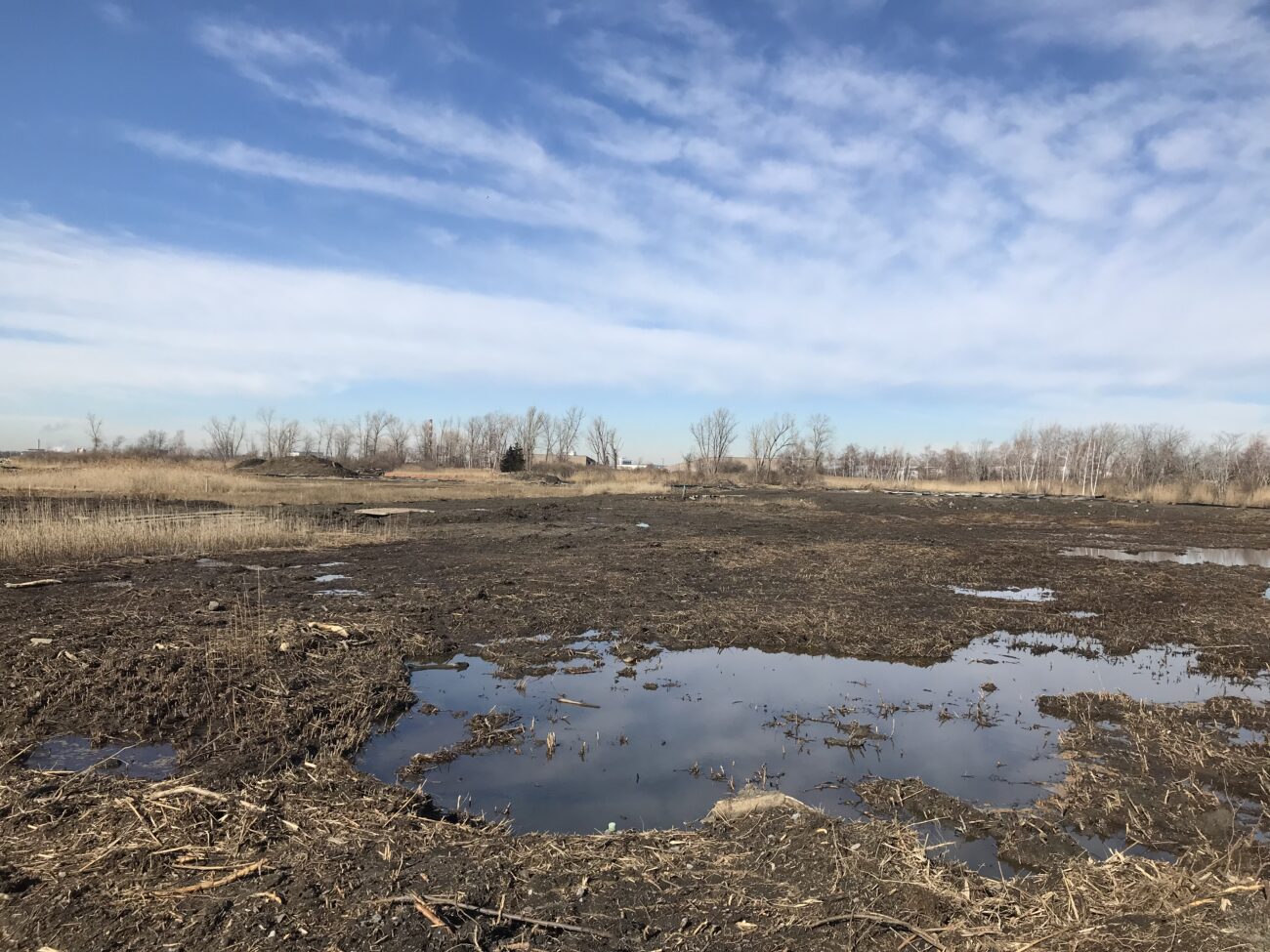
Monitoring immediately following the restoration revealed at least 12 saltmarsh sparrows returned to their annual nesting areas near the experimental hummocks, despite the disruptive activities taking place earlier in the year. University students will survey vegetation on the hummocks and throughout the restoration area, measuring and counting individual plants to see how different species grow at different elevations and in different types of soil, and to determine if additional plantings are needed. Audubon Connecticut will manage and control invasive plant species across the restoration area for three years, periodically removing and chemically treating the ever-persistent common reed. The project team will also monitor saltwater flooding of the marsh and carve runnels (short channels), if needed, to connect more areas to saltwater.
Molly Sperduto at molly_sperduto@fws.gov;
Corrie Folsom-O’Keefe cfolsom.okeefe@audubon.org;
Jack Matthias jack.matthias@audubon.org
Case Study
Project
Stratford, CT
Restoration of the Great Meadows Marsh
This project restored 46 acres of the Great Meadows Marsh in Connecticut that was degraded from dredge material that was dumped on site, poor drainage, and sea level rise. The marsh was also overrun with invasive plants and mosquitoes. A controlled fire was started to kill the invasive reeds growing in the marsh. Then a construction crew removed invasive plants and the dumped dredge material. Lastly, channels were carefully dug for tidal flushing which will allow the marsh to keep pace with sea level rise. Soil hummocks were constructed for Salt Marsh Sparrow habitat. Now the area continues to be monitored, assessed for resiliency, and provides a field for innovative solutions to be tested in.
Partners
Trustees: USFWS, NOAA, State of Connecticut; Project Partners: Audubon Connecticut, Town of Stratford
Case Study
Plan
Huntington, NY
Crab Meadow Watershed Hydrology Study and Stewardship Plan
This comprehensive study and plan, funded through the National Fish and Wildlife Foundation, Long Island Sound Futures Fund, identifies initial strategies to maintain and enhance the local watershed resources of Crab Meadow. It is meant to be a land management tool to guide the implementation of best practices. The plan was developed in consultation with many partners and stakeholders. There is now significant community buy-in to take action to protect and restore this important watershed.
Following adoption of the plan, the Town of Huntington began working with US Fish and Wildlife Service and Audubon to study and restore Crab Meadow marsh and implement recommendations from the Stewardship Plan. Audubon, in partnership with Town of Huntington and USFWS, received a 2024 Long Island Sound Futures Fund Grant ($429K) to develop design plans for marsh restoration at Crab Meadow.
Garrett Chelius gchelius@huntingtonny.gov, Victoria O’Neill victoria.oneill@audubon.org, Suzanne Paton suzanne_paton@fws.gov
Photo by Jonah Saitz, USFWS.
Case Study
Plan
Huntington, NY
Crab Meadow Watershed Hydrology Study and Stewardship Plan
This comprehensive study and plan, funded through the National Fish and Wildlife Foundation, Long Island Sound Futures Fund, identifies initial strategies to maintain and enhance the local watershed resources of Crab Meadow. It is meant to be a land management tool to guide the implementation of best practices. The plan was developed in consultation with many partners and stakeholders. There is now significant community buy-in to take action to protect and restore this important watershed.
Following adoption of the plan, the Town of Huntington began working with US Fish and Wildlife Service and Audubon to study and restore Crab Meadow marsh and implement recommendations from the Stewardship Plan. Audubon, in partnership with Town of Huntington and USFWS, received a 2024 Long Island Sound Futures Fund Grant ($429K) to develop design plans for marsh restoration at Crab Meadow.
Mapper
Level of Effort:
NYSDEC Shellfish Mapper
This NYSDEC tool provides information on shellfish closures in NY’s marine waters and can be used to help resource users understand where it is safe to harvest to shellfish.
Mapper
Level of Effort:
NYSDEC Shellfish Mapper
This NYSDEC tool provides information on shellfish closures in NY’s marine waters and can be used to help resource users understand where it is safe to harvest to shellfish.
Mapper
Level of Effort:
NYSDEC Boat and Fishing Access Map – Nassau and Suffolk
This interactive map provides information on boat ramps and saltwater fishing access points on Long Island in Nassau and Suffolk Counties.
Mapper
Level of Effort:
NYSDEC Boat and Fishing Access Map – Nassau and Suffolk
This interactive map provides information on boat ramps and saltwater fishing access points on Long Island in Nassau and Suffolk Counties.
Website
Level of Effort:
Connecticut Coastal Permitting
Contains guidance documents and information on coastal permitting from the State of Connecticut.
Website
Level of Effort:
Connecticut Coastal Permitting
Contains guidance documents and information on coastal permitting from the State of Connecticut.
Mapper
Level of Effort:
Northeast Ocean Data Portal
User-friendly access to expert-reviewed interactive maps on key topics such as marine life and habitat, marine-based industry, use and resources in the northeastern United States. The Data Explorer allows the user to define and view any combination of data hosted on the Portal on one map.
Mapper
Level of Effort:
Northeast Ocean Data Portal
User-friendly access to expert-reviewed interactive maps on key topics such as marine life and habitat, marine-based industry, use and resources in the northeastern United States. The Data Explorer allows the user to define and view any combination of data hosted on the Portal on one map.
Mapper
Level of Effort:
Connecticut Coastal Access Guide
This interactive map can help you find your way to over 350 diverse shoreline sites in Connecticut that provide a variety of opportunities for coastal enjoyment.
Mapper
Level of Effort:
Connecticut Coastal Access Guide
This interactive map can help you find your way to over 350 diverse shoreline sites in Connecticut that provide a variety of opportunities for coastal enjoyment.
Guidance Tool
Level of Effort:
Connecticut Beach Association’s Guide to Coastal Activities and Permitting
Guide that lists various beach-related actions/activities, permitting pathways, and other considerations
Guidance Tool
Level of Effort:
Connecticut Beach Association’s Guide to Coastal Activities and Permitting
Guide that lists various beach-related actions/activities, permitting pathways, and other considerations
Training
Local Waterfront Revitalization Programs: Challenges and Opportunities
In this Coastal Resiliency Network webinar, Barbara Kendall from the NYS Department of State provides an overview of Local Waterfront Revitalization Programs (LWRP) and then representatives from four NYS coastal communities discuss their experiences developing and implementing their LWRPs. The Coastal Resilience Network, led by the New York State Association of Conservation Commissions (NYSACC) with assistance from NY Sea Grant, is a collaborative open forum for communities in coastal Westchester, Nassau, and Suffolk Counties to discuss and learn about opportunities to increase their resilience to sea level rise, flooding, and extreme events.
Training
Local Waterfront Revitalization Programs: Challenges and Opportunities
In this Coastal Resiliency Network webinar, Barbara Kendall from the NYS Department of State provides an overview of Local Waterfront Revitalization Programs (LWRP) and then representatives from four NYS coastal communities discuss their experiences developing and implementing their LWRPs. The Coastal Resilience Network, led by the New York State Association of Conservation Commissions (NYSACC) with assistance from NY Sea Grant, is a collaborative open forum for communities in coastal Westchester, Nassau, and Suffolk Counties to discuss and learn about opportunities to increase their resilience to sea level rise, flooding, and extreme events.