

Resources for
Green infrastructure
Funding
: Feb 3 – Mar 26, 2026
typically $150,000-350,000
DEEP Clean Water Act Section 319 Nonpoint Source Grants
The Connecticut Department of Energy and Environmental Protection (DEEP) is now accepting proposals for fiscal year 2025 Clean Water Section 319 grants. Section 319 of the Federal Clean Water Act (Section 319) is a Federal program to control nonpoint sources (NPS) of water pollution. Connecticut receives funds from EPA for Section 319 grants that can be passed onto communities, local conservation groups, and other organizations for NPS implementation projects, plans, and statewide NPS management efforts.
Priority projects for FY26 include: Watershed Based Plan Implementation Projects, Watershed Based Plan (WBP) Development, Natural Hazards, and Advancing the Connecticut NPS Management Program Plan.
Funding
: Feb 3 – Mar 26, 2026
typically $150,000-350,000
DEEP Clean Water Act Section 319 Nonpoint Source Grants
The Connecticut Department of Energy and Environmental Protection (DEEP) is now accepting proposals for fiscal year 2025 Clean Water Section 319 grants. Section 319 of the Federal Clean Water Act (Section 319) is a Federal program to control nonpoint sources (NPS) of water pollution. Connecticut receives funds from EPA for Section 319 grants that can be passed onto communities, local conservation groups, and other organizations for NPS implementation projects, plans, and statewide NPS management efforts.
Funding
: Feb 6 – Mar 17, 2026
$1,000 - $4,000
Grow Grants Program
The New England Grassroots Environment Fund awards small grants in support of grassroots efforts and community-based environmental work in New England. The GROW GRANTS program is actively accepting applications from grassroots groups across New England. These grants fund small, volunteer-driven groups in New England working on issues including food access, immigrant support, climate resilience, youth work, mutual aid, and more. This program is geared toward groups with experience organizing in their community and have at least THREE leaders who are actively involved in group decision-making. Grants support groups to deepen their work by further developing a community vision, lowering barriers to participation, identifying new stakeholders, and working to bring more voices and lived experiences into core decision-making processes.
Grow grants prioritize support for community groups who represent a broad range of voices in their community and who are not being reached by other funders. The Grassroots Fund interprets the word 'environment' broadly and provides funding for a wide range of activities.
Funding
: Feb 6 – Mar 17, 2026
$1,000 - $4,000
Grow Grants Program
The New England Grassroots Environment Fund awards small grants in support of grassroots efforts and community-based environmental work in New England. The GROW GRANTS program is actively accepting applications from grassroots groups across New England. These grants fund small, volunteer-driven groups in New England working on issues including food access, immigrant support, climate resilience, youth work, mutual aid, and more. This program is geared toward groups with experience organizing in their community and have at least THREE leaders who are actively involved in group decision-making. Grants support groups to deepen their work by further developing a community vision, lowering barriers to participation, identifying new stakeholders, and working to bring more voices and lived experiences into core decision-making processes.
Funding
: Jan 5 – Feb 12, 2026
~50-100K
Building Community Capacity for Resiliency
The NY-NJ Harbor & Estuary Program (HEP), housed at the Hudson River Foundation, is offering funding to help local governments and nonprofit organizations strengthen community resilience to recurring extreme weather across the Hudson Raritan Estuary watershed. This Request for Proposals supports projects that advance research, planning, and on the ground infrastructure aimed at reducing climate driven risks such as flooding, storm impacts, and related water quality challenges. A total of $350,000 will be distributed across approximately four to six grants for projects that can be completed by June 30, 2027.
Eligible applicants must be local governments or nonprofits located in or directly serving communities within the Hudson Raritan Estuary region and aligned with HEP’s 2025-2035 Action Agenda. Priority is given to efforts that deliver tangible community benefits. Letters of Inquiry are due February 12, 2026, with selected applicants invited to submit full proposals afterward.
Funding
: Jan 5 – Feb 12, 2026
~50-100K
Building Community Capacity for Resiliency
The NY-NJ Harbor & Estuary Program (HEP), housed at the Hudson River Foundation, is offering funding to help local governments and nonprofit organizations strengthen community resilience to recurring extreme weather across the Hudson Raritan Estuary watershed. This Request for Proposals supports projects that advance research, planning, and on the ground infrastructure aimed at reducing climate driven risks such as flooding, storm impacts, and related water quality challenges. A total of $350,000 will be distributed across approximately four to six grants for projects that can be completed by June 30, 2027.
Guidance Tool
Level of Effort:
Forest Adaptation Workbook
Created by the Northern Institute of Applied Climate Science, the Adaptation Workbook provides a structured, five step process designed to help natural resource professionals and landowners translate broad climate trends into specific, actionable management plans. By moving from defining project goals to monitoring long term results, the workbook helps users assess local vulnerabilities and identify custom adaptation tactics. This flexible framework is applicable across diverse landscapes including forests, urban areas, and agricultural lands ensuring that climate data becomes a practical tool for protecting ecosystems rather than just a collection of abstract projections.
This resource page also offers a variety of supporting materials including: the full Forest Adaptation Resources guide, “Quick Guide” versions for rapid assessment, and a library of real-world demonstration projects that showcase successful adaptation in practice.
Guidance Tool
Level of Effort:
Forest Adaptation Workbook
Created by the Northern Institute of Applied Climate Science, the Adaptation Workbook provides a structured, five step process designed to help natural resource professionals and landowners translate broad climate trends into specific, actionable management plans. By moving from defining project goals to monitoring long term results, the workbook helps users assess local vulnerabilities and identify custom adaptation tactics. This flexible framework is applicable across diverse landscapes including forests, urban areas, and agricultural lands ensuring that climate data becomes a practical tool for protecting ecosystems rather than just a collection of abstract projections.
This resource page also offers a variety of supporting materials including: the full Forest Adaptation Resources guide, “Quick Guide” versions for rapid assessment, and a library of real-world demonstration projects that showcase successful adaptation in practice.
Funding
: Dec 12 – Feb 5, 2026
$20K - $200K
Long Island Sound Stewardship Fund 2026
The Long Island Sound Stewardship Fund 2026 is now open and supports nonprofit work that helps protect and restore the health and living resources of Long Island Sound. Funding is available for efforts that strengthen organizations (capacity building), build new collaborations, or support piloting tools and planning that increases environmental and natural resource impact.
Grant awards range from $20,000 to $200,000. Eligible applicants must be 501(c)(3) nonprofit organizations, and projects must be located within the Long Island Sound watershed in Connecticut and New York (within the LISS National Estuary Boundary). Applicants are encouraged to review the full Request for Proposals and application instructions before submitting. An optional informational webinar is available for organizations seeking additional guidance on the application process.
Funding
: Dec 12 – Feb 5, 2026
$20K - $200K
Long Island Sound Stewardship Fund 2026
The Long Island Sound Stewardship Fund 2026 is now open and supports nonprofit work that helps protect and restore the health and living resources of Long Island Sound. Funding is available for efforts that strengthen organizations (capacity building), build new collaborations, or support piloting tools and planning that increases environmental and natural resource impact.
Website
Level of Effort:
The Atlas of Inspiration
The Atlas of Inspiration is a national database that highlights real projects helping communities adapt to extreme weather, flooding, heat, and sea-level rise. It showcases innovative infrastructure, planning strategies, and funding approaches that can be adapted or scaled by other communities. The Atlas is designed to celebrate successful ideas and give decision-makers examples they can use when seeking state or federal funding.
The Atlas is fully searchable, allowing users to browse projects by type, climate hazard, or location. It builds on Rebuild by Design’s earlier work including the Atlas of Disaster and the Atlas of Accountability by showing not only the risks communities face, but the solutions that are already making a difference.
Rebuild by Design also invites communities to share their own climate resilience projects for inclusion in the Atlas. Submissions help expand the collection and highlight new approaches being used across the country.
Website
Level of Effort:
The Atlas of Inspiration
The Atlas of Inspiration is a national database that highlights real projects helping communities adapt to extreme weather, flooding, heat, and sea-level rise. It showcases innovative infrastructure, planning strategies, and funding approaches that can be adapted or scaled by other communities. The Atlas is designed to celebrate successful ideas and give decision-makers examples they can use when seeking state or federal funding.
The Atlas is fully searchable, allowing users to browse projects by type, climate hazard, or location. It builds on Rebuild by Design’s earlier work including the Atlas of Disaster and the Atlas of Accountability by showing not only the risks communities face, but the solutions that are already making a difference.
Rebuild by Design also invites communities to share their own climate resilience projects for inclusion in the Atlas. Submissions help expand the collection and highlight new approaches being used across the country.
Website
Level of Effort:
GSI Impact Hub
The GSI Impact Hub is an interactive platform that provides tools, research, and data to help communities plan and evaluate green stormwater infrastructure (GSI) projects. GSI uses natural systems like plants, soil, and stone to manage stormwater on-site reducing flooding, improving water quality, and creating healthier, more resilient neighborhoods. The Hub includes a benefits calculator, educational resources, and guidance to support city planners, advocates, and policymakers in designing projects that maximize environmental, social, and economic benefits.
Explore the GSI Impact Calculator, Detailed Resource Library, and Project Background to better understand how GSI can reduce flooding, improve water quality, and build climate-resilient neighborhoods.
Website
Level of Effort:
GSI Impact Hub
The GSI Impact Hub is an interactive platform that provides tools, research, and data to help communities plan and evaluate green stormwater infrastructure (GSI) projects. GSI uses natural systems like plants, soil, and stone to manage stormwater on-site reducing flooding, improving water quality, and creating healthier, more resilient neighborhoods. The Hub includes a benefits calculator, educational resources, and guidance to support city planners, advocates, and policymakers in designing projects that maximize environmental, social, and economic benefits.
Explore the GSI Impact Calculator, Detailed Resource Library, and Project Background to better understand how GSI can reduce flooding, improve water quality, and build climate-resilient neighborhoods.
Case Study
Project
Hamden, CT
Town of Hamden’s Bioretention Project
The Town of Hamden’s Bioretention Project is the largest municipally owned rain garden in the state! Save the Sound, in partnership with the Town of Hamden, completed this large-scale rain garden project at Hamden Town Center Park to improve local water quality, restore habitat, and enhance community resilience. The project transformed approximately 2.5 acres of lawn into a functioning green infrastructure system that now manages runoff from an 88-acre urban watershed draining Dixwell Avenue and surrounding neighborhoods. Prior to the project, stormwater often overflowed directly into Pardee Brook and the Mill River, carrying pollutants and inundating the park.
The newly constructed rain garden was engineered with layers of soil, sand, and rock, and planted with more than 7,000 native grasses, flowers, and shrubs thanks to additional support from the Land Trust of Hamden. These plantings naturally filter pollutants such as fertilizers, road salt, and chemicals. Community volunteers helped complete the planting, strengthening local stewardship in the Town of Hamden.


A 40,000 sq ft rain garden was installed and included restoration of an acre of park land. The system now treats over 20 million gallons of stormwater annually, reducing flooding and restoring more natural hydrology to Shepard Brook and the Mill River. Beyond its environmental benefits, the project created valuable wildlife habitat and a welcoming green space for residents to enjoy. Adaptive management, more planting, and stewardship is planned for 2025 and 2026.
Nicole Davis, Save the Sound
Jim Sirch, Hamden Land Conservation Trust
Stephen White, PE, Town of Hamden Engineer/LTA
Case Study
Project
Hamden, CT
Town of Hamden’s Bioretention Project
The Town of Hamden’s Bioretention Project is the largest municipally owned rain garden in the state! Save the Sound, in partnership with the Town of Hamden, completed this large-scale rain garden project at Hamden Town Center Park to improve local water quality, restore habitat, and enhance community resilience. The project transformed approximately 2.5 acres of lawn into a functioning green infrastructure system that now manages runoff from an 88-acre urban watershed draining Dixwell Avenue and surrounding neighborhoods. Prior to the project, stormwater often overflowed directly into Pardee Brook and the Mill River, carrying pollutants and inundating the park.
The newly constructed rain garden was engineered with layers of soil, sand, and rock, and planted with more than 7,000 native grasses, flowers, and shrubs thanks to additional support from the Land Trust of Hamden. These plantings naturally filter pollutants such as fertilizers, road salt, and chemicals. Community volunteers helped complete the planting, strengthening local stewardship in the Town of Hamden.
Funding
: Oct 1 – Dec 16, 2025
$100K - $1.5M
CT DEEP Long Island Sound Ecosystems Grant
The Connecticut Department of Energy and Environmental Protection’s (DEEP’s) Land and Water Resources Division requests proposals for the new CT DEEP Long Island Sound Ecosystems Grant, made possible by financial support provided by the Long Island Sound Partnership from the U.S. EPA. There are two primary goals of the program: 1) to promote large-scale habitat restoration and enhance restoration planning, while also helping coastal communities and ecosystems adapt to changing environmental conditions; and 2) to further promote the application of green stormwater infrastructure techniques to reduce nonpoint source pollution, improving water resource quality.
There is approximately $7 million available, and no match is required. Eligible projects include: 1) Habitat Restoration (planning/engineering/design and construction for habitat restoration projects); and 2) Green Stormwater Infrastructure (planning/engineering/design and construction for green stormwater infrastructure projects).
Funding
: Oct 1 – Dec 16, 2025
$100K - $1.5M
CT DEEP Long Island Sound Ecosystems Grant
The Connecticut Department of Energy and Environmental Protection’s (DEEP’s) Land and Water Resources Division requests proposals for the new CT DEEP Long Island Sound Ecosystems Grant, made possible by financial support provided by the Long Island Sound Partnership from the U.S. EPA. There are two primary goals of the program: 1) to promote large-scale habitat restoration and enhance restoration planning, while also helping coastal communities and ecosystems adapt to changing environmental conditions; and 2) to further promote the application of green stormwater infrastructure techniques to reduce nonpoint source pollution, improving water resource quality.
Funding
: May 19 – Jul 31, 2025
NYSDOS Smart Growth Community Planning Grant Program
The NYS Department of State (NYSDOS) is soliciting applications from eligible towns, villages, cities, counties, regional planning entities and not-for-profit organizations to support the creation, or modification of comprehensive plans, area plans, or zoning codes to align with smart growth principals.
Funding
: May 19 – Jul 31, 2025
NYSDOS Smart Growth Community Planning Grant Program
The NYS Department of State (NYSDOS) is soliciting applications from eligible towns, villages, cities, counties, regional planning entities and not-for-profit organizations to support the creation, or modification of comprehensive plans, area plans, or zoning codes to align with smart growth principals.
Funding
: May 1 – Aug 15, 2025
$1 million to $10 million per project
NYS EFC Green Resiliency Grants
This competitive grant program through the NYS Environmental Facilities Cooperation is designed to support flood-prone communities in implementing transformative green infrastructure projects that combat the effects of extreme weather. Eligible projects must utilize green infrastructure (GI) stormwater management practices (SMPs) and/or nature-based solutions to manage combined and/or sanitary sewer overflows and/or mitigate risks associated with extreme weather events.
GRG projects must be capable of capturing, treating, or increasing the time of concentration for a minimum of 2,500 cubic feet of stormwater per 90thpercentile rainfall event within a clearly defined drainage area1 that contributes to a specific water quality or quantity concern. Projects must demonstrate a concentrated impact on a singular drainage system. Proposals combining multiple, unconnected drainage areas should be submitted as separate applications. Applicants must have an ownership interest in the project site and have the right to access, operate, and maintain the project for its useful life.
Funding
: May 1 – Aug 15, 2025
$1 million to $10 million per project
NYS EFC Green Resiliency Grants
This competitive grant program through the NYS Environmental Facilities Cooperation is designed to support flood-prone communities in implementing transformative green infrastructure projects that combat the effects of extreme weather. Eligible projects must utilize green infrastructure (GI) stormwater management practices (SMPs) and/or nature-based solutions to manage combined and/or sanitary sewer overflows and/or mitigate risks associated with extreme weather events.
Funding
: Mar 25 – Mar 31, 2025
$10,000-$50,000
Suffolk County Soil & Water Conservation District (SCSWCD) Municipal and Community Assistance Programs
This grant opportunity is open to municipalities and non-governmental organizations interested in partnering with SCSWCD to implement a variety of projects focused on improving Suffolk County and its environment. These projects focus on revitalizing and protecting Long Islands ecosystems, waterbodies, ground water and habitats. The goal of this grant is to attract new partners to develop and implement innovative and sustainable solutions for environmental issues.
Any municipality within Suffolk County may apply for up to $50,000 total. This includes townships, villages, or government agencies; joint applicants are encouraged. Non-government agencies such as not for profit organizations, civic associations or community groups are eligible to apply for a $10,000 total award.
Funding
: Mar 25 – Mar 31, 2025
$10,000-$50,000
Suffolk County Soil & Water Conservation District (SCSWCD) Municipal and Community Assistance Programs
This grant opportunity is open to municipalities and non-governmental organizations interested in partnering with SCSWCD to implement a variety of projects focused on improving Suffolk County and its environment. These projects focus on revitalizing and protecting Long Islands ecosystems, waterbodies, ground water and habitats. The goal of this grant is to attract new partners to develop and implement innovative and sustainable solutions for environmental issues.
Funding
: Mar 25 – Apr 11, 2025
Up to $3 million
EFC Green Innovation Grant Program
The Green Innovation Grant Program supports projects across New York State that utilize unique EPA-designated green stormwater infrastructure design and create cutting-edge green technologies. Competitive grants are awarded to projects that implement one or more of the following green practices: green stormwater infrastructure, energy efficiency, water efficiency and environmental innovation.
Funding
: Mar 25 – Apr 11, 2025
Up to $3 million
EFC Green Innovation Grant Program
The Green Innovation Grant Program supports projects across New York State that utilize unique EPA-designated green stormwater infrastructure design and create cutting-edge green technologies. Competitive grants are awarded to projects that implement one or more of the following green practices: green stormwater infrastructure, energy efficiency, water efficiency and environmental innovation.
Funding
: Feb 26 – Jun 6, 2025
Minimum grant amount $300,000
Coastal Rehabilitation and Resilience Projects
Through New York State’s Clean Energy, Clean Water & Green Jobs Bond Act, the Department of State (DOS) is making $20 million available for habitat restoration, climate resiliency and risk reduction, and stormwater management projects located within the New York State Coastal areas, areas draining into the New York State Coastal area, and/or areas within the Coastal Nonpoint Source boundary (see map). Projects must be identified or implement goals outlined in state, regional, or local management plans/programs/studies. The program prioritizes projects using natural solutions to enhance community resilience while also delivering environmental, economic and social benefits. Eligible applicants include Municipalities (counties, cities, towns, villages, Indian Nations or Tribes recognized by the state or United States), Not-for-Profits, Soil and Water Conservation Districts, and New York State Agencies and Authorities. Projects may include design and construction, or construction.
Applications must be submitted through the web-based NYS Consolidated Funding Application http://regionalcouncils.ny.gov/.
Funding
: Feb 26 – Jun 6, 2025
Minimum grant amount $300,000
Coastal Rehabilitation and Resilience Projects
Through New York State’s Clean Energy, Clean Water & Green Jobs Bond Act, the Department of State (DOS) is making $20 million available for habitat restoration, climate resiliency and risk reduction, and stormwater management projects located within the New York State Coastal areas, areas draining into the New York State Coastal area, and/or areas within the Coastal Nonpoint Source boundary (see map). Projects must be identified or implement goals outlined in state, regional, or local management plans/programs/studies. The program prioritizes projects using natural solutions to enhance community resilience while also delivering environmental, economic and social benefits. Eligible applicants include Municipalities (counties, cities, towns, villages, Indian Nations or Tribes recognized by the state or United States), Not-for-Profits, Soil and Water Conservation Districts, and New York State Agencies and Authorities. Projects may include design and construction, or construction.
Training
This field trip was part of a Community Resilience Project Showcase leading up to the 2024 Annual SRC Workshop.
Hamden Bioretention Project Tour & Workshop
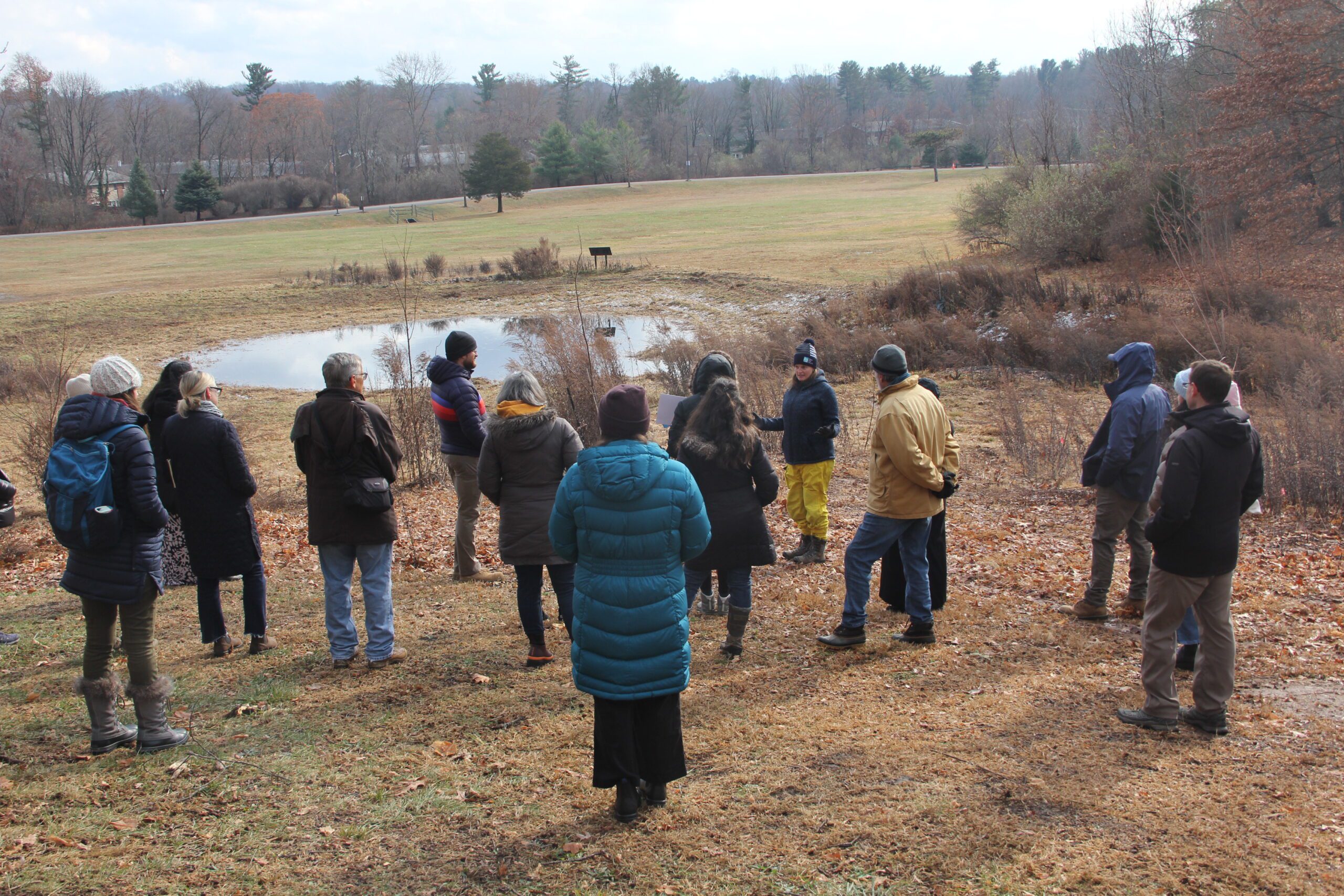 On December 5, 2024, the Sustainable and Resilient Communities (SRC) team of the Long Island Sound Study hosted a field trip featuring the Town of Hamden’s Bioretention Project – the largest municipally owned rain garden in the state! Participants began with a guided tour of the rain garden and bioretention areas at Town Center Park, where they heard from project planners and managers about its history, partnerships, challenges, and maintenance. Following this, participants gathered at the Hamden Government Center for a working lunch and presentations on topics including UConn’s Stormwater Corps, native plants, project engineering, and using nature-based solutions to advance climate resilience goals. The day concluded with a lively group discussion. Special thanks to our partners with the Town of Hamden, Save the Sound, the Hamden Land Trust, and UConn Extension.
Photo credit: Judy Benson




Training
This field trip was part of a Community Resilience Project Showcase leading up to the 2024 Annual SRC Workshop.
Hamden Bioretention Project Tour & Workshop
On December 5, 2024, the Sustainable and Resilient Communities (SRC) team of the Long Island Sound Study hosted a field trip featuring the Town of Hamden’s Bioretention Project – the largest municipally owned rain garden in the state! Participants began with a guided tour of the rain garden and bioretention areas at Town Center Park, where they heard from project planners and managers about its history, partnerships, challenges, and maintenance. Following this, participants gathered at the Hamden Government Center for a working lunch and presentations on topics including UConn’s Stormwater Corps, native plants, project engineering, and using nature-based solutions to advance climate resilience goals. The day concluded with a lively group discussion. Special thanks to our partners with the Town of Hamden, Save the Sound, the Hamden Land Trust, and UConn Extension.
Photo credit: Judy Benson
$75,000 - $350,000
Environmental Justice Thriving Communities Grantmaking Program
EPA has selected Environmental Justice for New England to serve as pass-through entity for the Environmental Justice Thriving Communities Grants for CT, ME, MA, NH, RI, and VT. Thriving Communities subgrants will be distributed to support capacity building in communities affected by environmental or public health issues to eligible applicants. The program aims to reduce the burden of the federal grants application process and distribute federal funds to potential applicants working to address environmental justice issues.
Tier 1 will consist of grants for $150,000 for assessment (one-year project period), Tier 2 will consist of grants for $250,000 for planning (1-2 year project period), and Tier 3 will consist of grants for $350,000 for project development (two-year project period). Preference will be given to projects in which the majority of the funds are going to capacity-limited organizations and groups. Additionally, noncompetitive awards, or "Seed Funds" will be made to capacity-constrained communities and CBOs in a fixed amount of $75,000 each.
$75,000 - $350,000
Environmental Justice Thriving Communities Grantmaking Program
EPA has selected Environmental Justice for New England to serve as pass-through entity for the Environmental Justice Thriving Communities Grants for CT, ME, MA, NH, RI, and VT. Thriving Communities subgrants will be distributed to support capacity building in communities affected by environmental or public health issues to eligible applicants. The program aims to reduce the burden of the federal grants application process and distribute federal funds to potential applicants working to address environmental justice issues.
Resource
Level of Effort:
Green Stormwater Infrastructure Workbook
This workbook made by Groundwork Bridgeport provides a thorough but accessible introduction to green stormwater infrastructure. The workbook explains the issues that green infrastructure can help solve, introduces several green infrastructure methods, and then provides definitions, explains why each is uses, and details how to build them.
Resource
Level of Effort:
Green Stormwater Infrastructure Workbook
This workbook made by Groundwork Bridgeport provides a thorough but accessible introduction to green stormwater infrastructure. The workbook explains the issues that green infrastructure can help solve, introduces several green infrastructure methods, and then provides definitions, explains why each is uses, and details how to build them.
The New York Community Trust: Westchester Ongoing Competitive Grants
The New York Community Trust, which brings together the New York Community Trust, The Long Island Community Foundation, and Westchester Community Foundation offers competitive grants to nonprofits to support projects in a number of areas across New York City, Westchester, Long Island and beyond. For work on Westchester, proposals are accepted from nonprofits during the specified timeframes.
The New York Community Trust: Westchester Ongoing Competitive Grants
The New York Community Trust, which brings together the New York Community Trust, The Long Island Community Foundation, and Westchester Community Foundation offers competitive grants to nonprofits to support projects in a number of areas across New York City, Westchester, Long Island and beyond. For work on Westchester, proposals are accepted from nonprofits during the specified timeframes.
The New York Community Trust: Long Island Ongoing Competitive Grants
The New York Community Trust, which brings together the New York Community Trust, The Long Island Community Foundation, and Westchester Community Foundation offers competitive grants to nonprofits to support projects in a number of areas across New York City, Westchester, Long Island and beyond. For work on Long Island, proposals are accepted from nonprofits during the specified timeframes.
The New York Community Trust: Long Island Ongoing Competitive Grants
The New York Community Trust, which brings together the New York Community Trust, The Long Island Community Foundation, and Westchester Community Foundation offers competitive grants to nonprofits to support projects in a number of areas across New York City, Westchester, Long Island and beyond. For work on Long Island, proposals are accepted from nonprofits during the specified timeframes.
Funding
: Feb 28 – May 17, 2024
$500,000 min
2024 Transportation Alternatives Program
This program provides funding for a variety of transportation projects such as pedestrian and bicycle facilities; construction of turnouts, overlooks, and viewing areas; community improvements such as historic preservation and vegetation management; environmental mitigation related to stormwater and habitat connectivity; recreational trails; safe routes to school projects; and vulnerable road user safety assessments.
These funds are made available to the State through partnership with the Federal Highway Administration (FHWA). The New Haven Urbanized Area alone is expected to receive $7.3 million between FFY 2026 and FFY 2030. To learn more and apply, please review the program application and solicitation memo attached. Applications must be submitted to Jim Rode at SCRCOG via email: jrode@scrcog.org by May 17, 2024. Project applications will be reviewed and ranked based on criteria provided by CT DOT. A prioritized list will be reviewed and finalized at the Transportation Committee meeting on June 12, 2024. Approval of the prioritized list of projects will be on the Board Meeting agenda on June 26, 2024.
Funding
: Feb 28 – May 17, 2024
$500,000 min
2024 Transportation Alternatives Program
This program provides funding for a variety of transportation projects such as pedestrian and bicycle facilities; construction of turnouts, overlooks, and viewing areas; community improvements such as historic preservation and vegetation management; environmental mitigation related to stormwater and habitat connectivity; recreational trails; safe routes to school projects; and vulnerable road user safety assessments.
Resource
Level of Effort:
Conservation Commissions and Natural Resource Resilience
This fact sheet for Conservation Commissions in Connecticut reviews the role of these commissions for enhancing the climate resilience of their communities. The resource was developed by CIRCA and covers the authority and duties of conservation commissions as well as detailing specific strategies and approaches.
Resource
Level of Effort:
Conservation Commissions and Natural Resource Resilience
This fact sheet for Conservation Commissions in Connecticut reviews the role of these commissions for enhancing the climate resilience of their communities. The resource was developed by CIRCA and covers the authority and duties of conservation commissions as well as detailing specific strategies and approaches.
Report
Level of Effort:
Zoning Strategies to Reduce Pollution of Inland Waters and Resultant Hypoxia of Long Island Sound
WEST COG developed this riparian zoning publication that is primarily focused on water quality, but also is highly relevant to climate mitigation.
Report
Level of Effort:
Zoning Strategies to Reduce Pollution of Inland Waters and Resultant Hypoxia of Long Island Sound
WEST COG developed this riparian zoning publication that is primarily focused on water quality, but also is highly relevant to climate mitigation.
Funding
: Nov 1 – Mar 31, 2025
$75,000 - $350,000
Thriving Communities Grantmaker Program
EPA has selected Fordham University to serve as pass-through entity for the Thriving Communities Grants for New York, New Jersey, Puerto Rico, and the US Virgin Islands. Thriving Communities subgrants will be distributed to support capacity building in communities affected by environmental or public health issues to eligible applicants. Applications will be accepted on a rolling basis until March 31, 2025.
Grants are available for funding in the following phases: Phase I = Assessment projects for up to $150,000 for a one-year project period Phase II = Planning projects for up to $250,000 for a 1-2 year project period, and Phase III = Project Development projects for up to $350,000 for a two-year project period. $150,000 awards may be made to organizations that offer a plan for engagement, capacity building, or assessment but do not provide a fully itemized budget (fixed amount awards). $250,000 and $350,000 awards must provide an itemized budget as well as a timeline for spending. Preference will be given to projects in which the majority of the funds are going to capacity-limited organizations and groups. Additionally, noncompetitive awards will be made to capacity-constrained communities and CBOs without the submission of an application to the competitive review process. These noncompetitive small subawards will be made in a fixed amount of $75,000 each, designed for ease of access, with a streamlined process that does not require participation in the competitive review process. Awardees will be selected through a participatory process, with fewer reporting requirements compared to competitive grants. Any person or organization in Region 2 may submit a nomination, including self-nominations.
Funding
: Nov 1 – Mar 31, 2025
$75,000 - $350,000
Thriving Communities Grantmaker Program
EPA has selected Fordham University to serve as pass-through entity for the Thriving Communities Grants for New York, New Jersey, Puerto Rico, and the US Virgin Islands. Thriving Communities subgrants will be distributed to support capacity building in communities affected by environmental or public health issues to eligible applicants. Applications will be accepted on a rolling basis until March 31, 2025.
Funding
: May 1 – Aug 16, 2024
Green Resiliency Grants
The New York State Environmental Facilities Corporation (EFC) is pleased to announce the availability of $60 million in grant funding through the inaugural round of the Green Resiliency Grant (GRG) program under the Clean Water, Clean Air and Green Jobs Environmental Bond Act of 2022 (Bond Act). The new program will prioritize grants to flood-prone communities and help them undertake innovative green infrastructure projects such as green roofs, green streets, and permeable pavement.
Projects must have a minimum total project cost of $1 million and be capable of capturing, treating, or reducing the time of concentration for a minimum of 100,000 cubic feet of stormwater runoff annually. Eligible projects include those that address combined and/or sanitary sewer overflow during extreme weather events and those that combine green infrastructure and nature-based features to ensure climate resilient infrastructure.
Funding
: May 1 – Aug 16, 2024
Green Resiliency Grants
The New York State Environmental Facilities Corporation (EFC) is pleased to announce the availability of $60 million in grant funding through the inaugural round of the Green Resiliency Grant (GRG) program under the Clean Water, Clean Air and Green Jobs Environmental Bond Act of 2022 (Bond Act). The new program will prioritize grants to flood-prone communities and help them undertake innovative green infrastructure projects such as green roofs, green streets, and permeable pavement.
Funding
: Mar 25, 2026
$500 - $1,000
Seed Grants Program
Awards small grants in support of grassroots efforts and community-based environmental work in New England. The Grassroots Fund utilizes participatory grantmaking to move resources to New England grassroots groups working at the intersections of Environmental Justice. The program is geared toward groups who have some experience implementing a project in their community. Grants support groups to deepen their work by further developing a community vision, lowering barriers to participation, identifying new stakeholders, and working to bring more voices and lived experiences into core decision-making processes.
The Seed grant program is geared towards groups launching new projects or starting to significantly change the direction of an existing project. Most often, groups have been working on the project less than a year and usually don't yet have much direct experience with implementing the idea. The Grassroots Fund interprets the word 'environment' broadly and provides funding for a wide range of activities.
Funding
: Mar 25, 2026
$500 - $1,000
Seed Grants Program
Awards small grants in support of grassroots efforts and community-based environmental work in New England. The Grassroots Fund utilizes participatory grantmaking to move resources to New England grassroots groups working at the intersections of Environmental Justice. The program is geared toward groups who have some experience implementing a project in their community. Grants support groups to deepen their work by further developing a community vision, lowering barriers to participation, identifying new stakeholders, and working to bring more voices and lived experiences into core decision-making processes.
Funding
: Oct 12 – Dec 15, 2023
$800M total available
FY23 Flood Mitigation Assistance Grant Program – New York
The Flood Mitigation Assistance grant program is a competitive program that provides funding to states, federally recognized Tribal governments, U.S. territories, and local governments. Since the National Flood Insurance Reform Act of 1994 was signed into law, funds are used for projects that reduce or eliminate the risk of repetitive flood damage to buildings insured by the National Flood Insurance Program.
The Flood Mitigation Assistance grant program funds activities and projects, including: - Capability and Capacity Building Activities - Mitigation Plans - Technical Assistance by States to Communities - Project Scoping - Localized Flood Risk Reduction Projects - Individual Flood Mitigation Projects - Management Costs Additional capability and capacity building activities also may be funded, including: - Partnership Development to Conduct Eligible Mitigation Activities - Enhancing Local Floodplain Management - Severe Repetitive Loss/Repetitive Loss Strategy Development - Other Capability and Capacity Building Activities
Funding
: Oct 12 – Dec 15, 2023
$800M total available
FY23 Flood Mitigation Assistance Grant Program – New York
The Flood Mitigation Assistance grant program is a competitive program that provides funding to states, federally recognized Tribal governments, U.S. territories, and local governments. Since the National Flood Insurance Reform Act of 1994 was signed into law, funds are used for projects that reduce or eliminate the risk of repetitive flood damage to buildings insured by the National Flood Insurance Program.
Funding
: Oct 12 – Dec 15, 2023
$1B total available
FY23 Building Resilient Infrastructure and Communities Grants (BRIC) – New York
The Federal Emergency Management Agency (FEMA) Building Resilient Infrastructure and Communities (BRIC) grant program will support states, local communities, tribes and territories as they undertake hazard mitigation projects, reducing the risks they face from disasters and natural hazards. The BRIC program’s guiding principles are to support communities through capability and capacity building, encourage and enable innovation; promote partnerships, enable large projects, maintain flexibility, and provide consistency.
FEMA will provide financial assistance to eligible BRIC applicants for the following activities: • Capability and Capacity-Building activities – activities that enhance the knowledge, skills, and expertise of the current workforce to expand or improve the administration of mitigation assistance. This includes activities in the following sub-categories: building codes, partnerships, project scoping, hazard mitigation planning and planning-related activities, and other activities; • Hazard Mitigation Projects – cost-effective projects designed to increase resilience and public safety; reduce injuries and loss of life; and reduce damage and destruction to property, critical services, facilities, and infrastructure (including natural systems) from a multitude of natural hazards, including drought, wildfire, earthquakes, extreme heat, and the effects of climate change; and • Management Costs – financial assistance to reimburse the recipient and subrecipient for eligible and reasonable indirect costs, direct administrative costs, and other administrative expenses associated with a specific mitigation measure or project in an amount up to 15% of the total amount of the grant award, of which not more than 10% of the total award amount may be used by the recipient and 5% by the subrecipient for such costs generally.
Funding
: Oct 12 – Dec 15, 2023
$1B total available
FY23 Building Resilient Infrastructure and Communities Grants (BRIC) – New York
The Federal Emergency Management Agency (FEMA) Building Resilient Infrastructure and Communities (BRIC) grant program will support states, local communities, tribes and territories as they undertake hazard mitigation projects, reducing the risks they face from disasters and natural hazards. The BRIC program’s guiding principles are to support communities through capability and capacity building, encourage and enable innovation; promote partnerships, enable large projects, maintain flexibility, and provide consistency.
Source Water Buffer Program
The Source Water Buffer Program is administered by the New York State Soil and Water Conservation Committee, in coordination with the Department. The goal of the program is to protect public drinking water and to enhance water quality of New York State’s watersheds, reservoirs, lakes, rivers, and streams. The Source Water Buffer Program funds the purchase of conservation easements and projects that establish riparian buffers on farmland that borders critical water sources.
Soil and Water Conservation Districts are eligible to apply to the program on behalf of interested farmers. Participating farmers must either own an eligible farm operation or lease land to an eligible farm operation. Eligible agricultural lands must be: Directly adjacent to surface waters designated as a drinking water source; Directly adjacent to tributaries that drain to designated drinking water source; Wetland areas directly adjacent to surface waters designated as a drinking water source; Within a wellhead protection area designated by the NYS Department of Health; or Within the contributing area directly adjacent to an aquifer sinkhole. Applications will be accepted on a rolling basis and will be funded on a first-come, first-served basis. If you are interested in learning more or participating in the Source Water Buffer Program, contact your local Soil and Water Conservation District.
Source Water Buffer Program
The Source Water Buffer Program is administered by the New York State Soil and Water Conservation Committee, in coordination with the Department. The goal of the program is to protect public drinking water and to enhance water quality of New York State’s watersheds, reservoirs, lakes, rivers, and streams. The Source Water Buffer Program funds the purchase of conservation easements and projects that establish riparian buffers on farmland that borders critical water sources.
Funding
: Mar 25 – May 20, 2025
$500
Long Island Garden Rewards Program
This program provides financial rewards for homeowners on Long Island who add green alternatives to their properties that reduce stormwater and nitrogen pollution entering Long Island Sound. Homeowners can be reimbursed for installing rain barrels, rain gardens, or native plantings on their properties. Application opened April 22nd, 2025 for this current season. Funds are limited and available on a first come, first serve basis.
Due to the high participation in the program, as of May 20, 2025 the Long Island Garden Rewards Program is closed. Thank you to all who participated. Check back for when applications open again!
Funding
: Mar 25 – May 20, 2025
$500
Long Island Garden Rewards Program
This program provides financial rewards for homeowners on Long Island who add green alternatives to their properties that reduce stormwater and nitrogen pollution entering Long Island Sound. Homeowners can be reimbursed for installing rain barrels, rain gardens, or native plantings on their properties. Application opened April 22nd, 2025 for this current season. Funds are limited and available on a first come, first serve basis.
Due to the high participation in the program, as of May 20, 2025 the Long Island Garden Rewards Program is closed. Thank you to all who participated. Check back for when applications open again!
The New York Community Trust: New York City Ongoing Competitive Grants
The New York Community Trust, which brings together the New York Community Trust, The Long Island Community Foundation, and Westchester Community Foundation offers competitive grants to nonprofits to support projects in a number of areas across New York City, Westchester, Long Island and beyond. For work in New York City, proposals are accepted from nonprofits anytime through the ongoing competitive grants proposal process.
The New York Community Trust: New York City Ongoing Competitive Grants
The New York Community Trust, which brings together the New York Community Trust, The Long Island Community Foundation, and Westchester Community Foundation offers competitive grants to nonprofits to support projects in a number of areas across New York City, Westchester, Long Island and beyond. For work in New York City, proposals are accepted from nonprofits anytime through the ongoing competitive grants proposal process.
Funding
: Mar 9 – May 1, 2026
$2,000-$15,000
Nassau County Soil and Water Conservation District – Part C Funding
The Nassau County Soil and Water Conservation District (the District) is seeking to fund a limited number of mission-aligned projects during 2026. Eligible applicants include local governments in Nassau County and not-for-profit organizations. Applications are due by May 01, 2026, and awards are expected to be made in May 2026. Projects must be completed by May 31, 2027. While these dates and the below amounts are not expected to change, funding amounts and timelines are subject to the District’s own receipt of funding from the New York State Soil and Water Conservation Committee.
Projects must meet one or more of the following criteria in Nassau County:
-
- Conserve or improve soils
- Improve water quality of our groundwater and/or surface water
- Control and prevent soil erosion and/or prevent floodwater and sediment damages
- Conservation, development, utilization, and disposal of water
- Preserve, increase, or improve natural resources including trees and plants
- Control or eliminate invasive plants or wildlife
- Control and abate NPS water pollution
- Preserve wildlife
Funding
: Mar 9 – May 1, 2026
$2,000-$15,000
Nassau County Soil and Water Conservation District – Part C Funding
The Nassau County Soil and Water Conservation District (the District) is seeking to fund a limited number of mission-aligned projects during 2026. Eligible applicants include local governments in Nassau County and not-for-profit organizations. Applications are due by May 01, 2026, and awards are expected to be made in May 2026. Projects must be completed by May 31, 2027. While these dates and the below amounts are not expected to change, funding amounts and timelines are subject to the District’s own receipt of funding from the New York State Soil and Water Conservation Committee.
Projects must meet one or more of the following criteria in Nassau County:
-
- Conserve or improve soils
- Improve water quality of our groundwater and/or surface water
- Control and prevent soil erosion and/or prevent floodwater and sediment damages
- Conservation, development, utilization, and disposal of water
- Preserve, increase, or improve natural resources including trees and plants
- Control or eliminate invasive plants or wildlife
- Control and abate NPS water pollution
- Preserve wildlife
Funding
: May 19 – Jul 31, 2025
Max award of $50-75K
Non-Agricultural Nonpoint Source Planning and Municipal Separate Storm Sewer System (MS4) Mapping Grant (NPG)
The Non-Agricultural Nonpoint Source Planning and MS4 Mapping Grant (NPG) is a competitive, reimbursement grant program that funds planning reports for nonpoint source water quality improvement projects and mapping of Municipal Separate Storm Sewer Systems (MS4s). The program aims to prepare nonpoint source projects for implementation funding, and to encourage and support cooperation among regulated MS4s to complete mapping of their stormwater system.
Applications are accepted annually through the Consolidated Funding Application (CFA). Municipalities and Indian Nations are eligible are for all project types. Soil and Water Conservation Districts are also eligible except for Decentralized Wastewater Treatment Facilities for Failing On-Site Treatment Systems.
Funding
: May 19 – Jul 31, 2025
Max award of $50-75K
Non-Agricultural Nonpoint Source Planning and Municipal Separate Storm Sewer System (MS4) Mapping Grant (NPG)
The Non-Agricultural Nonpoint Source Planning and MS4 Mapping Grant (NPG) is a competitive, reimbursement grant program that funds planning reports for nonpoint source water quality improvement projects and mapping of Municipal Separate Storm Sewer Systems (MS4s). The program aims to prepare nonpoint source projects for implementation funding, and to encourage and support cooperation among regulated MS4s to complete mapping of their stormwater system.
Funding
: May 19 – Jul 31, 2025
NYSDEC Water Quality Improvement Project (WQIP) Program
The NYS Department of Environmental Conservation (NYSDEC) WQIP funds implementation projects to improve water quality or habitat, promote flood risk reduction, restoration, and enhanced flood and climate resiliency, or protect a drinking water source.
Applications are accepted annually through the Consolidated Funding Application (CFA). Municipalities* (including Indian Nations) are eligible for all project types. Soil and Water Conservation Districts are eligible for all project types except Dam Safety Repair/Rehabilitation. Not-for-Profit Corporations are eligible for Aquatic Connectivity Restoration, Marine District Habitat Restoration, and Land Acquisition for Source Water Protection only.
Funding
: May 19 – Jul 31, 2025
NYSDEC Water Quality Improvement Project (WQIP) Program
The NYS Department of Environmental Conservation (NYSDEC) WQIP funds implementation projects to improve water quality or habitat, promote flood risk reduction, restoration, and enhanced flood and climate resiliency, or protect a drinking water source.
Funding
: May 19 – Jul 31, 2025
$50K-$2M for implementation grants, $10K-200K for certification grants
NYS Climate Smart Communities
The Climate Smart Communities (CSC) Grant program was established in 2016 to provide grants to cities, towns, villages, and counties of the State of New York for eligible climate change mitigation, adaptation, and planning and assessment projects. Funds are available for two broad project categories – implementation and certification. The first project category supports implementation projects related to the reduction of greenhouse gas emissions (mainly outside the power sector), climate change adaptation, and engineering feasibility studies for flood mitigation and Hydrofluorocarbons. The second supports planning and assessment projects aligned with Climate Smart Communities certification actions.
Applications are accepted annually through the Consolidated Funding Application (CFA). Municipalities need not be a registered or certified as a Climate Smart Community to apply for a grant.
Funding
: May 19 – Jul 31, 2025
$50K-$2M for implementation grants, $10K-200K for certification grants
NYS Climate Smart Communities
The Climate Smart Communities (CSC) Grant program was established in 2016 to provide grants to cities, towns, villages, and counties of the State of New York for eligible climate change mitigation, adaptation, and planning and assessment projects. Funds are available for two broad project categories – implementation and certification. The first project category supports implementation projects related to the reduction of greenhouse gas emissions (mainly outside the power sector), climate change adaptation, and engineering feasibility studies for flood mitigation and Hydrofluorocarbons. The second supports planning and assessment projects aligned with Climate Smart Communities certification actions.
Funding
: May 19 – Jul 31, 2025
$50K-$2M
NYSDOS Local Waterfront Revitalization Program
The NYS Department of State (NYSDOS) is soliciting applications from eligible villages, towns, cities located along New York’s coasts or designated inland waterways, counties, or regional planning councils to advance the preparation or implementation of strategies for community and waterfront revitalization through the following grant categories: Preparing or Updating a Local Waterfront Revitalization Program (LWRP), including Updating an LWRP to be More Resilient to Climate Risks; Preparing an LWRP Component, including a Watershed Management Plan; Implementing an LWRP or a completed LWRP Component.
For project-specific planning, feasibility, design, and/or construction needed to advance eligible activities, an eligible applicant must be currently preparing or have an approved LWRP or LWRP Component. The proposed project must be located within the LWRP waterfront revitalization area boundary or LWRP Component boundary. Applications are accepted annually through the Consolidated Funding Application (CFA).
Funding
: May 19 – Jul 31, 2025
$50K-$2M
NYSDOS Local Waterfront Revitalization Program
The NYS Department of State (NYSDOS) is soliciting applications from eligible villages, towns, cities located along New York’s coasts or designated inland waterways, counties, or regional planning councils to advance the preparation or implementation of strategies for community and waterfront revitalization through the following grant categories: Preparing or Updating a Local Waterfront Revitalization Program (LWRP), including Updating an LWRP to be More Resilient to Climate Risks; Preparing an LWRP Component, including a Watershed Management Plan; Implementing an LWRP or a completed LWRP Component.
Funding
: Mar 25 – Jul 28, 2023
Up to $3M
Green Innovation Grant Program (GIGP)
The Green Innovation Grant Program (GIGP) supports projects across New York State that utilize unique EPA-designated green stormwater infrastructure design and create cutting-edge green technologies. Competitive grants are awarded annually to projects that improve water quality and mitigate the effects of climate change through the implementation of one or more of the following green practices: Green Stormwater Infrastructure, Energy Efficiency, Water Efficiency and Environmental Innovation.
Funding
: Mar 25 – Jul 28, 2023
Up to $3M
Green Innovation Grant Program (GIGP)
The Green Innovation Grant Program (GIGP) supports projects across New York State that utilize unique EPA-designated green stormwater infrastructure design and create cutting-edge green technologies. Competitive grants are awarded annually to projects that improve water quality and mitigate the effects of climate change through the implementation of one or more of the following green practices: Green Stormwater Infrastructure, Energy Efficiency, Water Efficiency and Environmental Innovation.
Funding
: May 7 – Aug 13, 2025
$50,000-$200,000
NYSDEC Community Impact Grant Program
$5.9 million is now available for community-based organizations for projects that address exposure of communities to multiple environmental harms and risks. Eligible applicants are Tribal Organizations and not-for-profit community-based organizations having 501(c)(3) status, or a community-based organization may partner with a NFP that will serve as their fiscal sponsor. Eligible projects must address a community’s exposure to multiple environmental harms and risks and include a new research component that will be used to expand the knowledge of the affected community.
Funding
: May 7 – Aug 13, 2025
$50,000-$200,000
NYSDEC Community Impact Grant Program
$5.9 million is now available for community-based organizations for projects that address exposure of communities to multiple environmental harms and risks. Eligible applicants are Tribal Organizations and not-for-profit community-based organizations having 501(c)(3) status, or a community-based organization may partner with a NFP that will serve as their fiscal sponsor. Eligible projects must address a community’s exposure to multiple environmental harms and risks and include a new research component that will be used to expand the knowledge of the affected community.
Funding
: Mar 25 – May 30, 2025
N/A
NYS Clean Water State Revolving Fund (CWSRF)
The NYS Environmental Facilities Corporation (EFC) Clean Water State Revolving Fund provides interest-free or low-interest rate financing for wastewater and sewer infrastructure projects to municipalities throughout New York State. A variety of projects are eligible for financing, including construction or restoration of sewers and wastewater treatment facilities, stormwater management, landfill closures, as well as habitat restoration and protection projects. There are several different types of financing available to clean water project applicants. EFC provides both short and long-term financing, interest-free or low interest to accommodate municipalities of all population sizes with varying financial needs. When communities repay their financings, it allows EFC to finance new projects and the funds “revolve” over time.
The New York State Environmental Facilities Corporation (EFC) is preparing its Intended Use Plan for Federal Fiscal Year (FFY) 2026, which begins October 1, 2025. Municipalities are invited to list new projects. The project listing and an approvable engineering report consistent with the Engineering Report Outline (effective 10/1/2024) must be submitted no later than May 30, 2025, to be included on the Annual List and eligible for financing in FFY 2026. EFC provides low-cost financial assistance for water quality projects in New York State. If you have questions, email EFC at plus@efc.ny.gov or call Alex Brunelle, Program Coordinator, at (518) 402-6924.
The first step in seeking State Revolving Funds is getting your project listed in the Intended Use Plan (IUP). The IUP prepared annually to account for how the Clean Water State Revolving Fund (CWSRF) will be used during a federal fiscal year. Any project funded by the State Revolving Fund is required by law to be listed in the IUP. The requested information includes contact information, a general description of the project’s scope, a budget, and a project schedule. You must submit an approvable engineering report and Smart Growth Assessment Form with the project listing or have one on file in order to be on the Annual List. Once your project is on the IUP, you can submit a complete formal financing application.
Funding
: Mar 25 – May 30, 2025
N/A
NYS Clean Water State Revolving Fund (CWSRF)
The NYS Environmental Facilities Corporation (EFC) Clean Water State Revolving Fund provides interest-free or low-interest rate financing for wastewater and sewer infrastructure projects to municipalities throughout New York State. A variety of projects are eligible for financing, including construction or restoration of sewers and wastewater treatment facilities, stormwater management, landfill closures, as well as habitat restoration and protection projects. There are several different types of financing available to clean water project applicants. EFC provides both short and long-term financing, interest-free or low interest to accommodate municipalities of all population sizes with varying financial needs. When communities repay their financings, it allows EFC to finance new projects and the funds “revolve” over time.
The New York State Environmental Facilities Corporation (EFC) is preparing its Intended Use Plan for Federal Fiscal Year (FFY) 2026, which begins October 1, 2025. Municipalities are invited to list new projects. The project listing and an approvable engineering report consistent with the Engineering Report Outline (effective 10/1/2024) must be submitted no later than May 30, 2025, to be included on the Annual List and eligible for financing in FFY 2026. EFC provides low-cost financial assistance for water quality projects in New York State. If you have questions, email EFC at plus@efc.ny.gov or call Alex Brunelle, Program Coordinator, at (518) 402-6924.
Funding
: May 5 – Jun 27, 2025
$50,000-$250,000
Suffolk County Water Quality Protection and Restoration Program and Land Stewardship Initiative (WQPRP)
The Suffolk County Water Quality Improvement Division works to protect and improve Suffolk County’s ground and surface waters. The WQPRP provides funding to protect and restore surface and groundwater resources throughout the County. Funding is available for both planning/ engineering and construction expenses.
Priority project types for the 2025 funding round include: stormwater abatement and prevention, establishment and/or testing of innovative and alternative on-site sanitary waste disposal systems, wetlands preservation and enhancement, integrated marsh management , non-structural shoreline stabilization and restoration projects, and preservation and restoration initiatives targeted at protection of rare, threatened, or endangered species, or other priority species or critical natural resource areas identified by the County of Suffolk. All projects must have a funding resolution adopted by the Suffolk County Legislature within one year of the award.
Funding
: May 5 – Jun 27, 2025
$50,000-$250,000
Suffolk County Water Quality Protection and Restoration Program and Land Stewardship Initiative (WQPRP)
The Suffolk County Water Quality Improvement Division works to protect and improve Suffolk County’s ground and surface waters. The WQPRP provides funding to protect and restore surface and groundwater resources throughout the County. Funding is available for both planning/ engineering and construction expenses.
Funding
: Jan 1 – Apr 15, 2023
~$1,500
EPOC 2022 Environmental Grant Program
The EPOC Grant Program provides non-profit and not-for-profit environmental advocacy groups, community based groups and environmental education organizations funding for local projects that benefit the environment.
Funding
: Jan 1 – Apr 15, 2023
~$1,500
EPOC 2022 Environmental Grant Program
The EPOC Grant Program provides non-profit and not-for-profit environmental advocacy groups, community based groups and environmental education organizations funding for local projects that benefit the environment.
Funding
: Nov 20 – Jan 17, 2025
varies by grant type
CT DEEP Clean Water Fund Priority List
Through the Clean Water Fund, CT DEEP is able to provide grants and low-interest loans for infrastructure projects to meet clean water needs such as addressing combined sewer overflows, nutrient pollution, wastewater collection infrastructure needs, and projects using green infrastructure and addressing resiliency. See the Priority List Memo and Project Request Form for updates.
DEEP is preparing the Clean Water Fund Priority List for FY 2026 and FY 2027 (7/1/25 – 6/30/27) and is requesting information on any planning, design, or construction projects you intend to start during the time period listed above. For FY26-27, note that there is a Green Components section for identifying components that will either provide a reduction in energy consumption, reduce inflow and infiltration, or install various types of green infrastructure.
Funding
: Nov 20 – Jan 17, 2025
varies by grant type
CT DEEP Clean Water Fund Priority List
Through the Clean Water Fund, CT DEEP is able to provide grants and low-interest loans for infrastructure projects to meet clean water needs such as addressing combined sewer overflows, nutrient pollution, wastewater collection infrastructure needs, and projects using green infrastructure and addressing resiliency. See the Priority List Memo and Project Request Form for updates.
Funding
: Jul 8 – Nov 1, 2024
$40,000
Healthy Communities Grant Program for New England
The Healthy Communities Grant Program is EPA New England’s main competitive grant program to work directly with communities to reduce environmental risks to protect and improve human health and the quality of life. he Healthy Communities Grant Program will achieve this through identifying and funding projects that:
– Target resources to benefit communities at risk.
– Assess, understand, and reduce environmental and human health risks.
– Increase collaboration through partnerships and community-based projects.
– Build institutional and community capacity to understand and solve environmental and human health problems.
– Achieve measurable environmental and human health benefits.
To qualify as eligible projects under the Healthy Communities Grant Program, proposed projects must: (1) be located in and/or directly benefit one or more of the Target Investment Areas; and (2) identify how the proposed project will achieve measurable environmental and/or public health results in one or more of the Target Program Areas. Target Investment Areas include: (1) areas near New England Ports that are being redeveloped to support offshore wind and related industries; (2) environmental justice areas of potential concern; (3) geographic priority areas or sectors in Northern & Southern New England; and (4) sensitive populations. Detailed descriptions of the target areas can be found in the annual RFA.
Funding
: Jul 8 – Nov 1, 2024
$40,000
Healthy Communities Grant Program for New England
The Healthy Communities Grant Program is EPA New England’s main competitive grant program to work directly with communities to reduce environmental risks to protect and improve human health and the quality of life. he Healthy Communities Grant Program will achieve this through identifying and funding projects that:
– Target resources to benefit communities at risk.
– Assess, understand, and reduce environmental and human health risks.
– Increase collaboration through partnerships and community-based projects.
– Build institutional and community capacity to understand and solve environmental and human health problems.
– Achieve measurable environmental and human health benefits.
$2,500-$65,000
Urban and Community Forestry Planning Grant
The Urban and Community Forestry Planning Grant Program offers funding to support projects that will help municipalities and nonprofit organizations collect baseline data that can be used to inform future management decisions.
Projects may include, but are not limited to, conducting inventories of street and/or park trees, creating urban and community forest management plans, developing monitoring programs to document tree condition, and surveys of urban forested natural areas. Funds can be used to generate new materials and resources or to update existing ones such as previous inventories or out-of-date management plans. All applicants will need to articulate how such projects will be used to promote data-driven forest management in their respective cities in the future.
$2,500-$65,000
Urban and Community Forestry Planning Grant
The Urban and Community Forestry Planning Grant Program offers funding to support projects that will help municipalities and nonprofit organizations collect baseline data that can be used to inform future management decisions.
Funding
: Oct 24 – Feb 20, 2024
$25,000 to $150,000
New England Bay Watershed Education and Training (B-WET)
NOAA’s Bay Watershed Education and Training (B-WET) program is an environmental education program that promotes place-based experiential learning for K–12 students and related professional development for teachers.This funding opportunity focuses on projects combining long-term, classroom-integrated “Meaningful Watershed Educational Experiences” and capacity building for K-12 Environmental Literacy at the state and local level.
For FY24, B-WET New England has two priorities: Priority 1: Projects combining long-term, classroom-integrated Meaningful Watershed Education Experiences (MWEEs) for students and teacher professional development. Priority 2: Capacity building for K-12 environmental literacy at the state and local level.
Funding
: Oct 24 – Feb 20, 2024
$25,000 to $150,000
New England Bay Watershed Education and Training (B-WET)
NOAA’s Bay Watershed Education and Training (B-WET) program is an environmental education program that promotes place-based experiential learning for K–12 students and related professional development for teachers.This funding opportunity focuses on projects combining long-term, classroom-integrated “Meaningful Watershed Educational Experiences” and capacity building for K-12 Environmental Literacy at the state and local level.
Funding
: Mar 25 – Feb 27, 2024
up to $2,000
The Connecticut Society for Women Environmental Professionals Grant Program
The Connecticut Society for Women Environmental Professionals Grant Program provides funding for local projects in Connecticut that benefit the environment. Grants of up to $2,000 will be awarded. Any application meeting the grant guidelines that is not successful in one cycle may reapply during any following cycle. The applications will be judged based on the environmental benefits of each project, in comparison to others. “Environmental benefits” can vary widely and successful applications have ranged from property clean-ups to environmental education.
The applications will be judged based on the environmental benefits of each project, in comparison to others. “Environmental benefits” can vary widely and successful applications have ranged from property clean-ups to environmental education.
Funding
: Mar 25 – Feb 27, 2024
up to $2,000
The Connecticut Society for Women Environmental Professionals Grant Program
The Connecticut Society for Women Environmental Professionals Grant Program provides funding for local projects in Connecticut that benefit the environment. Grants of up to $2,000 will be awarded. Any application meeting the grant guidelines that is not successful in one cycle may reapply during any following cycle. The applications will be judged based on the environmental benefits of each project, in comparison to others. “Environmental benefits” can vary widely and successful applications have ranged from property clean-ups to environmental education.
Funding
: Mar 20 – Sep 17, 2024
$1,000 - $4,000
Grow Grants Program
Awards small grants in support of grassroots efforts and community-based environmental work in New England. The Grassroots Fund utilizes participatory grantmaking to move resources to New England grassroots groups working at the intersections of Environmental Justice. The program is geared toward groups who have some experience implementing a project in their community. Grants support groups to deepen their work by further developing a community vision, lowering barriers to participation, identifying new stakeholders, and working to bring more voices and lived experiences into core decision-making processes.
Grow grants prioritize support for community groups who represent a broad range of voices in their community and who are not being reached by other funders. The Grassroots Fund interprets the word 'environment' broadly and provides funding for a wide range of activities.
Funding
: Mar 20 – Sep 17, 2024
$1,000 - $4,000
Grow Grants Program
Awards small grants in support of grassroots efforts and community-based environmental work in New England. The Grassroots Fund utilizes participatory grantmaking to move resources to New England grassroots groups working at the intersections of Environmental Justice. The program is geared toward groups who have some experience implementing a project in their community. Grants support groups to deepen their work by further developing a community vision, lowering barriers to participation, identifying new stakeholders, and working to bring more voices and lived experiences into core decision-making processes.
typically $150,000-350,000
DEEP Clean Water Act Section 319 Nonpoint Source Grants
Grants are awarded for projects that address Nonpoint Source impacts in surface waters including creation and implementation of approved Watershed Based Plans.
Priority projects for FY25 include: Environmental Justice and Environmental Equity, Adapting to Climate Change, Watershed Based Plan Implementation Projects, Watershed Based Plan Development
typically $150,000-350,000
DEEP Clean Water Act Section 319 Nonpoint Source Grants
Grants are awarded for projects that address Nonpoint Source impacts in surface waters including creation and implementation of approved Watershed Based Plans.
Funding
: Mar 25, 2026
Up to $6,000
Community Match Fund
Sustainable CT’s Community Match Fund is an innovative program that provides fast, flexible funding and support for engaging your community on wide-ranging sustainability projects. Eligible projects receive dollar-for-dollar matching funds from Sustainable CT.
The Community Match Fund is organized into three funding focus areas: (1) The Environmental Fund; (2) The Vibrant Communities Fund; and (3) The Social Change Amplifier Fund.
Funding
: Mar 25, 2026
Up to $6,000
Community Match Fund
Sustainable CT’s Community Match Fund is an innovative program that provides fast, flexible funding and support for engaging your community on wide-ranging sustainability projects. Eligible projects receive dollar-for-dollar matching funds from Sustainable CT.
Funding
: Mar 25 – Apr 12, 2023
$100,000 - $1,000,000
National Fish and Wildlife Foundation’s (NFWF) National Coastal Resilience Fund (NCRF)
NFWF will award up to $140 million in grants to create and restore natural systems in order to increase protection for communities from coastal hazards, such as storms, sea- and lake-level changes, inundation, and coastal erosion, while improving habitats for fish and wildlife species. NFWF prioritizes projects that are community led or incorporate direct community engagement and benefit underserved communities facing disproportionate harm from climate impacts.
Funding
: Mar 25 – Apr 12, 2023
$100,000 - $1,000,000
National Fish and Wildlife Foundation’s (NFWF) National Coastal Resilience Fund (NCRF)
NFWF will award up to $140 million in grants to create and restore natural systems in order to increase protection for communities from coastal hazards, such as storms, sea- and lake-level changes, inundation, and coastal erosion, while improving habitats for fish and wildlife species. NFWF prioritizes projects that are community led or incorporate direct community engagement and benefit underserved communities facing disproportionate harm from climate impacts.
Funding
: Mar 10 – May 5, 2023
$75,000 - $250,000 (~$800,000 total available- projected around 4-10 projects total)
National Estuary Program Coastal Watersheds Grant
The NEP Coastal Watersheds Grant Program is a nationally competitive grants program designed to support projects that address urgent and challenging issues threatening the well-being of coastal and estuarine areas within determined estuaries of national significance.
Funding
: Mar 10 – May 5, 2023
$75,000 - $250,000 (~$800,000 total available- projected around 4-10 projects total)
National Estuary Program Coastal Watersheds Grant
The NEP Coastal Watersheds Grant Program is a nationally competitive grants program designed to support projects that address urgent and challenging issues threatening the well-being of coastal and estuarine areas within determined estuaries of national significance.
Funding
: Dec 6 – Apr 16, 2025
typically $4M-6M
NOAA Transformational Habitat Restoration and Coastal Resilience Grants
NOAA is seeking proposals for transformational projects that will restore coastal habitat and strengthen community resilience under the Bipartisan Infrastructure Law.
This funding will prioritize habitat restoration actions that rebuild productive and sustainable fisheries, contribute to the recovery and conservation of threatened and endangered species, use natural infrastructure to reduce damage from flooding and storms, promote resilient ecosystems and communities, and yield socioeconomic benefits. This funding opportunity will invest in projects that have the greatest potential to provide holistic benefits, through habitat-based approaches that strengthen both ecosystem and community resilience.
Projects selected through this funding opportunity will have a transformative impact for coastal communities and tribes across the country. They will help sustain our nation’s fisheries, make significant strides in the recovery of threatened and endangered species, and help protect coastal communities and ecosystems from the impacts of climate change. They will support efforts such as reconnecting rivers to their historic floodplains, outplanting corals to rebuild reefs, building living shorelines that protect coasts from erosion and sea level rise, and more.
Funding
: Dec 6 – Apr 16, 2025
typically $4M-6M
NOAA Transformational Habitat Restoration and Coastal Resilience Grants
NOAA is seeking proposals for transformational projects that will restore coastal habitat and strengthen community resilience under the Bipartisan Infrastructure Law.
This funding will prioritize habitat restoration actions that rebuild productive and sustainable fisheries, contribute to the recovery and conservation of threatened and endangered species, use natural infrastructure to reduce damage from flooding and storms, promote resilient ecosystems and communities, and yield socioeconomic benefits. This funding opportunity will invest in projects that have the greatest potential to provide holistic benefits, through habitat-based approaches that strengthen both ecosystem and community resilience.
Funding
: Oct 12 – Jan 23, 2024
$800M total available
FY23 Flood Mitigation Assistance Grant Program – Connecticut
The Flood Mitigation Assistance grant program is a competitive program that provides funding to states, federally recognized Tribal governments, U.S. territories, and local governments. Since the National Flood Insurance Reform Act of 1994 was signed into law, funds are used for projects that reduce or eliminate the risk of repetitive flood damage to buildings insured by the National Flood Insurance Program.
The Flood Mitigation Assistance grant program funds activities and projects, including: - Capability and Capacity Building Activities - Mitigation Plans - Technical Assistance by States to Communities - Project Scoping - Localized Flood Risk Reduction Projects - Individual Flood Mitigation Projects - Management Costs Additional capability and capacity building activities also may be funded, including: - Partnership Development to Conduct Eligible Mitigation Activities - Enhancing Local Floodplain Management - Severe Repetitive Loss/Repetitive Loss Strategy Development - Other Capability and Capacity Building Activities
Funding
: Oct 12 – Jan 23, 2024
$800M total available
FY23 Flood Mitigation Assistance Grant Program – Connecticut
The Flood Mitigation Assistance grant program is a competitive program that provides funding to states, federally recognized Tribal governments, U.S. territories, and local governments. Since the National Flood Insurance Reform Act of 1994 was signed into law, funds are used for projects that reduce or eliminate the risk of repetitive flood damage to buildings insured by the National Flood Insurance Program.
Funding
: Oct 12 – Jan 23, 2024
$1B total available
FY23 Building Resilient Infrastructure and Communities Grants (BRIC) – Connecticut
The Federal Emergency Management Agency (FEMA) Building Resilient Infrastructure and Communities (BRIC) grant program will support states, local communities, tribes and territories as they undertake hazard mitigation projects, reducing the risks they face from disasters and natural hazards. The BRIC program’s guiding principles are to support communities through capability and capacity building, encourage and enable innovation; promote partnerships, enable large projects, maintain flexibility, and provide consistency.
FEMA will provide financial assistance to eligible BRIC applicants for the following activities: • Capability and Capacity-Building activities – activities that enhance the knowledge, skills, and expertise of the current workforce to expand or improve the administration of mitigation assistance. This includes activities in the following sub-categories: building codes, partnerships, project scoping, hazard mitigation planning and planning-related activities, and other activities; • Hazard Mitigation Projects – cost-effective projects designed to increase resilience and public safety; reduce injuries and loss of life; and reduce damage and destruction to property, critical services, facilities, and infrastructure (including natural systems) from a multitude of natural hazards, including drought, wildfire, earthquakes, extreme heat, and the effects of climate change; and • Management Costs – financial assistance to reimburse the recipient and subrecipient for eligible and reasonable indirect costs, direct administrative costs, and other administrative expenses associated with a specific mitigation measure or project in an amount up to 15% of the total amount of the grant award, of which not more than 10% of the total award amount may be used by the recipient and 5% by the subrecipient for such costs generally.
Funding
: Oct 12 – Jan 23, 2024
$1B total available
FY23 Building Resilient Infrastructure and Communities Grants (BRIC) – Connecticut
The Federal Emergency Management Agency (FEMA) Building Resilient Infrastructure and Communities (BRIC) grant program will support states, local communities, tribes and territories as they undertake hazard mitigation projects, reducing the risks they face from disasters and natural hazards. The BRIC program’s guiding principles are to support communities through capability and capacity building, encourage and enable innovation; promote partnerships, enable large projects, maintain flexibility, and provide consistency.
$50K - $2M
Long Island Sound Futures Fund 2026
The Long Island Sound Futures Fund (LISFF) is seeking proposals to restore the health and living resources of Long Island Sound (Sound). The program is managed by National Fish and Wildlife Foundation (NFWF) in collaboration with the U.S. Environmental Protection Agency (EPA) and the Long Island Sound Partnership (LIS Partnership). Major funding is from EPA through the LIS Partnership.
There are multiple funding categories under the LISFF each with a different range of grant funding. 1) Implementation Projects: $50,000 to $2 million for projects with particularly high environmental community benefit relative to cost, including: a) Water quality, habitat restoration and resilience projects; b) Projects with the greatest promise to demonstrate, influence, pilot, innovate and/or provide a proof of concept with the aim of accelerating local and regional water quality improvements, natural resource restoration, coastal resilience and/or community and public outreach/engagement. 2) Design/Planning Projects: $50,000 to $500,000 for: a) Water quality or habitat restoration projects; b) Watershed plans; c) Community resilience/sustainability/natural hazard mitigation plans. 3) Outreach, Education and Public Participation Projects: $50,000 to $500,000.
$50K - $2M
Long Island Sound Futures Fund 2026
The Long Island Sound Futures Fund (LISFF) is seeking proposals to restore the health and living resources of Long Island Sound (Sound). The program is managed by National Fish and Wildlife Foundation (NFWF) in collaboration with the U.S. Environmental Protection Agency (EPA) and the Long Island Sound Partnership (LIS Partnership). Major funding is from EPA through the LIS Partnership.
$5M min (small communities) or $20M min (large communities)
Water Infrastructure Finance and Innovation Act (WIFIA)
The WIFIA program accelerates investment in our nation’s water infrastructure by providing long-term, low-cost supplemental loans for regionally and nationally significant projects. Managed out of USEPA Headquarters. Projects eligible for CWSRF would also be eligible for this loan.
Like a bank, the WIFIA program has funding available on an ongoing basis. This allows prospective borrowers to request financing on their schedule. A rolling selection process allows EPA to provide year-round access to WIFIA funding and quicker selection decisions to prospective borrowers. In addition, under this iterative, rolling selection process, the WIFIA program can provide technical assistance to prospective borrowers, particularly disadvantaged and small communities, that need support to complete their Letter of Interest (LOI) package. The WIFIA program can fund development and implementation activities for a wide variety of drinking water, wastewater, and stormwater infrastructure projects, including: - Drinking water and wastewater treatment plant projects - Drinking water, wastewater, and stormwater distribution and conveyance system projects - Nonpoint source management and national estuary program projects - Construction, repair, and replacement of decentralized wastewater treatment systems - Stormwater management projects - Green infrastructure projects - Source water protection projects - Enhanced energy efficiency projects at drinking water and wastewater facilities - Brackish or seawater desalination, aquifer recharge, alternative water supply, and water recycling projects - Drought prevention, reduction, or mitigation projects - Acquisition of property if it is integral to the project or will mitigate the environmental impact of a project - A combination of eligible projects secured by a common security pledge or submitted under one application by an SRF program
$5M min (small communities) or $20M min (large communities)
Water Infrastructure Finance and Innovation Act (WIFIA)
The WIFIA program accelerates investment in our nation’s water infrastructure by providing long-term, low-cost supplemental loans for regionally and nationally significant projects. Managed out of USEPA Headquarters. Projects eligible for CWSRF would also be eligible for this loan.
Case Study
Plan
East Haddam, CT
East Haddam Community Resilience Building Summary of Findings
With support from the Nature Conservancy and Sustainable CT, East Haddam organized a Community Resilience Building process and workshop, the results of which were compiled into this summary. The team engaged with community members to determine the present hazards and vulnerabilities and identify resilient solutions.
Case Study
Plan
East Haddam, CT
East Haddam Community Resilience Building Summary of Findings
With support from the Nature Conservancy and Sustainable CT, East Haddam organized a Community Resilience Building process and workshop, the results of which were compiled into this summary. The team engaged with community members to determine the present hazards and vulnerabilities and identify resilient solutions.
Case Study
Project
Sea Cliff, NY
Scudders Pond Subwatershed Improvements
The Hempstead Harbor Protection Committee and Village of Sea Cliff completed subwatershed improvements at Scudders Pond to address stormwater drainage problems impacting the water quality of the pond and Hempstead Harbor, highlighted as a priority in the 1998 Hempstead Harbor Water Quality Improvement Plan. The improvements included dredging the pond, installing a hydrodynamic separator to intercept sediment, removing invasive Phragmites australis and replacing with native plants, realigning the stream to reduce erosion, redirecting the stormwater from residences to the bioswale, creation of a biofilter wetland area, replacement of the weir between the upper and lower ponds and weir at Shore Road.

Water quality improvements in Scudders Pond and Hempstead Harbor, views of the Pond have been restored.
Eric Swenson, Hempstead Harbor Protection Committee, hempsteadharbor@gmail.com
Case Study
Project
Sea Cliff, NY
Scudders Pond Subwatershed Improvements
The Hempstead Harbor Protection Committee and Village of Sea Cliff completed subwatershed improvements at Scudders Pond to address stormwater drainage problems impacting the water quality of the pond and Hempstead Harbor, highlighted as a priority in the 1998 Hempstead Harbor Water Quality Improvement Plan. The improvements included dredging the pond, installing a hydrodynamic separator to intercept sediment, removing invasive Phragmites australis and replacing with native plants, realigning the stream to reduce erosion, redirecting the stormwater from residences to the bioswale, creation of a biofilter wetland area, replacement of the weir between the upper and lower ponds and weir at Shore Road.
Case Study
Project
Sunken Meadow State Park Restoration
Increased development and the historic construction of a dam on Sunken Meadow Creek in the 1950’s led to reduced tidal exchange, increased water levels in the creek, poor water quality, and the proliferation of invasive species. In 2008 a number of partners (NYS OPRHP, NOAA, NYSDEC, LISS, TNC, Save the Sound, USFWS, LI Botanical Society) came together to work to restore the degraded marsh habitat around Sunken Meadow Creek, increase tidal flow, improve aquatic organism passage, limit invasives, and improve water quality. A restoration feasibility study was completed in 2010. In 2012 Superstorm Sandy blew out the dam on Sunken Meadow Creek, naturally kick-starting restoration. Following Superstorm Sandy, the project partners were able to quickly capitalize on available funding and grants, due to their prior planning efforts. A bridge was built across the Creek where the dam blew out, salt marsh habitat was restored at three locations, green infrastructure was installed in one of the parking areas to capture and treat stormwater runoff, fish passage feasibility on the creek was investigated, and education and outreach was conducted to thousands of people. These projects were completed in 2019. Now, with funding through Long Island Sound Futures Fund, Audubon NY is leading a large-scale marsh restoration project at Sunken Meadow Creek to restore important high-marsh habitat for at risk species, like the Saltmarsh Sparrow, and to increase the resilience of the marsh in the face of rising sea levels. Audubon will be working to finalize the designs and secure permits over the next two years, with on-the-ground restoration expected in 2026.
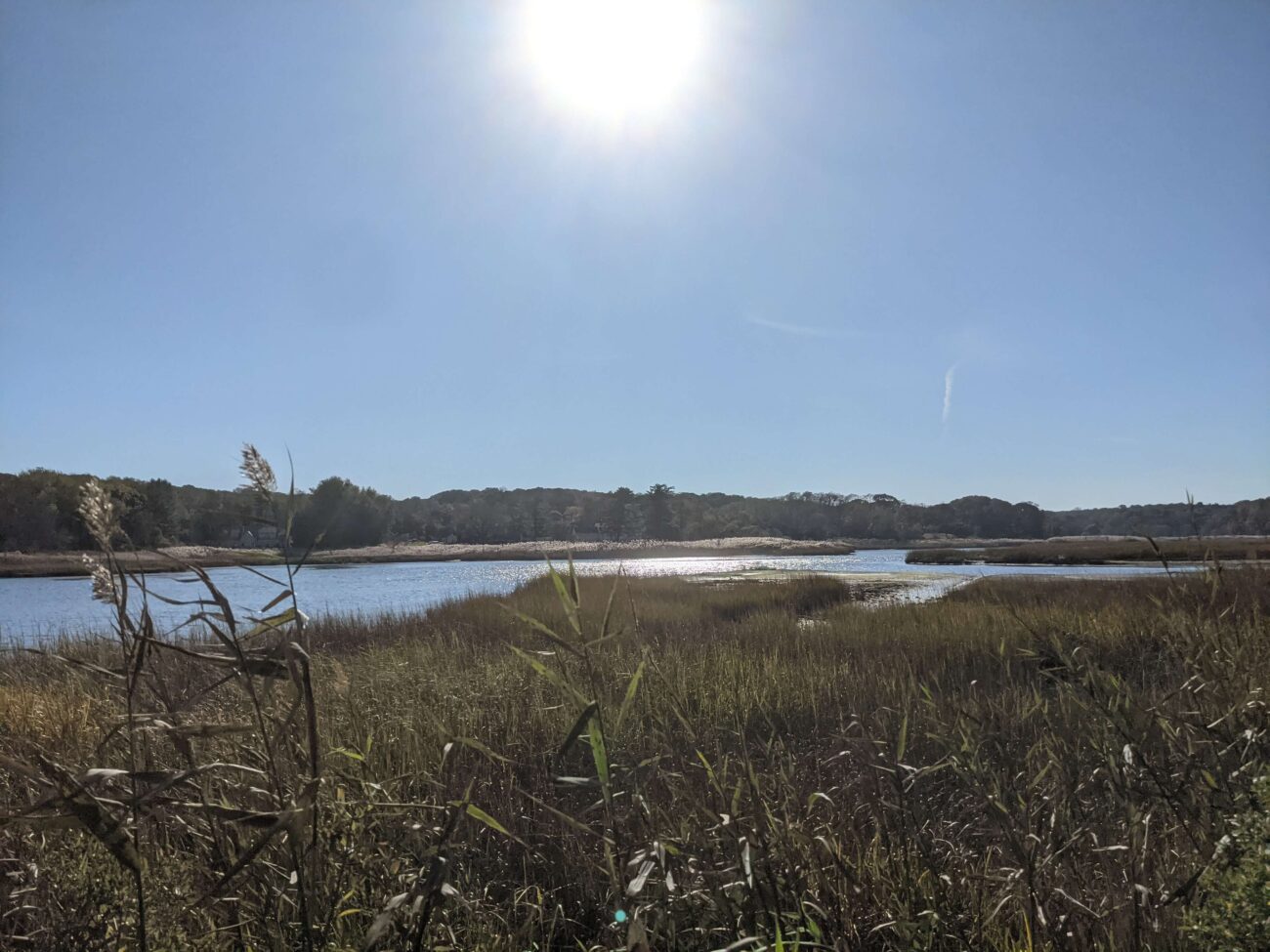


Overall the project has been highly successful, reducing flooding, polluted runoff, and invasives, as well as increasing the recreational value and beauty of the Park. There has been positive feedback from the public following the restoration projects. Some challenges remain with dealing with invasive species. It was determined that proceeding with the fish passage plans was not worthwhile, following the feasibility assessment.
Sean Cruickshank Sean.Cruickshank@parks.ny.gov, Jon Vander Werff jvanderwerff@savethesound.org, Phoebe Clark phoebe.clark@audubon.org, Vicky O’Neill victoria.oneill@audubon.org
Case Study
Project
Sunken Meadow State Park Restoration
Increased development and the historic construction of a dam on Sunken Meadow Creek in the 1950’s led to reduced tidal exchange, increased water levels in the creek, poor water quality, and the proliferation of invasive species. In 2008 a number of partners (NYS OPRHP, NOAA, NYSDEC, LISS, TNC, Save the Sound, USFWS, LI Botanical Society) came together to work to restore the degraded marsh habitat around Sunken Meadow Creek, increase tidal flow, improve aquatic organism passage, limit invasives, and improve water quality. A restoration feasibility study was completed in 2010. In 2012 Superstorm Sandy blew out the dam on Sunken Meadow Creek, naturally kick-starting restoration. Following Superstorm Sandy, the project partners were able to quickly capitalize on available funding and grants, due to their prior planning efforts. A bridge was built across the Creek where the dam blew out, salt marsh habitat was restored at three locations, green infrastructure was installed in one of the parking areas to capture and treat stormwater runoff, fish passage feasibility on the creek was investigated, and education and outreach was conducted to thousands of people. These projects were completed in 2019. Now, with funding through Long Island Sound Futures Fund, Audubon NY is leading a large-scale marsh restoration project at Sunken Meadow Creek to restore important high-marsh habitat for at risk species, like the Saltmarsh Sparrow, and to increase the resilience of the marsh in the face of rising sea levels. Audubon will be working to finalize the designs and secure permits over the next two years, with on-the-ground restoration expected in 2026.
Case Study
Plan
Huntington, NY
Crab Meadow Watershed Hydrology Study and Stewardship Plan
This comprehensive study and plan, funded through the National Fish and Wildlife Foundation, Long Island Sound Futures Fund, identifies initial strategies to maintain and enhance the local watershed resources of Crab Meadow. It is meant to be a land management tool to guide the implementation of best practices. The plan was developed in consultation with many partners and stakeholders. There is now significant community buy-in to take action to protect and restore this important watershed.
Following adoption of the plan, the Town of Huntington began working with US Fish and Wildlife Service and Audubon to study and restore Crab Meadow marsh and implement recommendations from the Stewardship Plan. Audubon, in partnership with Town of Huntington and USFWS, received a 2024 Long Island Sound Futures Fund Grant ($429K) to develop design plans for marsh restoration at Crab Meadow.
Garrett Chelius gchelius@huntingtonny.gov, Victoria O’Neill victoria.oneill@audubon.org, Suzanne Paton suzanne_paton@fws.gov
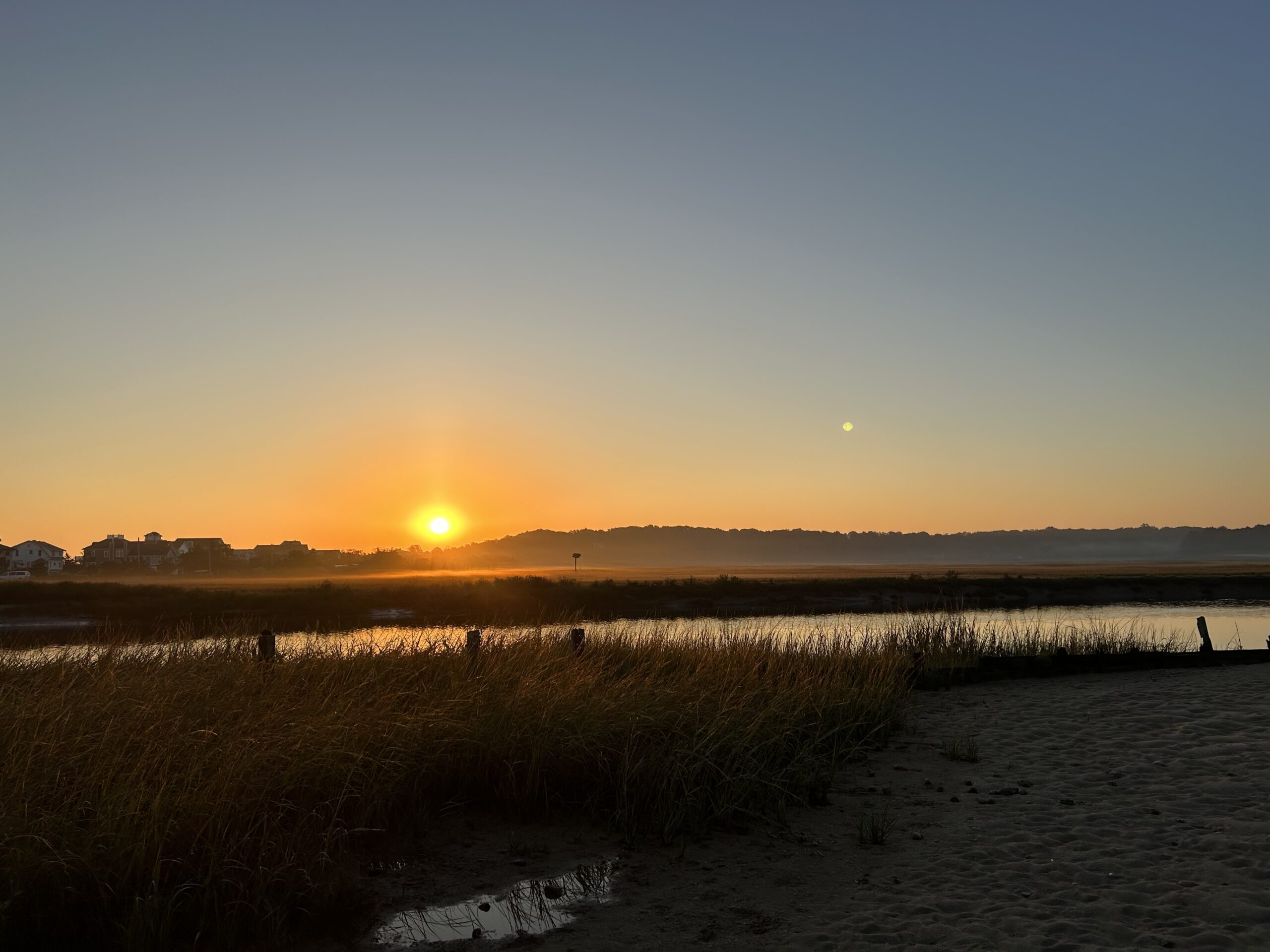 Photo by Jonah Saitz, USFWS.
Case Study
Plan
Huntington, NY
Crab Meadow Watershed Hydrology Study and Stewardship Plan
This comprehensive study and plan, funded through the National Fish and Wildlife Foundation, Long Island Sound Futures Fund, identifies initial strategies to maintain and enhance the local watershed resources of Crab Meadow. It is meant to be a land management tool to guide the implementation of best practices. The plan was developed in consultation with many partners and stakeholders. There is now significant community buy-in to take action to protect and restore this important watershed.
Following adoption of the plan, the Town of Huntington began working with US Fish and Wildlife Service and Audubon to study and restore Crab Meadow marsh and implement recommendations from the Stewardship Plan. Audubon, in partnership with Town of Huntington and USFWS, received a 2024 Long Island Sound Futures Fund Grant ($429K) to develop design plans for marsh restoration at Crab Meadow.
Case Study
Project
Rain Gardens on Western Waterfront
Friends of the Bay installed two raingardens at the Western Waterfront, which was done in October 2021 with the help of volunteers.


The main ways Friends of the Bay measured outcomes was by observing the absorption of water into the gardens after rain storms and seeing pollinators just a day or two after planting. The biggest benefit though was the engagement by the Town of Oyster Bay in fixing another rain garden at the Western Waterfront with help from a grant they received as well as plans to install more rain gardens in the area. Friends of the Bay was also able to engage a corps. of dedicated volunteers from the community. The long-term impact of the work is the continuation of stormwater runoff mitigation to the bay.
Friends of the Bay, info@friendsofthebay.org
Case Study
Project
Rain Gardens on Western Waterfront
Friends of the Bay installed two raingardens at the Western Waterfront, which was done in October 2021 with the help of volunteers.
Case Study
Project
Norwalk, CT
Webster Street Parking Lot Green Infrastructure Project
In 2019, the City of Norwalk secured a LIS Future Fund grant to install green infrastructure in the Webster Street Parking to reduce the impacts of stormwater on the Norwalk River and Harbor and mitigate local flooding of surrounding businesses through the installation of four different types of infiltration and bio-retention structures:
1) Underground infiltration systems.
2) Retention basins and curb inlet planters in eight different areas.
3) Porous pavement with storage in two areas.
4) Infiltration gutters and tree filters in two other areas.
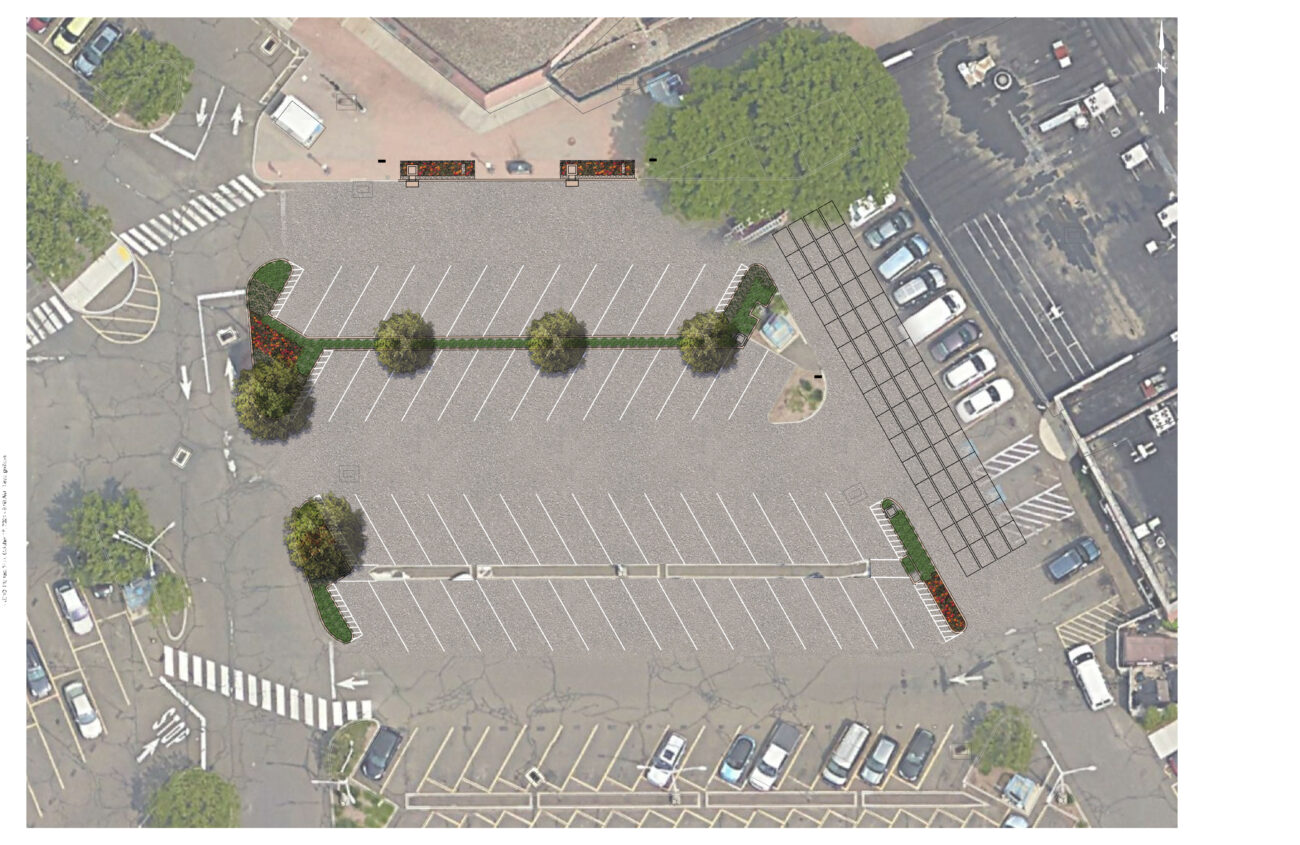

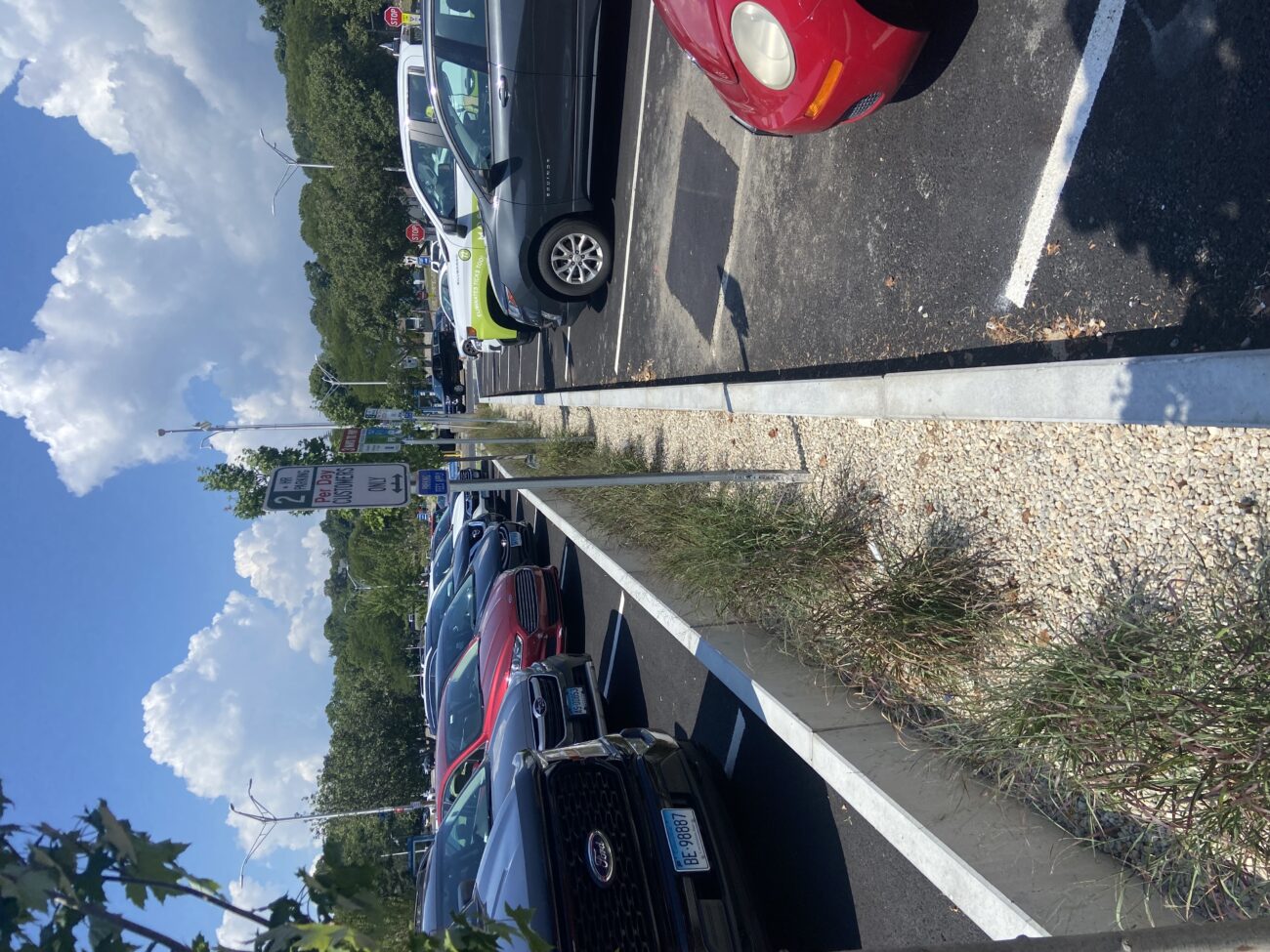


The project is estimated to remove 12 lbs. of nitrogen and preventing over 6 million gallons of stormwater from entering Norwalk Harbor annually. Since it's installation, the site has not experienced any flooding incidents (as of 2024), indicating that it seems to be functioning well.
Bryan Lutz
Assistant Director of Parking
blutz@norwalkct.gov; 203-854-7253
Case Study
Project
Norwalk, CT
Webster Street Parking Lot Green Infrastructure Project
In 2019, the City of Norwalk secured a LIS Future Fund grant to install green infrastructure in the Webster Street Parking to reduce the impacts of stormwater on the Norwalk River and Harbor and mitigate local flooding of surrounding businesses through the installation of four different types of infiltration and bio-retention structures:
1) Underground infiltration systems.
2) Retention basins and curb inlet planters in eight different areas.
3) Porous pavement with storage in two areas.
4) Infiltration gutters and tree filters in two other areas.
Case Study
Project
New Haven, CT
New Haven Bioswales
The City of New Haven has installed 286 right-of-way bioswales throughout the city as part of a multifaceted approach to reducing flooding in the downtown area. Right-of-way bioswales are engineered planted areas that are located on sidewalks. They are designed to capture and infiltrate stormwater into the ground that would otherwise directly enter a storm drain. These bioswales were installed as the result of various partnerships and funding opportunities related to flood prevention, localized drainage solutions, combined sewer overflow mitigation, research, and traffic calming projects.
Project Lead
City of New Haven, Dept of Engineering
Project Partners
Urban Resources Initiative, EMERGE Inc., Save the Sound, Yale School of the Environment, and Quinnipiac University, among others.

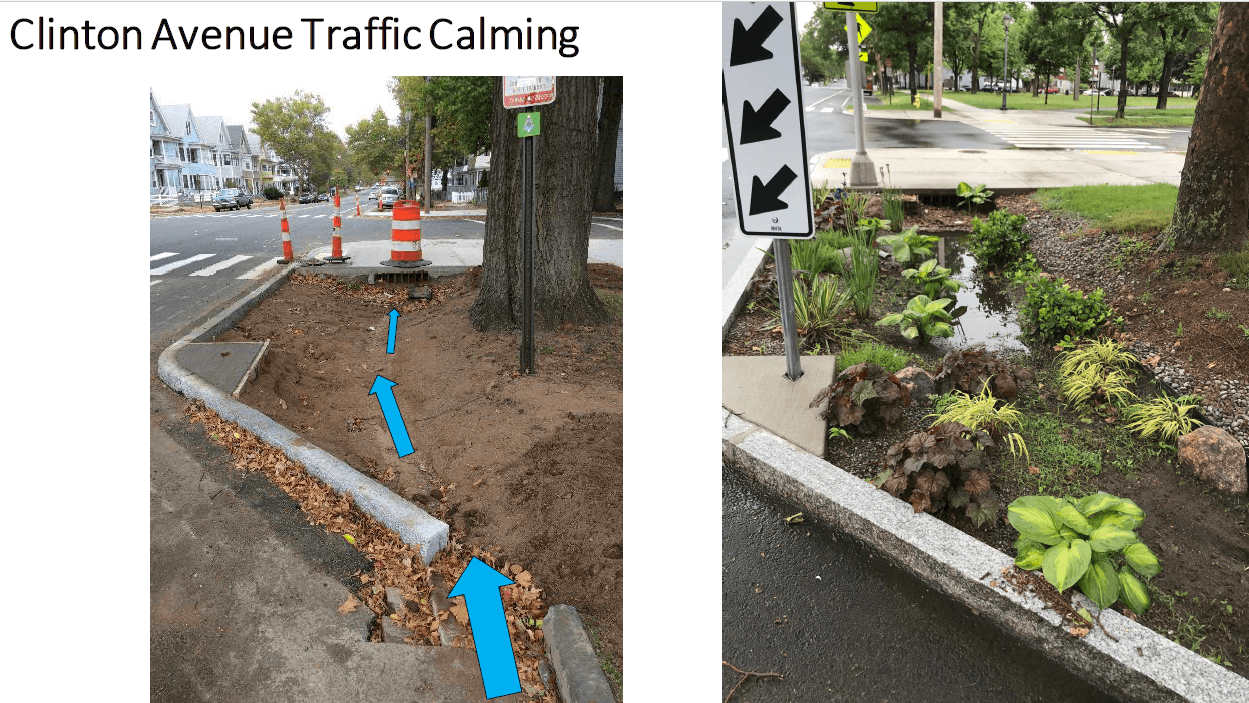

Monitoring performed by Yale School of the Environment researchers (led by Prof. Gaboury Benoit) have demonstrated that the bioswales have captured 70-75% of stormwater runoff in two locations. These results indicate that the bioswales are highly effective in diverting stormwater and thus, preventing pollution.
Dawn Henning
dhenning@newhavenct.gov
475-434-1643
Case Study
Project
New Haven, CT
New Haven Bioswales
The City of New Haven has installed 286 right-of-way bioswales throughout the city as part of a multifaceted approach to reducing flooding in the downtown area. Right-of-way bioswales are engineered planted areas that are located on sidewalks. They are designed to capture and infiltrate stormwater into the ground that would otherwise directly enter a storm drain. These bioswales were installed as the result of various partnerships and funding opportunities related to flood prevention, localized drainage solutions, combined sewer overflow mitigation, research, and traffic calming projects.
Project Lead
City of New Haven, Dept of Engineering
Project Partners
Urban Resources Initiative, EMERGE Inc., Save the Sound, Yale School of the Environment, and Quinnipiac University, among others.
Guidance Tool
Level of Effort:
CT DEEP: Connecticut Stormwater Quality Manual
This website provides an overview of each chapter of Connecticut’s new Stormwater Quality Manual, which includes guidance on how to design, install, and maintain these types of practices.
Guidance Tool
Level of Effort:
CT DEEP: Connecticut Stormwater Quality Manual
This website provides an overview of each chapter of Connecticut’s new Stormwater Quality Manual, which includes guidance on how to design, install, and maintain these types of practices.
Website
Level of Effort:
CLEAR: Rain Garden App
A website and a downloadable app for your mobile device. The resource has information about rain gardens, designing, selecting plants, and installing a garden on your property.
Website
Level of Effort:
CLEAR: Rain Garden App
A website and a downloadable app for your mobile device. The resource has information about rain gardens, designing, selecting plants, and installing a garden on your property.
Story Map
Level of Effort:
CLEAR: The State of Low Impact Development in Connecticut
This story map by the by the UConn Center for Land Use Education and Research (CLEAR) and the Naugatuck Valley Council of Governments (NVCOG) shows a snapshot of Connecticut Municipalities’ Low Impact Development Policies (LID) that are included plans of conservation and development, zoning/subdivision regulations, and stormwater/LID design manuals.
Story Map
Level of Effort:
CLEAR: The State of Low Impact Development in Connecticut
This story map by the by the UConn Center for Land Use Education and Research (CLEAR) and the Naugatuck Valley Council of Governments (NVCOG) shows a snapshot of Connecticut Municipalities’ Low Impact Development Policies (LID) that are included plans of conservation and development, zoning/subdivision regulations, and stormwater/LID design manuals.
Guidance Tool
Level of Effort:
NYSDEC/NYSDOS Using Natural Measures to Reduce the Risk of Flooding and Erosion
This document developed in support of the NYS Community Risk and Resiliency Act 1) Describes natural resilience measures and how they can be used to mitigate the risks of flooding and erosion, 2) Provides definitions for different types of natural resilience measures and distinguishes among conserved, restored, nature-based and hard structural approaches, 3) Provides information on the value and benefits of using natural resilience measures, along with information on the co-benefits they provide, 4) Lists key factors to consider in the restoration, design and construction of natural resilience measures, and 5) Provides background to support the development of NYS agency guidance on natural resilience measures in the future
Guidance Tool
Level of Effort:
NYSDEC/NYSDOS Using Natural Measures to Reduce the Risk of Flooding and Erosion
This document developed in support of the NYS Community Risk and Resiliency Act 1) Describes natural resilience measures and how they can be used to mitigate the risks of flooding and erosion, 2) Provides definitions for different types of natural resilience measures and distinguishes among conserved, restored, nature-based and hard structural approaches, 3) Provides information on the value and benefits of using natural resilience measures, along with information on the co-benefits they provide, 4) Lists key factors to consider in the restoration, design and construction of natural resilience measures, and 5) Provides background to support the development of NYS agency guidance on natural resilience measures in the future
Guidance Tool
Level of Effort:
NYS Stormwater Design Manual
The New York State Stormwater Management Design Manual provides designers with a general overview on how to size, design, select, and locate stormwater management practices at a development site to comply with State stormwater performance standards.
Guidance Tool
Level of Effort:
NYS Stormwater Design Manual
The New York State Stormwater Management Design Manual provides designers with a general overview on how to size, design, select, and locate stormwater management practices at a development site to comply with State stormwater performance standards.
Guidance Tool
Level of Effort:
NOAA Digital Coast – Ecosystem Services
Healthy ecosystems provide a wide range of benefits, from recreational opportunities to storm surge protection. These benefits are often referred to as ecosystem services. Understanding how changes to the ecosystem may affect these benefits should play a role in the community’s decision making process. This page provides a guide to learning more and key NOAA Digital Coast resources useful for this task.
Guidance Tool
Level of Effort:
NOAA Digital Coast – Ecosystem Services
Healthy ecosystems provide a wide range of benefits, from recreational opportunities to storm surge protection. These benefits are often referred to as ecosystem services. Understanding how changes to the ecosystem may affect these benefits should play a role in the community’s decision making process. This page provides a guide to learning more and key NOAA Digital Coast resources useful for this task.
Incentive Program
Long Island Garden Rewards Program
The Long Island Garden Rewards Program offers reimbursement of up to $500 total for making your yard more water friendly. Homeowners can be reimbursed for installing rain barrels, rain gardens, or native plantings on their properties. These actions reduce the amount of nitrogen pollution entering local waterways and helps conserve water. Funds are limited and available on a first come, first serve basis.
Due to the high participation in the program, as of May 20, 2025 the Long Island Garden Rewards Program is closed. Thank you to all who participated. Check back for when applications open again!
Incentive Program
Long Island Garden Rewards Program
The Long Island Garden Rewards Program offers reimbursement of up to $500 total for making your yard more water friendly. Homeowners can be reimbursed for installing rain barrels, rain gardens, or native plantings on their properties. These actions reduce the amount of nitrogen pollution entering local waterways and helps conserve water. Funds are limited and available on a first come, first serve basis.
Due to the high participation in the program, as of May 20, 2025 the Long Island Garden Rewards Program is closed. Thank you to all who participated. Check back for when applications open again!
Guidance Tool
Level of Effort:
Building Community Resilience with Nature-Based Solutions: Strategies for Success (FEMA)
This guide gives community leaders five main strategies to carry out Nature-Based Solution projects: 1) Building Strong Partnerships, 2) Engaging the Whole Community, 3) Matching Project Size with Desired Goals and Benefits, 4) Maximizing Benefits, and 5) Designing for the Future. This is not a technical guide for planning, constructing, or funding NBS. It covers the value of each strategy and suggests how to move forward with NBS projects.
Guidance Tool
Level of Effort:
Building Community Resilience with Nature-Based Solutions: Strategies for Success (FEMA)
This guide gives community leaders five main strategies to carry out Nature-Based Solution projects: 1) Building Strong Partnerships, 2) Engaging the Whole Community, 3) Matching Project Size with Desired Goals and Benefits, 4) Maximizing Benefits, and 5) Designing for the Future. This is not a technical guide for planning, constructing, or funding NBS. It covers the value of each strategy and suggests how to move forward with NBS projects.
Guidance Tool
Level of Effort:
EPA Green Infrastructure
Includes information about preparing for, and implementing green infrastructure with helpful links to other fact sheets and resources.
Guidance Tool
Level of Effort:
EPA Green Infrastructure
Includes information about preparing for, and implementing green infrastructure with helpful links to other fact sheets and resources.
Guidance Tool
Level of Effort:
Adapt CT (CTSG & CLEAR) – Climate Adaptation Academy
Aimed at municipalities, this website provides workshop materials and legal issue fact sheets on topics relating to climate adaptation, including living shorelines, flooding, liability, shoreline boundaries, and more.
Guidance Tool
Level of Effort:
Adapt CT (CTSG & CLEAR) – Climate Adaptation Academy
Aimed at municipalities, this website provides workshop materials and legal issue fact sheets on topics relating to climate adaptation, including living shorelines, flooding, liability, shoreline boundaries, and more.
Guidance Tool
Level of Effort:
Adapt CT (CTSG & CLEAR) – Coastal Landscaping Guide for Long Island Sound
Helps shoreline homeowners choose appropriate landscaping options including plant species.
Guidance Tool
Level of Effort:
Adapt CT (CTSG & CLEAR) – Coastal Landscaping Guide for Long Island Sound
Helps shoreline homeowners choose appropriate landscaping options including plant species.
Guidance Tool
Level of Effort:
Adapt CT (CTSG & CLEAR) – Connecticut Coastal Planting Guide
List of native plants that will grow well in Connecticut’s coastal zone. Includes wildlife and pollinator benefits.
Guidance Tool
Level of Effort:
Adapt CT (CTSG & CLEAR) – Connecticut Coastal Planting Guide
List of native plants that will grow well in Connecticut’s coastal zone. Includes wildlife and pollinator benefits.
Guidance Tool
Level of Effort:
Adapt CT (CTSG & CLEAR) – Native Plants for Riparian Corridors in Connecticut
A guide listing the trees, shrubs, grasses, sedges, reeds and herbaceous plants best for the banks of rivers, streams or other bodies of water (a companion to: A Planting Guide for Riparian Sites Along the Connecticut Coast)
Guidance Tool
Level of Effort:
Adapt CT (CTSG & CLEAR) – Native Plants for Riparian Corridors in Connecticut
A guide listing the trees, shrubs, grasses, sedges, reeds and herbaceous plants best for the banks of rivers, streams or other bodies of water (a companion to: A Planting Guide for Riparian Sites Along the Connecticut Coast)
Website
Level of Effort:
CLEAR: Center for Land Use Education and Research
CLEAR, a program of UConn’s College of Agriculture, Health, and Natural Resources, provides information, education, and assistance to land use decision makers, in support of balancing growth and natural resource protection.
Website
Level of Effort:
CLEAR: Center for Land Use Education and Research
CLEAR, a program of UConn’s College of Agriculture, Health, and Natural Resources, provides information, education, and assistance to land use decision makers, in support of balancing growth and natural resource protection.
Guidance Tool
Level of Effort:
Adapt CT (CTSG & CLEAR) – A Planting Guide for Riparian Sites Along the Connecticut Coast
lists native trees, shrubs, ferns, grasses, sedges, reeds and herbaceous plants suitable for planting along the banks of a river, stream or other body of water.
Guidance Tool
Level of Effort:
Adapt CT (CTSG & CLEAR) – A Planting Guide for Riparian Sites Along the Connecticut Coast
lists native trees, shrubs, ferns, grasses, sedges, reeds and herbaceous plants suitable for planting along the banks of a river, stream or other body of water.
Training
SRC Annual Bi-State Workshop 2022
The first annual Long Island Sound Bi-State Sustainable and Resilient Communities Workshop brought together more than 260 people virtually on Dec. 1, 2022 to learn about opportunities to increase the resilience of the Sound’s communities to climate change and other environmental threats. Interactive sessions included opportunities to learn more about the SRC Extension Professionals’ needs assessment findings and recommendations, the newly released Long Island Sound Resilience Grant Writing Assistance Program, and tips for success with Long Island Sound funding opportunities. Concurrent breakout sessions highlighted the work of partners related to shoreline planning and implementation, using green infrastructure for stormwater management, sustainable climate planning for relocation, and new sustainability/resilience tools available in both New York and Connecticut. Videos of the workshop’s six sessions are available on YouTube. They can be accessed below along with supporting documents.

Training
SRC Annual Bi-State Workshop 2022
The first annual Long Island Sound Bi-State Sustainable and Resilient Communities Workshop brought together more than 260 people virtually on Dec. 1, 2022 to learn about opportunities to increase the resilience of the Sound’s communities to climate change and other environmental threats. Interactive sessions included opportunities to learn more about the SRC Extension Professionals’ needs assessment findings and recommendations, the newly released Long Island Sound Resilience Grant Writing Assistance Program, and tips for success with Long Island Sound funding opportunities. Concurrent breakout sessions highlighted the work of partners related to shoreline planning and implementation, using green infrastructure for stormwater management, sustainable climate planning for relocation, and new sustainability/resilience tools available in both New York and Connecticut. Videos of the workshop’s six sessions are available on YouTube. They can be accessed below along with supporting documents.
Training
Reimagining Long Island Lawns: Eco-Friendly Practices
On July 18th, 2023 NYS Department of Environmental Conservation and NY Sea Grant hosted a free public webinar to share more about what steps homeowners can take in their own yards to protect and improve Long Island waters! Featured experts from New York Sea Grant, NYS Department of Environmental Conservation, Long Island Commission for Aquifer Protection, Cornell Cooperative Extension Suffolk County, and Rewild Long Island discussed smart fertilizer practices, water conservation, and native plantings.
Training
Reimagining Long Island Lawns: Eco-Friendly Practices
On July 18th, 2023 NYS Department of Environmental Conservation and NY Sea Grant hosted a free public webinar to share more about what steps homeowners can take in their own yards to protect and improve Long Island waters! Featured experts from New York Sea Grant, NYS Department of Environmental Conservation, Long Island Commission for Aquifer Protection, Cornell Cooperative Extension Suffolk County, and Rewild Long Island discussed smart fertilizer practices, water conservation, and native plantings.
Training
Steps to Resilience
This online information session held Sept. 19, and repeated Sept. 21, provides an introduction to resilience planning in the Long Island Sound region. It includes discussions on local climate impacts and projections, resilience planning strategies, and climate certification programs for both New York and Connecticut municipalities. In addition to the main presentation, videos of the Connecticut and New York breakout sessions can be accessed below. The presentations and other resource materials are available here.


Training
Steps to Resilience
This online information session held Sept. 19, and repeated Sept. 21, provides an introduction to resilience planning in the Long Island Sound region. It includes discussions on local climate impacts and projections, resilience planning strategies, and climate certification programs for both New York and Connecticut municipalities. In addition to the main presentation, videos of the Connecticut and New York breakout sessions can be accessed below. The presentations and other resource materials are available here.