

Resources for
Habitat
Guidance Tool
Level of Effort:
Climate Action Tool
The 2025 expansion of the Climate Action Tool (CAT) allows you to:
1) Access information on climate impacts and vulnerability of species and habitats; and
2) Explore adaptation strategies and actions, related to connectivity, conservation planning, and forestry, among other relevant areas.
This tool was developed by the Northeast Climate Adaptation Science Center and the University of Massachusetts Amherst (UMass) Center for Agriculture, Food, and the Environment.
Guidance Tool
Level of Effort:
Climate Action Tool
The 2025 expansion of the Climate Action Tool (CAT) allows you to:
1) Access information on climate impacts and vulnerability of species and habitats; and
2) Explore adaptation strategies and actions, related to connectivity, conservation planning, and forestry, among other relevant areas.
This tool was developed by the Northeast Climate Adaptation Science Center and the University of Massachusetts Amherst (UMass) Center for Agriculture, Food, and the Environment.
Funding
: Jul 20, 2026
min $50K
Forever Connecticut Fund
CLCC’s Forever Connecticut Fund is a conservation finance tool that provides land trusts with access to immediate, flexible capital to acquire natural and working lands, including fee simple and conservation easements. Beyond financial assistance, the Forever Connecticut Fund strengthens organizations through a new capacity-building program that includes one-on-one coaching from a development expert to help land trusts secure grants and donations, launch capital campaigns, and boost their overall fundraising capacity.
The Forever CT Fund is designed to help land trusts act quickly on conservation opportunities when traditional funding sources are not immediately available. Applications are accepted by invitation only. Email Yaw to discuss your project(s) and eligibility for funding.
Funding
: Jul 20, 2026
min $50K
Forever Connecticut Fund
CLCC’s Forever Connecticut Fund is a conservation finance tool that provides land trusts with access to immediate, flexible capital to acquire natural and working lands, including fee simple and conservation easements. Beyond financial assistance, the Forever Connecticut Fund strengthens organizations through a new capacity-building program that includes one-on-one coaching from a development expert to help land trusts secure grants and donations, launch capital campaigns, and boost their overall fundraising capacity.
Funding
: Jul 20, 2026
min $50K
The Land & Easement Acquisition Program (LEAP)
The Land & Easement Acquisition Program (LEAP) is designed to bridge funding gaps and accelerate the protection of valuable conservation lands. CLCC will prioritize projects that:
- Have a closing time frame of 12 months or less.
- Demonstrate a strong commitment to conservation.
- Align with statewide land conservation goals.
- Have leveraged and/or exhausted other public and private funding sources.
Applications are accepted by invitation only. Potential applicants are required to contact Yaw Darko, CLCC’s Director of Grants and Programs, to discuss their project and determine eligibility.
Funding
: Jul 20, 2026
min $50K
The Land & Easement Acquisition Program (LEAP)
The Land & Easement Acquisition Program (LEAP) is designed to bridge funding gaps and accelerate the protection of valuable conservation lands. CLCC will prioritize projects that:
- Have a closing time frame of 12 months or less.
- Demonstrate a strong commitment to conservation.
- Align with statewide land conservation goals.
- Have leveraged and/or exhausted other public and private funding sources.
Mapper
Level of Effort:
Resilient Land Mapping Tool
The Resilient Land Mapping Tool, developed by The Nature Conservancy’s Center for Resilient Conservation Science, is an interactive mapping tool that helps users explore climate resilient landscapes across the United States. The tool allows users to view and analyze data on terrestrial resilience, biodiversity, connectivity, and other conservation indicators to support land protection and planning decisions. Users can explore different map layers, analyze specific areas, and download datasets for conservation research and planning. This tool is designed to support conservation efforts that protect biodiversity and maintain ecological functions in a changing climate.
Mapper
Level of Effort:
Resilient Land Mapping Tool
The Resilient Land Mapping Tool, developed by The Nature Conservancy’s Center for Resilient Conservation Science, is an interactive mapping tool that helps users explore climate resilient landscapes across the United States. The tool allows users to view and analyze data on terrestrial resilience, biodiversity, connectivity, and other conservation indicators to support land protection and planning decisions. Users can explore different map layers, analyze specific areas, and download datasets for conservation research and planning. This tool is designed to support conservation efforts that protect biodiversity and maintain ecological functions in a changing climate.
Funding
: Feb 20 – Mar 31, 2026
$100,000 - $7M
National Coastal Resilience Fund 2026
The National Coastal Resilience Fund (NCRF) is a national focused on reducing risks to coastal communities. The NCRF is now soliciting pre-proposals for coastal resilience projects that restore, increase, and strengthen natural infrastructure such as coastal marshes and wetlands, dune and beach systems, oyster and coral reefs, rivers and floodplains, coastal forest, and barrier islands that mitigate the impacts of storms and other coastal hazards to communities.
The National Coastal Resilience Fund invests in projects under four project categories: 1) Community Capacity Building and Planning, 2) Site Assessment and Preliminary Design, 3) Final Design and Permitting, 4) Restoration Implementation. Informational webinars are available to provide an overview of the NCRF funding opportunity on 2/24, 2/25, and 2/26.
Funding
: Feb 20 – Mar 31, 2026
$100,000 - $7M
National Coastal Resilience Fund 2026
The National Coastal Resilience Fund (NCRF) is a national focused on reducing risks to coastal communities. The NCRF is now soliciting pre-proposals for coastal resilience projects that restore, increase, and strengthen natural infrastructure such as coastal marshes and wetlands, dune and beach systems, oyster and coral reefs, rivers and floodplains, coastal forest, and barrier islands that mitigate the impacts of storms and other coastal hazards to communities.
Funding
: Feb 2 – Mar 13, 2026
training & technical assistance
Living Shoreline Planning Series
The Northeast Regional Ocean Council (NROC) and The Nature Conservancy (TNC) invite coastal communities, Tribes, and non-profit organizations from across New England to apply for the Living Shoreline Planning Series, which will offer free training and technical assistance to help guide you and your team through the process of identifying and developing a conceptual design for a living shoreline. These projects will be designed to reduce erosion and coastal flooding and increase resilience with co-benefits like improving habitat and public access to coastal resources. The training and technical assistance are intended to build capacity towards designing, permitting, and implementing living shoreline projects in New England and ensure your community or organization is well positioned to secure funding to advance the project beyond the conceptual design phase.
Up to 10 applicants from across New England will be selected to participate in the Living Shoreline Planning Series, which will consist of five online learning-facilitation sessions and one in-person site visit. The Living Shoreline Planning Series is open for applications from any coastal municipality, Tribe, or non-profit organization located within New England.
Funding
: Feb 2 – Mar 13, 2026
training & technical assistance
Living Shoreline Planning Series
The Northeast Regional Ocean Council (NROC) and The Nature Conservancy (TNC) invite coastal communities, Tribes, and non-profit organizations from across New England to apply for the Living Shoreline Planning Series, which will offer free training and technical assistance to help guide you and your team through the process of identifying and developing a conceptual design for a living shoreline. These projects will be designed to reduce erosion and coastal flooding and increase resilience with co-benefits like improving habitat and public access to coastal resources. The training and technical assistance are intended to build capacity towards designing, permitting, and implementing living shoreline projects in New England and ensure your community or organization is well positioned to secure funding to advance the project beyond the conceptual design phase.
SRC Training
Dodge Paddock & Beal Preserve Marsh Restoration Field Trip and Workshop
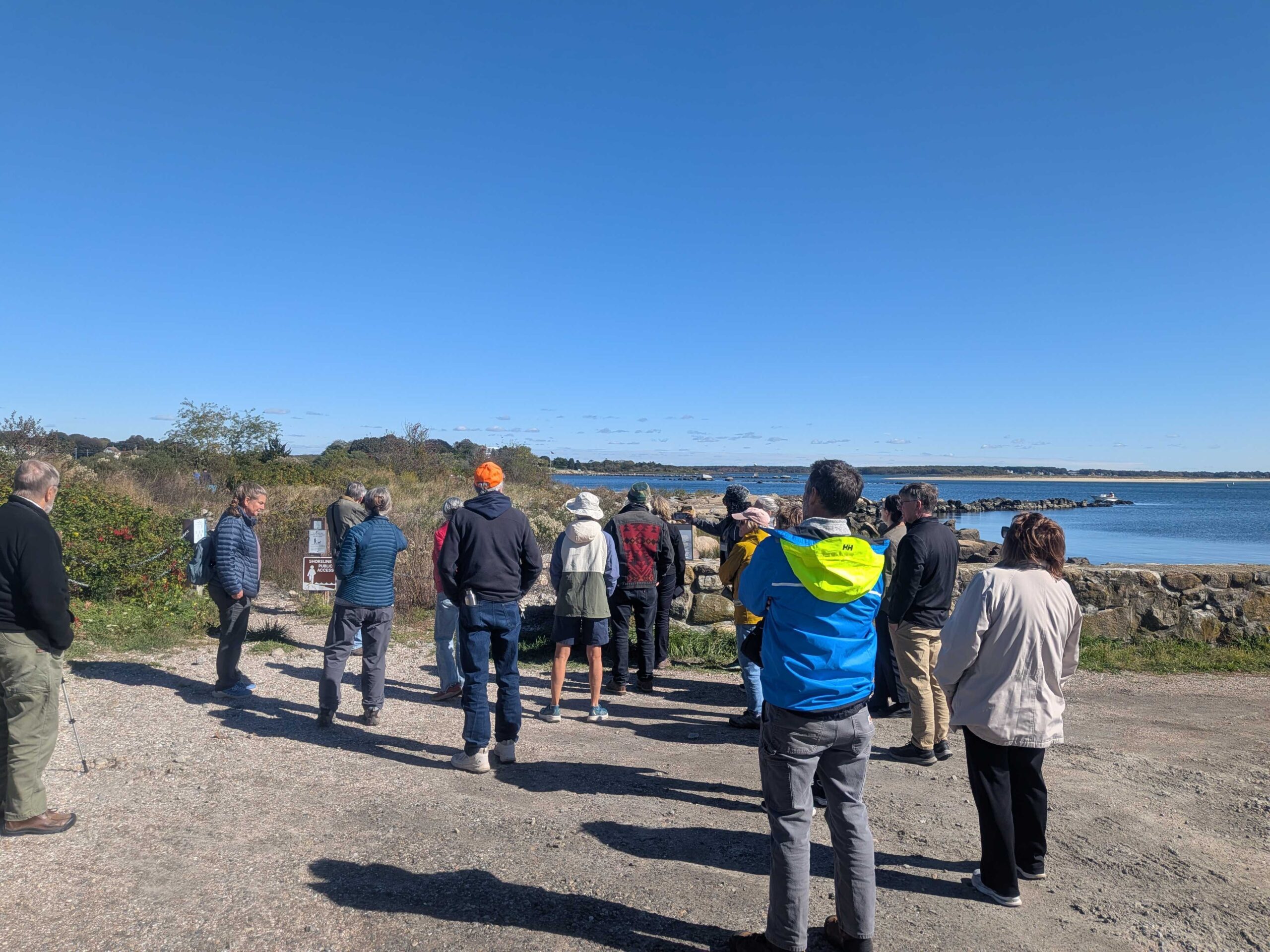
On October 16, 2025, the Sustainable and Resilient Communities (SRC) team of the Long Island Sound Partnership hosted a field trip featuring the Dodge Paddock and Beal Preserve Marsh Restoration Project in Stonington Borough. The day started with a presentation outlining the history and current state of the site, followed by a walk to Dodge Paddock and Beal Preserve where there was a guided tour led by Connecticut Sea Grant, Avalonia Land Conservancy, and local volunteers. The day included a deep dive into the invasive species removal process, plantings to accommodate marsh migration, and a close up look at what has grown since then. Special thanks to our partners with Avalonia Land Conservancy, Connecticut Sea Grant, and the Stonington Community.


SRC Training
Dodge Paddock & Beal Preserve Marsh Restoration Field Trip and Workshop
On October 16, 2025, the Sustainable and Resilient Communities (SRC) team of the Long Island Sound Partnership hosted a field trip featuring the Dodge Paddock and Beal Preserve Marsh Restoration Project in Stonington Borough. The day started with a presentation outlining the history and current state of the site, followed by a walk to Dodge Paddock and Beal Preserve where there was a guided tour led by Connecticut Sea Grant, Avalonia Land Conservancy, and local volunteers. The day included a deep dive into the invasive species removal process, plantings to accommodate marsh migration, and a close up look at what has grown since then. Special thanks to our partners with Avalonia Land Conservancy, Connecticut Sea Grant, and the Stonington Community.
Funding
: Oct 1 – Dec 16, 2025
$100K - $1.5M
CT DEEP Long Island Sound Ecosystems Grant
The Connecticut Department of Energy and Environmental Protection’s (DEEP’s) Land and Water Resources Division requests proposals for the new CT DEEP Long Island Sound Ecosystems Grant, made possible by financial support provided by the Long Island Sound Partnership from the U.S. EPA. There are two primary goals of the program: 1) to promote large-scale habitat restoration and enhance restoration planning, while also helping coastal communities and ecosystems adapt to changing environmental conditions; and 2) to further promote the application of green stormwater infrastructure techniques to reduce nonpoint source pollution, improving water resource quality.
There is approximately $7 million available, and no match is required. Eligible projects include: 1) Habitat Restoration (planning/engineering/design and construction for habitat restoration projects); and 2) Green Stormwater Infrastructure (planning/engineering/design and construction for green stormwater infrastructure projects).
Funding
: Oct 1 – Dec 16, 2025
$100K - $1.5M
CT DEEP Long Island Sound Ecosystems Grant
The Connecticut Department of Energy and Environmental Protection’s (DEEP’s) Land and Water Resources Division requests proposals for the new CT DEEP Long Island Sound Ecosystems Grant, made possible by financial support provided by the Long Island Sound Partnership from the U.S. EPA. There are two primary goals of the program: 1) to promote large-scale habitat restoration and enhance restoration planning, while also helping coastal communities and ecosystems adapt to changing environmental conditions; and 2) to further promote the application of green stormwater infrastructure techniques to reduce nonpoint source pollution, improving water resource quality.
Mapper
Level of Effort:
The Long Island Sound and Watershed Metadata Map Application
The Long Island Sound watershed is home to nearly 9 million people in parts of Connecticut, Massachusetts, New Hampshire, New York, Rhode Island, Vermont, and Canada. Government agencies, nonprofits, and Tribal Nations have overseen numerous projects to monitor and protect the water resources of this watershed and the sound. Although there is an abundance of data, there is no easy way to search them or a central place to manage this information. To help, the U.S. Geological Survey, the U.S. Environmental Protection Agency, and the Long Island Sound Study have created an interactive map to help users find and understand data about the water resources of the Long Island Sound and its watershed.
This mapping tool does not host data or maintain data repositories. Instead, it compiles and presents metadata from publicly accessible databases managed by State and other organizations.
Refer to this fact sheet for details about the application and its data sources: The Long Island Sound and Watershed Metadata map application
Mapper
Level of Effort:
The Long Island Sound and Watershed Metadata Map Application
The Long Island Sound watershed is home to nearly 9 million people in parts of Connecticut, Massachusetts, New Hampshire, New York, Rhode Island, Vermont, and Canada. Government agencies, nonprofits, and Tribal Nations have overseen numerous projects to monitor and protect the water resources of this watershed and the sound. Although there is an abundance of data, there is no easy way to search them or a central place to manage this information. To help, the U.S. Geological Survey, the U.S. Environmental Protection Agency, and the Long Island Sound Study have created an interactive map to help users find and understand data about the water resources of the Long Island Sound and its watershed.
This mapping tool does not host data or maintain data repositories. Instead, it compiles and presents metadata from publicly accessible databases managed by State and other organizations.
Refer to this fact sheet for details about the application and its data sources: The Long Island Sound and Watershed Metadata map application
Funding
: Jun 25 – Sep 23, 2024
National Culvert Removal, Replacement, & Restoration Grants – FY24 (Year 3)
The Bipartisan Infrastructure Law established the National Culvert Removal, Replacement, and Restoration Grant program (Culvert Aquatic Organism Passage Program) to provide funding for projects that would meaningfully improve or restore passage for anadromous fish (anadromous fish species are born in freshwater such as streams and rivers, spend most of their lives in the marine environment, and migrate back to freshwater to spawn).
Eligible projects include projects to replace, remove, or repair culverts or weirs that would meaningfully improve or restore fish passage for anadromous fish. With respect to weirs, the project may include—infrastructure to facilitate fish passage around or over the weir; and weir improvements.
Funding
: Jun 25 – Sep 23, 2024
National Culvert Removal, Replacement, & Restoration Grants – FY24 (Year 3)
The Bipartisan Infrastructure Law established the National Culvert Removal, Replacement, and Restoration Grant program (Culvert Aquatic Organism Passage Program) to provide funding for projects that would meaningfully improve or restore passage for anadromous fish (anadromous fish species are born in freshwater such as streams and rivers, spend most of their lives in the marine environment, and migrate back to freshwater to spawn).
Funding
: Apr 25 – Jun 26, 2025
$75,000 - $300,000
Northeast Forest and Rivers Fund 2025 Request for Proposals
NFWF is soliciting proposals for the Northeast Forests and Rivers Fund to restore and sustain healthy rivers, forests, and grasslands that provide habitat for diverse fish and wildlife populations.
Within the Long Island Sound and Connecticut River watershed, NEFRF will only consider projects to sustain and restore healthy forests, grasslands and fish passage projects. All other projects should apply to the Long Island Sound Futures Fund (LISFF).
Funding
: Apr 25 – Jun 26, 2025
$75,000 - $300,000
Northeast Forest and Rivers Fund 2025 Request for Proposals
NFWF is soliciting proposals for the Northeast Forests and Rivers Fund to restore and sustain healthy rivers, forests, and grasslands that provide habitat for diverse fish and wildlife populations.
Funding
: Mar 27 – May 6, 2025
$100,000 - $10M
National Coastal Resilience Fund 2025
The National Coastal Resilience Fund (NCRF) is a national program focused on reducing risks to coastal communities. The NCRF is now soliciting pre-proposals for projects that will create and/or restore natural systems in order to increase protection for communities from coastal hazards, such as storms, sea- and lake-level changes, inundation, and coastal erosion, while improving habitats for fish and wildlife species.
NCRF program priorities include: nature-based solutions, community risk reduction benefits, fish and wildlife benefits, community impact and engagement, and transferability and sustainability. The National Coastal Resilience Fund invests in projects under four project categories: 1) Community Capacity Building and Planning, 2) Site Assessment and Preliminary Design, 3) Final Design and Permitting, 4) Restoration Implementation.
Funding
: Mar 27 – May 6, 2025
$100,000 - $10M
National Coastal Resilience Fund 2025
The National Coastal Resilience Fund (NCRF) is a national program focused on reducing risks to coastal communities. The NCRF is now soliciting pre-proposals for projects that will create and/or restore natural systems in order to increase protection for communities from coastal hazards, such as storms, sea- and lake-level changes, inundation, and coastal erosion, while improving habitats for fish and wildlife species.
Funding
: Mar 1 – Apr 1, 2026
$50K - $500K (or 30% of appraised value)
The Land & Easement Acquisition Program (LEAP) March-April
The Land & Easement Acquisition Program (LEAP) is designed to bridge funding gaps and accelerate the protection of valuable conservation lands. CLCC will prioritize projects that:
- Have a closing time frame of 12 months or less.
- Demonstrate a strong commitment to conservation.
- Align with statewide land conservation goals.
- Have leveraged and/or exhausted other public and private funding sources.
Applications are accepted by invitation only. Potential applicants are required to contact Yaw Darko, CLCC’s Director of Grants and Programs, to discuss their project and determine eligibility.
Funding
: Mar 1 – Apr 1, 2026
$50K - $500K (or 30% of appraised value)
The Land & Easement Acquisition Program (LEAP) March-April
The Land & Easement Acquisition Program (LEAP) is designed to bridge funding gaps and accelerate the protection of valuable conservation lands. CLCC will prioritize projects that:
- Have a closing time frame of 12 months or less.
- Demonstrate a strong commitment to conservation.
- Align with statewide land conservation goals.
- Have leveraged and/or exhausted other public and private funding sources.
Funding
: Feb 28 – May 17, 2024
$500,000 min
2024 Transportation Alternatives Program
This program provides funding for a variety of transportation projects such as pedestrian and bicycle facilities; construction of turnouts, overlooks, and viewing areas; community improvements such as historic preservation and vegetation management; environmental mitigation related to stormwater and habitat connectivity; recreational trails; safe routes to school projects; and vulnerable road user safety assessments.
These funds are made available to the State through partnership with the Federal Highway Administration (FHWA). The New Haven Urbanized Area alone is expected to receive $7.3 million between FFY 2026 and FFY 2030. To learn more and apply, please review the program application and solicitation memo attached. Applications must be submitted to Jim Rode at SCRCOG via email: jrode@scrcog.org by May 17, 2024. Project applications will be reviewed and ranked based on criteria provided by CT DOT. A prioritized list will be reviewed and finalized at the Transportation Committee meeting on June 12, 2024. Approval of the prioritized list of projects will be on the Board Meeting agenda on June 26, 2024.
Funding
: Feb 28 – May 17, 2024
$500,000 min
2024 Transportation Alternatives Program
This program provides funding for a variety of transportation projects such as pedestrian and bicycle facilities; construction of turnouts, overlooks, and viewing areas; community improvements such as historic preservation and vegetation management; environmental mitigation related to stormwater and habitat connectivity; recreational trails; safe routes to school projects; and vulnerable road user safety assessments.
Resource
Level of Effort:
Conservation Commissions and Natural Resource Resilience
This fact sheet for Conservation Commissions in Connecticut reviews the role of these commissions for enhancing the climate resilience of their communities. The resource was developed by CIRCA and covers the authority and duties of conservation commissions as well as detailing specific strategies and approaches.
Resource
Level of Effort:
Conservation Commissions and Natural Resource Resilience
This fact sheet for Conservation Commissions in Connecticut reviews the role of these commissions for enhancing the climate resilience of their communities. The resource was developed by CIRCA and covers the authority and duties of conservation commissions as well as detailing specific strategies and approaches.
Funding
: Feb 14 – Jun 21, 2024
$50,000 - $1M
2025 National Coastal Wetlands Conservation Grant Program
The primary goal of the National Coastal Wetlands Conservation Grant (NCWCG) Program is the long‐term conservation of coastal wetland ecosystems. The program is designed to acquire, restore, and enhance wetlands in coastal areas through competitive matching grants to eligible State agencies.
The NCWCG Program provides eligible State agencies with grants for projects that protect and restore valuable coastal wetland resources. Projects can include: (1) Acquisition of a real property interest (e.g., conservation easement or fee title) in coastal lands or waters (coastal wetlands ecosystems) from willing sellers or partners for long‐term conservation; (2) Restoration, enhancement, or management of coastal wetlands ecosystems; or (3) A combination of acquisition, restoration, enhancement, and management. Participation is limited to State agencies or entities designated as eligible by the Governor of a coastal State. The eligible agency is usually a State natural resource or fish and wildlife agency.
Funding
: Feb 14 – Jun 21, 2024
$50,000 - $1M
2025 National Coastal Wetlands Conservation Grant Program
The primary goal of the National Coastal Wetlands Conservation Grant (NCWCG) Program is the long‐term conservation of coastal wetland ecosystems. The program is designed to acquire, restore, and enhance wetlands in coastal areas through competitive matching grants to eligible State agencies.
Funding
: Feb 27 – Apr 15, 2024
$1,000-$5,000
Connecticut Botanical Society Small Grants Program
The Small Grants Program provides funding for land conservation projects that provide protection of rare or uncommon native plant species or natural communities, or areas of high native diversity. We will also consider habitat improvement projects, protection of open space in low-income and urban communities, and assistance with fund-raising for projects that meet the above criteria.
Note that applicants must be a member of CBS to apply.
Funding
: Feb 27 – Apr 15, 2024
$1,000-$5,000
Connecticut Botanical Society Small Grants Program
The Small Grants Program provides funding for land conservation projects that provide protection of rare or uncommon native plant species or natural communities, or areas of high native diversity. We will also consider habitat improvement projects, protection of open space in low-income and urban communities, and assistance with fund-raising for projects that meet the above criteria.
Funding
: Feb 22 – Apr 10, 2024
$100,000 - $10M
National Coastal Resilience Fund 2024
The NCRF is a national program with the goal of enhancing protection for coastal communities from the impacts of storms, floods, and other natural coastal hazards and to improve habitats for fish and wildlife. This year, NFWF will award approximately $140 million in grants for the planning, design, and implementation of natural and nature-based solutions.
All projects under this program must demonstrate dual benefits to both coastal communities and habitats. Award decisions will be made based on regional circumstances and needs, but all proposals must address the following priorities: 1) Nature-Based Solutions; 2) Community Resilience Benefit; 3) Fish and Wildlife Benefit; 4) Community Impact and Engagement; and 5) Transferability and Sustainability. To implement these program priorities, NFWF funds activities in four categories designed to advance a project through NFWF’s “project pipeline” from planning to implementation: 1) Community Capacity Building and Planning; 2) Site Assessment and Preliminary Design; 3) Final Design and Permitting; 4) Restoration Implementation.
Funding
: Feb 22 – Apr 10, 2024
$100,000 - $10M
National Coastal Resilience Fund 2024
The NCRF is a national program with the goal of enhancing protection for coastal communities from the impacts of storms, floods, and other natural coastal hazards and to improve habitats for fish and wildlife. This year, NFWF will award approximately $140 million in grants for the planning, design, and implementation of natural and nature-based solutions.
Funding
: Apr 15 – Jul 11, 2024
$75,000 - $300,000
Northeast Forest and Rivers Fund 2024 Request for Proposals
The Northeast Forests and Rivers Fund (formerly known as the New England Forests and Rivers Fund) provides grants to restore and sustain healthy rivers, forests, and grasslands that provide habitat for diverse fish and wildlife populations.
Within the Long Island Sound and Connecticut River watershed, NEFRF will only consider projects to sustain and restore healthy forests, grasslands and fish passage projects. All other projects should apply to the Long Island Sound Futures Fund (LISFF).
Funding
: Apr 15 – Jul 11, 2024
$75,000 - $300,000
Northeast Forest and Rivers Fund 2024 Request for Proposals
The Northeast Forests and Rivers Fund (formerly known as the New England Forests and Rivers Fund) provides grants to restore and sustain healthy rivers, forests, and grasslands that provide habitat for diverse fish and wildlife populations.
Case Study
Project
Roslyn Harbor, NY
Restoring Coastal Grassland at the William Cullen Bryant Preserve
The Nassau County Museum of Art restored coastal grassland and use the restored grassland to educate visitors about the environment at the William Cullen Bryant Preserve, Roslyn Harbor, New York. The project will restore an important coastal habitat of Long Island Sound. The whole area was seeded mid-October 2023 and the meadow growth began in the spring of 2024, although it will take 2-3 years to resemble a meadow. See photos below of the established grassland approximately 2 years after the seeding.


8 acres of coastal grassland restored, 1000 people reached through education and outreach. Grasslands absorb and maintain more carbon within the root system and absorb more water into the aquifer than forests.
Jean Henning, Conservation Project Coordinator, William Cullen Bryant Preserve
jdshenning@gmail.com
Case Study
Project
Roslyn Harbor, NY
Restoring Coastal Grassland at the William Cullen Bryant Preserve
The Nassau County Museum of Art restored coastal grassland and use the restored grassland to educate visitors about the environment at the William Cullen Bryant Preserve, Roslyn Harbor, New York. The project will restore an important coastal habitat of Long Island Sound. The whole area was seeded mid-October 2023 and the meadow growth began in the spring of 2024, although it will take 2-3 years to resemble a meadow. See photos below of the established grassland approximately 2 years after the seeding.
Mapper
Level of Effort:
Tree Equity Score
In cities across America, trees have historically been planted along race and class lines. Ensuring equitable tree cover across every neighborhood can help address social inequities so that all people can thrive. The map shows your city or town’s current Tree Equity Score and how it can be improved. Each score is calculated using a science-based approach and readily available data from a variety of sources.
Mapper
Level of Effort:
Tree Equity Score
In cities across America, trees have historically been planted along race and class lines. Ensuring equitable tree cover across every neighborhood can help address social inequities so that all people can thrive. The map shows your city or town’s current Tree Equity Score and how it can be improved. Each score is calculated using a science-based approach and readily available data from a variety of sources.