Resources for
management
Funding
: Dec 31 – Dec 31, 2027
Connecticut Conservation Partnership Program (CCPP)
Administered by the Connecticut Land Conservation Council (CLCC), CCPP has established a coordinated process by which land trust applicants to the Connecticut Department of Energy and Environmental Protection (DEEP) Open Space and Watershed Land Acquisition Grant Program (OSWA) may apply for a federal grant as a source of match funds.
Easements can be held by USDA-NRCS (U.S. Held Easements) or an eligible entity (Entity Held Easements). Priorities are for conservation easements on nonindustrial private forest and watershed lands.
Funding
: Dec 31 – Dec 31, 2027
Connecticut Conservation Partnership Program (CCPP)
Administered by the Connecticut Land Conservation Council (CLCC), CCPP has established a coordinated process by which land trust applicants to the Connecticut Department of Energy and Environmental Protection (DEEP) Open Space and Watershed Land Acquisition Grant Program (OSWA) may apply for a federal grant as a source of match funds.
Funding
: May 21 – Apr 30, 2026
max $100K
Climate-Smart Forest Stewardship Grant Program
CLCC’s Climate-Smart Forest Stewardship Grant Program is a new initiative that enables land trusts to take care of their forests. To help land trusts face these challenges, CLCC will provide funding for land trusts that integrate climate mitigation, resilience, and adaptation strategies into their long-term forest stewardship.
Projects must take place in a USFS-defined rural area. Applicants must be current members of CLCC. Interested applicants must have an initial conversation with CLCC to discuss project eligibility. Site visits are strongly encouraged prior to submitting an application.
Funding
: May 21 – Apr 30, 2026
max $100K
Climate-Smart Forest Stewardship Grant Program
CLCC’s Climate-Smart Forest Stewardship Grant Program is a new initiative that enables land trusts to take care of their forests. To help land trusts face these challenges, CLCC will provide funding for land trusts that integrate climate mitigation, resilience, and adaptation strategies into their long-term forest stewardship.
Guidance Tool
Level of Effort:
Forest Adaptation Workbook
Created by the Northern Institute of Applied Climate Science, the Adaptation Workbook provides a structured, five step process designed to help natural resource professionals and landowners translate broad climate trends into specific, actionable management plans. By moving from defining project goals to monitoring long term results, the workbook helps users assess local vulnerabilities and identify custom adaptation tactics. This flexible framework is applicable across diverse landscapes including forests, urban areas, and agricultural lands ensuring that climate data becomes a practical tool for protecting ecosystems rather than just a collection of abstract projections.
This resource page also offers a variety of supporting materials including: the full Forest Adaptation Resources guide, “Quick Guide” versions for rapid assessment, and a library of real-world demonstration projects that showcase successful adaptation in practice.
Guidance Tool
Level of Effort:
Forest Adaptation Workbook
Created by the Northern Institute of Applied Climate Science, the Adaptation Workbook provides a structured, five step process designed to help natural resource professionals and landowners translate broad climate trends into specific, actionable management plans. By moving from defining project goals to monitoring long term results, the workbook helps users assess local vulnerabilities and identify custom adaptation tactics. This flexible framework is applicable across diverse landscapes including forests, urban areas, and agricultural lands ensuring that climate data becomes a practical tool for protecting ecosystems rather than just a collection of abstract projections.
This resource page also offers a variety of supporting materials including: the full Forest Adaptation Resources guide, “Quick Guide” versions for rapid assessment, and a library of real-world demonstration projects that showcase successful adaptation in practice.
Events
Connecticut Association of Floodplain Managers 12th Annual Conference
The Connecticut Association of Flood Managers (CAFM) will convene its 12th Annual Conference and Meeting at the Central Connecticut State University Student Center in New Britain, Connecticut on Thursday, November 20, 2025. A cornerstone of CAFM’s mission is to educate a broad range of professionals regarding recent flooding concerns and other issues and problems associated with managing flood risk, making communities more resilient, disaster recovery, and the protection of floodplains. Our goal for this conference is to examine the current challenges facing Connecticut and share experiences and lessons learned as flood managers and municipal officials.
Save the Date – Registration coming soon!
Events
Connecticut Association of Floodplain Managers 12th Annual Conference
The Connecticut Association of Flood Managers (CAFM) will convene its 12th Annual Conference and Meeting at the Central Connecticut State University Student Center in New Britain, Connecticut on Thursday, November 20, 2025. A cornerstone of CAFM’s mission is to educate a broad range of professionals regarding recent flooding concerns and other issues and problems associated with managing flood risk, making communities more resilient, disaster recovery, and the protection of floodplains. Our goal for this conference is to examine the current challenges facing Connecticut and share experiences and lessons learned as flood managers and municipal officials.
Save the Date – Registration coming soon!
Data
Level of Effort:
NYSDEC Division of Water Grants Data Portal
This portal contains the comprehensive dataset of awarded projects for the Water Quality Improvement Project Program (WQIP) and the Non-Agricultural Nonpoint Source Planning and MS4 Mapping Grant (NPG). Data is displayed simultaneously on a map and data table and can be filtered by Grant Program, Applicant, County, Project Type, and Funding Source.
Data
Level of Effort:
NYSDEC Division of Water Grants Data Portal
This portal contains the comprehensive dataset of awarded projects for the Water Quality Improvement Project Program (WQIP) and the Non-Agricultural Nonpoint Source Planning and MS4 Mapping Grant (NPG). Data is displayed simultaneously on a map and data table and can be filtered by Grant Program, Applicant, County, Project Type, and Funding Source.
Events
LISCIF: Managing Projects, Day 2
Offered through the Long Island Sound Community Impact Fund (LISCIF), the Management Center (TMC) will host an online “Managing Projects” training for the region. This training will focus on approaches, practices, and tools to manage complex projects equitably and toward excellent results. The concepts are grounded in the challenges of managing projects on a team in a non-profit context. Participants are encouraged to come with a project you are currently managing to workshop during the sessions. Note that this is a two-day workshop, running from 12:00pm – 3:00pm on August 18th and 19th.
Events
LISCIF: Managing Projects, Day 2
Offered through the Long Island Sound Community Impact Fund (LISCIF), the Management Center (TMC) will host an online “Managing Projects” training for the region. This training will focus on approaches, practices, and tools to manage complex projects equitably and toward excellent results. The concepts are grounded in the challenges of managing projects on a team in a non-profit context. Participants are encouraged to come with a project you are currently managing to workshop during the sessions. Note that this is a two-day workshop, running from 12:00pm – 3:00pm on August 18th and 19th.
Events
LISCIF: Managing Projects, Day 1
Offered through the Long Island Sound Community Impact Fund (LISCIF), the Management Center (TMC) will host an online “Managing Projects” training for the region. This training will focus on approaches, practices, and tools to manage complex projects equitably and toward excellent results. The concepts are grounded in the challenges of managing projects on a team in a non-profit context. Participants are encouraged to come with a project you are currently managing to workshop during the sessions. Note that this is a two-day workshop, running from 12:00pm – 3:00pm on August 18th and 19th.
Events
LISCIF: Managing Projects, Day 1
Offered through the Long Island Sound Community Impact Fund (LISCIF), the Management Center (TMC) will host an online “Managing Projects” training for the region. This training will focus on approaches, practices, and tools to manage complex projects equitably and toward excellent results. The concepts are grounded in the challenges of managing projects on a team in a non-profit context. Participants are encouraged to come with a project you are currently managing to workshop during the sessions. Note that this is a two-day workshop, running from 12:00pm – 3:00pm on August 18th and 19th.
Funding
: May 21, 2026
EPA Water Technical Assistance
EPA WaterTA aims to assist communities with applications for federal funding, quality infrastructure, and reliable water services in partnership with drinking water, wastewater, and stormwater utilities and local government. If your community is facing drinking water, wastewater, or stormwater challenges, you can submit a request for no-cost, direct assistance using the WaterTA Request Form. Please note that WaterTA is not a grant program, nor does it provide direct monetary assistance.
The EPA’s free WaterTA increases access to safe and reliable water and wastewater services for communities nationwide by providing hands-on support to identify water infrastructure or water quality challenges, develop plans to address these challenges, build technical, managerial, and financial capacity, maintain regulatory compliance, prepare application materials to finance water infrastructure projects with public funding, and improve resilience. For example, WaterTA providers can assist with planning, assessment, project development, partnerships and engagement, applying for funding and financing, and program management.
Funding
: May 21, 2026
EPA Water Technical Assistance
EPA WaterTA aims to assist communities with applications for federal funding, quality infrastructure, and reliable water services in partnership with drinking water, wastewater, and stormwater utilities and local government. If your community is facing drinking water, wastewater, or stormwater challenges, you can submit a request for no-cost, direct assistance using the WaterTA Request Form. Please note that WaterTA is not a grant program, nor does it provide direct monetary assistance.
Training
This field trip was part of a Community Resilience Project Showcase leading up to the 2024 Annual SRC Workshop.
Hamden Bioretention Project Tour & Workshop
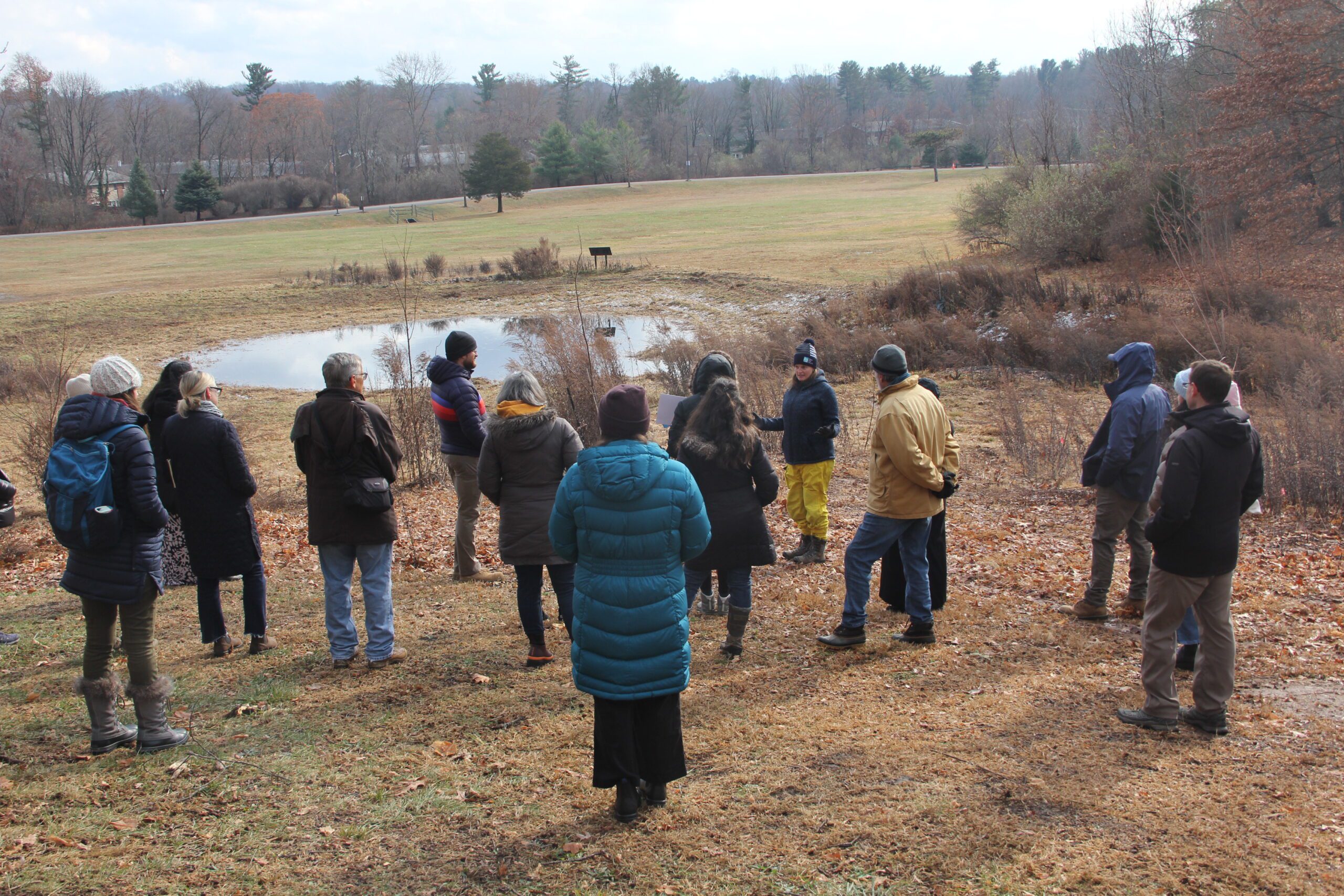
On December 5, 2024, the Sustainable and Resilient Communities (SRC) team of the Long Island Sound Study hosted a field trip featuring the Town of Hamden’s Bioretention Project – the largest municipally owned rain garden in the state! Participants began with a guided tour of the rain garden and bioretention areas at Town Center Park, where they heard from project planners and managers about its history, partnerships, challenges, and maintenance. Following this, participants gathered at the Hamden Government Center for a working lunch and presentations on topics including UConn’s Stormwater Corps, native plants, project engineering, and using nature-based solutions to advance climate resilience goals. The day concluded with a lively group discussion. Special thanks to our partners with the Town of Hamden, Save the Sound, the Hamden Land Trust, and UConn Extension.
Photo credit: Judy Benson
Training
This field trip was part of a Community Resilience Project Showcase leading up to the 2024 Annual SRC Workshop.
Hamden Bioretention Project Tour & Workshop
On December 5, 2024, the Sustainable and Resilient Communities (SRC) team of the Long Island Sound Study hosted a field trip featuring the Town of Hamden’s Bioretention Project – the largest municipally owned rain garden in the state! Participants began with a guided tour of the rain garden and bioretention areas at Town Center Park, where they heard from project planners and managers about its history, partnerships, challenges, and maintenance. Following this, participants gathered at the Hamden Government Center for a working lunch and presentations on topics including UConn’s Stormwater Corps, native plants, project engineering, and using nature-based solutions to advance climate resilience goals. The day concluded with a lively group discussion. Special thanks to our partners with the Town of Hamden, Save the Sound, the Hamden Land Trust, and UConn Extension.
Photo credit: Judy Benson
Funding
: Jun 15, 2026
max $150K
Resilient Forestry Practices Grant
Municipally-owned woodlands play a vital role in supporting well-functioning natural systems and a high quality of life for Connecticut residents. They improve air and water quality, support a variety of plant and wildlife species, strengthen landscape health and resilience, and provide recreational and other community benefits. These forests, however, face growing threats to their health from pests, diseases, invasive species, extreme weather events, and other stressors. Many of these stressors and threats can be managed or mitigated through resilient forestry practices.
With support from the Inflation Reduction Act, CT DEEP’s Urban and Community Forestry (UCF) Program has $1 million available to help rural communities in Connecticut implement resilient forestry practices.
Federally recognized tribes or rural municipalities with a population less than 50,000 are eligible. Because practices must be supported by an appropriate level of forest planning, a forest management or stewardship plan completed by a Connecticut-certified forester is required for funding. Potential applicants who do not currently have a forest management plan or whose plan does not include eligible resilient forestry practices may still apply for funding by working with a CT DEEP Service Forester to develop a Practice Plan prior to applying.
Funding
: Jun 15, 2026
max $150K
Resilient Forestry Practices Grant
Municipally-owned woodlands play a vital role in supporting well-functioning natural systems and a high quality of life for Connecticut residents. They improve air and water quality, support a variety of plant and wildlife species, strengthen landscape health and resilience, and provide recreational and other community benefits. These forests, however, face growing threats to their health from pests, diseases, invasive species, extreme weather events, and other stressors. Many of these stressors and threats can be managed or mitigated through resilient forestry practices.
With support from the Inflation Reduction Act, CT DEEP’s Urban and Community Forestry (UCF) Program has $1 million available to help rural communities in Connecticut implement resilient forestry practices.