

Resources for
mitigation
Guidance Tool
Level of Effort:
Climate Action Tool
The 2025 expansion of the Climate Action Tool (CAT) allows you to:
1) Access information on climate impacts and vulnerability of species and habitats; and
2) Explore adaptation strategies and actions, related to connectivity, conservation planning, and forestry, among other relevant areas.
This tool was developed by the Northeast Climate Adaptation Science Center and the University of Massachusetts Amherst (UMass) Center for Agriculture, Food, and the Environment.
Guidance Tool
Level of Effort:
Climate Action Tool
The 2025 expansion of the Climate Action Tool (CAT) allows you to:
1) Access information on climate impacts and vulnerability of species and habitats; and
2) Explore adaptation strategies and actions, related to connectivity, conservation planning, and forestry, among other relevant areas.
This tool was developed by the Northeast Climate Adaptation Science Center and the University of Massachusetts Amherst (UMass) Center for Agriculture, Food, and the Environment.
Funding
: Mar 13 – Jun 1, 2026
Port Infrastructure Development Program
The Maritime Administration’s 2026 Port Infrastructure Development Program (PIDP) Discretionary Grant Opportunity Notice of Funding Opportunity announced $488,628,000 in available funding for FY26. PIDP grants support efforts by ports and industry stakeholders to improve port and related freight infrastructure to meet the nation’s freight transportation needs and ensure our port infrastructure can meet anticipated growth in freight volumes.
Eligible projects are within the boundary of a port, or outside the boundary of a port and directly related to port operations or to an intermodal connection to a port that improve the safety, efficiency, or reliability of: 1) The loading and unloading of goods at a port; 2) The movement of goods into, out of, around, or within a port; 3) Operational improvements at a port; 4) Resiliency in response to environmental factors; or 5) Infrastructure that supports seafood and seafood-related businesses.
Funding
: Mar 13 – Jun 1, 2026
Port Infrastructure Development Program
The Maritime Administration’s 2026 Port Infrastructure Development Program (PIDP) Discretionary Grant Opportunity Notice of Funding Opportunity announced $488,628,000 in available funding for FY26. PIDP grants support efforts by ports and industry stakeholders to improve port and related freight infrastructure to meet the nation’s freight transportation needs and ensure our port infrastructure can meet anticipated growth in freight volumes.
Funding
: Apr 8 – May 8, 2026
Over $2.3M available, divided by region
Connecticut Wetland In-Lieu Fee Program Grant
Audubon Connecticut’s 2026 Request for Letters of Intent is now open. Local organizations including land trusts, universities, environmental nonprofits, and state agencies are invited to submit a short letter of intent for grant funding to protect and enhance wetlands. The Connecticut Wetland In-Lieu Fee (ILF) Program has accrued funds that are now available for the preservation, restoration, and enhancement of wetland and watercourse resources and associated upland buffers in the State of Connecticut. The National Audubon Society, Inc., through its state office, Audubon Connecticut, is the “sponsor” of Connecticut’s ILF program. The program allows permittees to pay a fee in lieu of taking on mitigation themselves. Instead, local organizations like land trusts, and other environmental nonprofits, are given the opportunity to apply for and receive grant funding for the preservation, restoration, and enhancement of wetland and watercourse resources and associated upland buffers in the State of Connecticut.
Restoration and enhancement projects are strongly encouraged and will likely score and rank higher than preservation-only projects. For restoration and enhancement projects, consultation with qualified professionals is recommended. See the Request for Letters of Intent at the link for details.
Funding
: Apr 8 – May 8, 2026
Over $2.3M available, divided by region
Connecticut Wetland In-Lieu Fee Program Grant
Audubon Connecticut’s 2026 Request for Letters of Intent is now open. Local organizations including land trusts, universities, environmental nonprofits, and state agencies are invited to submit a short letter of intent for grant funding to protect and enhance wetlands. The Connecticut Wetland In-Lieu Fee (ILF) Program has accrued funds that are now available for the preservation, restoration, and enhancement of wetland and watercourse resources and associated upland buffers in the State of Connecticut. The National Audubon Society, Inc., through its state office, Audubon Connecticut, is the “sponsor” of Connecticut’s ILF program. The program allows permittees to pay a fee in lieu of taking on mitigation themselves. Instead, local organizations like land trusts, and other environmental nonprofits, are given the opportunity to apply for and receive grant funding for the preservation, restoration, and enhancement of wetland and watercourse resources and associated upland buffers in the State of Connecticut.
Funding
: Mar 25 – May 22, 2026
FY24 & 25 Building Resilient Infrastructure and Communities Grants (BRIC) – New York
The Federal Emergency Management Agency (FEMA) Building Resilient Infrastructure and Communities (BRIC) grant program makes federal funds available to states, U.S. territories, federally recognized tribal governments, and local governments for hazard mitigation activities. It does so by recognizing the need to upgrade and modernize the nation’s infrastructure against the growing risks to communities and the need for natural hazard risk mitigation activities that promote resilience with respect to natural hazards. $1B total is available.
The New York State Division of Homeland Security and Emergency Services (DHSES) is pleased to announce the availability of the Federal Emergency Management Agency (FEMA) Fiscal Year 2024 & 2025 Building Resilient Infrastructure and Communities (BRIC) funding opportunity. Subapplications are due, submitted within FEMAGO (FEMAGO – Login), no later than May 22nd, 2026.
Prioritizes comprehensive, long-term risk reduction strategies that improve public infrastructure, mitigate risk to one or more community lifelines, and support adoption and enforcement of improved/modernized building codes. The following project types are eligible: construction, scoping, planning related activities. Communities and local governments can apply as subapplicants or subawardees. There have been a number of significant changes made to eligibility, documentation requirements, maximum project funding amounts, and terms and conditions within this federal Notice of Funding Opportunity (NOFO) compared to previous years, please read through the NOFO carefully. If you have any questions about the above noted funding opportunity, please send them via email to hazardmitigation@dhses.ny.gov.
Funding
: Mar 25 – May 22, 2026
FY24 & 25 Building Resilient Infrastructure and Communities Grants (BRIC) – New York
The Federal Emergency Management Agency (FEMA) Building Resilient Infrastructure and Communities (BRIC) grant program makes federal funds available to states, U.S. territories, federally recognized tribal governments, and local governments for hazard mitigation activities. It does so by recognizing the need to upgrade and modernize the nation’s infrastructure against the growing risks to communities and the need for natural hazard risk mitigation activities that promote resilience with respect to natural hazards. $1B total is available.
The New York State Division of Homeland Security and Emergency Services (DHSES) is pleased to announce the availability of the Federal Emergency Management Agency (FEMA) Fiscal Year 2024 & 2025 Building Resilient Infrastructure and Communities (BRIC) funding opportunity. Subapplications are due, submitted within FEMAGO (FEMAGO – Login), no later than May 22nd, 2026.
Funding
: Mar 25 – Jul 1, 2026
max $1-$25M depending on category
FY24 & 25 Building Resilient Infrastructure and Communities Grants (BRIC) – Connecticut
The Federal Emergency Management Agency (FEMA) Building Resilient Infrastructure and Communities (BRIC) grant program makes federal funds available to states, U.S. territories, federally recognized tribal governments, and local governments for hazard mitigation activities. It does so by recognizing the need to upgrade and modernize the nation’s infrastructure against the growing risks to communities and the need for natural hazard risk mitigation activities that promote resilience with respect to natural hazards. $1B total is available.
CT DEMHS is pleased to announce that the application period is now open for the Fiscal Year (FY) 2024/2025 BRIC grant program under the FEMA Hazard Mitigation Assistance Program. All sub-applications must be submitted to the State via the FEMA GO system no later than July 1, 2026. DEMHS will host weekly office hours via Microsoft Teams for application assistance. Please contact DEMHS.HMGP@ct.gov with any project-specific questions or to discuss your application strategy under the new requirements.
FEMA has introduced major programmatic shifts this cycle, strictly prioritizing construction-ready physical infrastructure. Federal Program Priorities include: Activities that incentivize natural hazard risk reduction activities that mitigate risk to public infrastructure; Activities that prioritize benefits to disadvantaged communities; Activities that incorporate nature-based solutions; Activities that enhance climate resilience and adaptation; Activities that facilitate the adoption and enforcement of the latest published editions of building codes.
Funding
: Mar 25 – Jul 1, 2026
max $1-$25M depending on category
FY24 & 25 Building Resilient Infrastructure and Communities Grants (BRIC) – Connecticut
The Federal Emergency Management Agency (FEMA) Building Resilient Infrastructure and Communities (BRIC) grant program makes federal funds available to states, U.S. territories, federally recognized tribal governments, and local governments for hazard mitigation activities. It does so by recognizing the need to upgrade and modernize the nation’s infrastructure against the growing risks to communities and the need for natural hazard risk mitigation activities that promote resilience with respect to natural hazards. $1B total is available.
CT DEMHS is pleased to announce that the application period is now open for the Fiscal Year (FY) 2024/2025 BRIC grant program under the FEMA Hazard Mitigation Assistance Program. All sub-applications must be submitted to the State via the FEMA GO system no later than July 1, 2026. DEMHS will host weekly office hours via Microsoft Teams for application assistance. Please contact DEMHS.HMGP@ct.gov with any project-specific questions or to discuss your application strategy under the new requirements.
Funding
: Mar 6 – Apr 6, 2026
typically $100K-$2M
FY27 Congressionally Directed Spending / Community Project Funding
Congressionally Directed Spending requests, also known as Community Project Funding or Earmarks, are funding requests for high-impact, Connecticut-based projects that can be completed with assistance from the federal government. In Connecticut, applications go through the offices of Senator Blumenthal and Senator Murphy. The project must meet the eligibility requirements for at least one of the accounts listed.
Please note, you only need to submit one application for each project and it will be sent to both offices. Requests may be made for the following bills: 1) Agriculture, Rural Development, Food and Drug Administration, and Related Agencies; 2) Commerce, Justice, Science, and Related Agencies; 3) Energy and Water Development; 4) Financial Services and General Government; 5) Homeland Security; 6) Interior, Environment, and Related Agencies; 7) Labor, Health, and Human Services, Education, and Related Agencies; 8) Transportation, Housing and Urban Development, and Related Agencies; 9) Military Construction, Veteran Affairs, and Related Agencies.
Funding
: Mar 6 – Apr 6, 2026
typically $100K-$2M
FY27 Congressionally Directed Spending / Community Project Funding
Congressionally Directed Spending requests, also known as Community Project Funding or Earmarks, are funding requests for high-impact, Connecticut-based projects that can be completed with assistance from the federal government. In Connecticut, applications go through the offices of Senator Blumenthal and Senator Murphy. The project must meet the eligibility requirements for at least one of the accounts listed.
Funding
: Sep 19 – Apr 30, 2026
max $100K
Climate-Smart Forest Stewardship Grant Program
CLCC’s Climate-Smart Forest Stewardship Grant Program is a new initiative that enables land trusts to take care of their forests. To help land trusts face these challenges, CLCC will provide funding for land trusts that integrate climate mitigation, resilience, and adaptation strategies into their long-term forest stewardship.
Projects must take place in a USFS-defined rural area. Applicants must be current members of CLCC. Interested applicants must have an initial conversation with CLCC to discuss project eligibility. Site visits are strongly encouraged prior to submitting an application.
Funding
: Sep 19 – Apr 30, 2026
max $100K
Climate-Smart Forest Stewardship Grant Program
CLCC’s Climate-Smart Forest Stewardship Grant Program is a new initiative that enables land trusts to take care of their forests. To help land trusts face these challenges, CLCC will provide funding for land trusts that integrate climate mitigation, resilience, and adaptation strategies into their long-term forest stewardship.
Funding
: Jun 16 – Jul 25, 2025
Over $2.3M available, divided by region
Connecticut Wetland In-Lieu Fee Program Grant
The Connecticut Wetland In-Lieu Fee (ILF) Program has accrued sufficient funds that are now available for the preservation, restoration, and enhancement of wetland and watercourse resources and associated upland buffers in the State of Connecticut. The National Audubon Society, Inc., through its state office, Audubon Connecticut, is the “sponsor” of Connecticut’s ILF program. The program allows permittees to pay a fee in lieu of taking on mitigation themselves. Instead, local organizations like land trusts, and other environmental nonprofits, are given the opportunity to apply for and receive grant funding for the preservation, restoration, and enhancement of wetland and watercourse resources and associated upland buffers in the State of Connecticut.
Restoration and enhancement projects are strongly encouraged and will likely score and rank higher than preservation projects. For restoration and enhancement projects, consultation with qualified professionals is recommended. See the Request for Letters of Intent at the link for details.
Funding
: Jun 16 – Jul 25, 2025
Over $2.3M available, divided by region
Connecticut Wetland In-Lieu Fee Program Grant
The Connecticut Wetland In-Lieu Fee (ILF) Program has accrued sufficient funds that are now available for the preservation, restoration, and enhancement of wetland and watercourse resources and associated upland buffers in the State of Connecticut. The National Audubon Society, Inc., through its state office, Audubon Connecticut, is the “sponsor” of Connecticut’s ILF program. The program allows permittees to pay a fee in lieu of taking on mitigation themselves. Instead, local organizations like land trusts, and other environmental nonprofits, are given the opportunity to apply for and receive grant funding for the preservation, restoration, and enhancement of wetland and watercourse resources and associated upland buffers in the State of Connecticut.
Funding
: Apr 17 – Apr 27, 2025
FY26 Congressionally Directed Spending / Community Project Funding (Sen. Blumenthal & Sen. Murphy)
Congressionally Directed Spending requests, also known as Community Project Funding or Earmarks, are funding requests for high-impact, Connecticut-based projects that can be completed with assistance from the federal government. The project must meet the eligibility requirements for at least one of the accounts listed.
Please note, you only need to submit one application for each project and it will be sent to both offices. Requests may be made for the following bills: 1) Agriculture, Rural Development, Food and Drug Administration, and Related Agencies; 2) Commerce, Justice, Science and Related Agencies; 3) Energy and Water Development, and Related Agencies; 4) Financial Services and General Government; 5) Homeland Security; 6) Interior, Environment, and Related Agencies; 7) Labor, Health, and Human Services, Education, and Related Agencies; 8) Transportation, Housing and Urban Development, and Related Agencies; 9) Military Construction and Veteran Affairs.
Funding
: Apr 17 – Apr 27, 2025
FY26 Congressionally Directed Spending / Community Project Funding (Sen. Blumenthal & Sen. Murphy)
Congressionally Directed Spending requests, also known as Community Project Funding or Earmarks, are funding requests for high-impact, Connecticut-based projects that can be completed with assistance from the federal government. The project must meet the eligibility requirements for at least one of the accounts listed.
Funding
: Sep 19, 2026
FEMA Flood Mitigation Assistance Swift Current FY 2026
FEMA’s Fiscal Year 2026 Flood Mitigation Assistance Swift Current provides $600 million to mitigate flood risks for properties insured through the National Flood Insurance Program (NFIP) after a flood-related, major disaster declaration. The local government is considered the subapplicant and will develop a subapplication with any interested property owners. Application deadlines vary by state.
FEMA will accept applications upon activation for major disaster declarations of flood-related events that occurred between June 1, 2025, and May 31, 2027. Eligible project types include: Property acquisition and structure demolition or relocation; Structure elevation; Dry floodproofing of historic residential buildings or non-residential structures; Non-structural retrofitting of existing structures and facilities; Mitigation reconstruction; and Structural retrofitting of existing structures.
Funding
: Sep 19, 2026
FEMA Flood Mitigation Assistance Swift Current FY 2026
FEMA’s Fiscal Year 2026 Flood Mitigation Assistance Swift Current provides $600 million to mitigate flood risks for properties insured through the National Flood Insurance Program (NFIP) after a flood-related, major disaster declaration. The local government is considered the subapplicant and will develop a subapplication with any interested property owners. Application deadlines vary by state.
SRC Training
This field trip was part of a Community Resilience Project Showcase leading up to the 2024 Annual SRC Workshop.
Hamden Bioretention Project Tour & Workshop
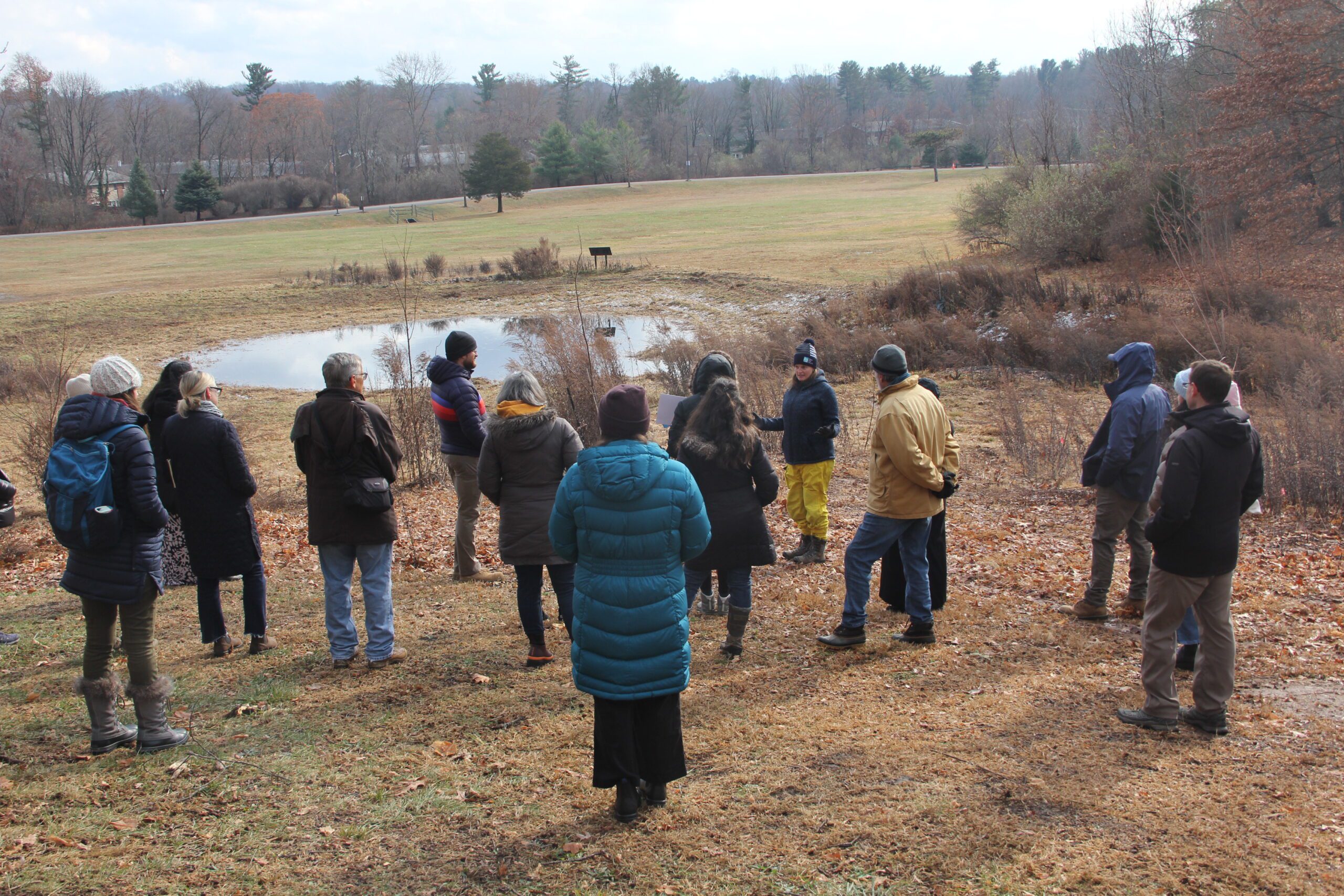 On December 5, 2024, the Sustainable and Resilient Communities (SRC) team of the Long Island Sound Study hosted a field trip featuring the Town of Hamden’s Bioretention Project – the largest municipally owned rain garden in the state! Participants began with a guided tour of the rain garden and bioretention areas at Town Center Park, where they heard from project planners and managers about its history, partnerships, challenges, and maintenance. Following this, participants gathered at the Hamden Government Center for a working lunch and presentations on topics including UConn’s Stormwater Corps, native plants, project engineering, and using nature-based solutions to advance climate resilience goals. The day concluded with a lively group discussion. Special thanks to our partners with the Town of Hamden, Save the Sound, the Hamden Land Trust, and UConn Extension.
Photo credit: Judy Benson




SRC Training
This field trip was part of a Community Resilience Project Showcase leading up to the 2024 Annual SRC Workshop.
Hamden Bioretention Project Tour & Workshop
On December 5, 2024, the Sustainable and Resilient Communities (SRC) team of the Long Island Sound Study hosted a field trip featuring the Town of Hamden’s Bioretention Project – the largest municipally owned rain garden in the state! Participants began with a guided tour of the rain garden and bioretention areas at Town Center Park, where they heard from project planners and managers about its history, partnerships, challenges, and maintenance. Following this, participants gathered at the Hamden Government Center for a working lunch and presentations on topics including UConn’s Stormwater Corps, native plants, project engineering, and using nature-based solutions to advance climate resilience goals. The day concluded with a lively group discussion. Special thanks to our partners with the Town of Hamden, Save the Sound, the Hamden Land Trust, and UConn Extension.
Photo credit: Judy Benson
Funding
: Jul 1 – Aug 30, 2024
$250K - $500K
Environmental Justice Data Fund
The second round of grantmaking for the Environmental Justice Data Fund (EJDF) will be supported by a $4 million fund. The EJDF aims to help frontline communities historically underserved and disproportionately impacted by climate change and environmental injustice in the United States use data to address environmental hazards, with special attention to matters regarding air and water quality. The EJDF will support eligible organizations to unlock resources, increase their access to federal infrastructure funding, and advocate for new policies that empower communities to address past environmental harm and pave the way to a more sustainable, climate-resilient future.
The fund aims to provide one-time flexible project support for data projects that: 1) range from building organizational capacity for data work to implementing research and data; 2) may involve research planning, scenario planning, data collection, data analysis, and/or data visualization, or other activities; 3) will use data work to mitigate past environmental harm and promote climate resilience (preference will be given to projects that work on air and water quality); and 4) serve communities that have been historically underserved and disproportionately impacted by climate change and environmental injustice, including Black, Latino/a/x/e, Indigenous, Tribal, Southern, rural, and low-income communities.
Funding
: Jul 1 – Aug 30, 2024
$250K - $500K
Environmental Justice Data Fund
The second round of grantmaking for the Environmental Justice Data Fund (EJDF) will be supported by a $4 million fund. The EJDF aims to help frontline communities historically underserved and disproportionately impacted by climate change and environmental injustice in the United States use data to address environmental hazards, with special attention to matters regarding air and water quality. The EJDF will support eligible organizations to unlock resources, increase their access to federal infrastructure funding, and advocate for new policies that empower communities to address past environmental harm and pave the way to a more sustainable, climate-resilient future.
Funding
: Jul 18 – Sep 30, 2024
$2,000 - $50,000
Climate & Equity Grants 2024
In collaboration with CT Department of Energy and Environmental Protection (DEEP), the Connecticut Institute for Resilience and Climate Adaptation (CIRCA) requests grant proposals for projects that increase the capacity of vulnerable communities to mitigate, plan for, and respond to climate change impacts. This funding supports the recommendations of the Governor’s Council on Climate Change (GC3).
Funds can be used for planning, capacity-building, or education projects that advance community-scale climate adaptation and/or climate mitigation efforts. This year, for the first time, additional funding is available to support participation from community-based organizations in state climate planning meetings.
Funding
: Jul 18 – Sep 30, 2024
$2,000 - $50,000
Climate & Equity Grants 2024
In collaboration with CT Department of Energy and Environmental Protection (DEEP), the Connecticut Institute for Resilience and Climate Adaptation (CIRCA) requests grant proposals for projects that increase the capacity of vulnerable communities to mitigate, plan for, and respond to climate change impacts. This funding supports the recommendations of the Governor’s Council on Climate Change (GC3).
Report
Level of Effort:
The Fifth National Climate Assessment
The Fifth National Climate Assessment is the US Government’s preeminent report on climate change impacts, risks, and responses. It is a congressionally mandated interagency effort that provides the scientific foundation to support informed decision-making across the United States.
Report
Level of Effort:
The Fifth National Climate Assessment
The Fifth National Climate Assessment is the US Government’s preeminent report on climate change impacts, risks, and responses. It is a congressionally mandated interagency effort that provides the scientific foundation to support informed decision-making across the United States.
Funding
: Feb 28 – May 17, 2024
$500,000 min
2024 Transportation Alternatives Program
This program provides funding for a variety of transportation projects such as pedestrian and bicycle facilities; construction of turnouts, overlooks, and viewing areas; community improvements such as historic preservation and vegetation management; environmental mitigation related to stormwater and habitat connectivity; recreational trails; safe routes to school projects; and vulnerable road user safety assessments.
These funds are made available to the State through partnership with the Federal Highway Administration (FHWA). The New Haven Urbanized Area alone is expected to receive $7.3 million between FFY 2026 and FFY 2030. To learn more and apply, please review the program application and solicitation memo attached. Applications must be submitted to Jim Rode at SCRCOG via email: jrode@scrcog.org by May 17, 2024. Project applications will be reviewed and ranked based on criteria provided by CT DOT. A prioritized list will be reviewed and finalized at the Transportation Committee meeting on June 12, 2024. Approval of the prioritized list of projects will be on the Board Meeting agenda on June 26, 2024.
Funding
: Feb 28 – May 17, 2024
$500,000 min
2024 Transportation Alternatives Program
This program provides funding for a variety of transportation projects such as pedestrian and bicycle facilities; construction of turnouts, overlooks, and viewing areas; community improvements such as historic preservation and vegetation management; environmental mitigation related to stormwater and habitat connectivity; recreational trails; safe routes to school projects; and vulnerable road user safety assessments.
Report
Level of Effort:
Zoning Strategies to Reduce Pollution of Inland Waters and Resultant Hypoxia of Long Island Sound
WEST COG developed this riparian zoning publication that is primarily focused on water quality, but also is highly relevant to climate mitigation.
Report
Level of Effort:
Zoning Strategies to Reduce Pollution of Inland Waters and Resultant Hypoxia of Long Island Sound
WEST COG developed this riparian zoning publication that is primarily focused on water quality, but also is highly relevant to climate mitigation.
Guidance Tool
Level of Effort:
Federal Flood Mitigation Funding Program Cheat Sheet
This resource outlines six different federal mitigation funding programs. It provides an overview of available options and links to learn more information and apply.
Guidance Tool
Level of Effort:
Federal Flood Mitigation Funding Program Cheat Sheet
This resource outlines six different federal mitigation funding programs. It provides an overview of available options and links to learn more information and apply.
Funding
: Mar 11 – Apr 14, 2024
FY25 Congressionally Directed Spending / Community Project Funding (Sen. Blumenthal & Sen. Murphy)
Congressionally Directed Spending requests, also known as Community Project Funding or Earmarks, are funding requests for high-impact, Connecticut-based projects that can be completed with assistance from the federal government. The project must meet the eligibility requirements for at least one of the accounts listed.
Please note, you only need to submit one application for each project and it will be sent to both offices. Requests may be made for the following bills: 1) Agriculture, Rural Development, Food and Drug Administration, and Related Agencies; 2) Commerce, Justice, Science and Related Agencies; 3) Energy and Water Development, and Related Agencies; 4) Financial Services and General Government; 5) Homeland Security; 6) Interior, Environment, and Related Agencies; 7) Labor, Health, and Human Services, Education, and Related Agencies; 8) Transportation, Housing and Urban Development, and Related Agencies.
Funding
: Mar 11 – Apr 14, 2024
FY25 Congressionally Directed Spending / Community Project Funding (Sen. Blumenthal & Sen. Murphy)
Congressionally Directed Spending requests, also known as Community Project Funding or Earmarks, are funding requests for high-impact, Connecticut-based projects that can be completed with assistance from the federal government. The project must meet the eligibility requirements for at least one of the accounts listed.