

Resources for
runoff
Report
Level of Effort:
Building Urban Flood Resilience with Ecosystem Services
This report from the Liberty Mutual Climate Transition Center and the Boston College Center for Corporate Citizenship examines how nature-based solutions can help communities reduce urban flood risk while improving long-term resilience. It offers recommendations for businesses, policymakers, and communities seeking to better manage flood risk. The report makes a case for corporate participation and emphasizes innovative strategies from nature-based solutions to financial investment mechanisms.
Report
Level of Effort:
Building Urban Flood Resilience with Ecosystem Services
This report from the Liberty Mutual Climate Transition Center and the Boston College Center for Corporate Citizenship examines how nature-based solutions can help communities reduce urban flood risk while improving long-term resilience. It offers recommendations for businesses, policymakers, and communities seeking to better manage flood risk. The report makes a case for corporate participation and emphasizes innovative strategies from nature-based solutions to financial investment mechanisms.
Story Map
Level of Effort:
Long Island Sound Lawn Fertilizer Outreach Targeting Tool
Nitrogen (N) from residential lawn fertilizer is one of the most challenging and persistent problems impacting the health of Long Island Sound (LIS). An interdisciplinary team of researchers from Clark University, the University of Connecticut, the University of Maryland, and the University of Miami collaborated on an effort to better target education and outreach campaigns to reduce the use of lawn fertilizer in areas of greatest impact.
This Story Map and the associated Lawn Fertilizer Outreach Targeting Tool can help identify areas of the watershed for which interventions to reduce lawn fertilizer may have greater impacts.
Story Map
Level of Effort:
Long Island Sound Lawn Fertilizer Outreach Targeting Tool
Nitrogen (N) from residential lawn fertilizer is one of the most challenging and persistent problems impacting the health of Long Island Sound (LIS). An interdisciplinary team of researchers from Clark University, the University of Connecticut, the University of Maryland, and the University of Miami collaborated on an effort to better target education and outreach campaigns to reduce the use of lawn fertilizer in areas of greatest impact.
This Story Map and the associated Lawn Fertilizer Outreach Targeting Tool can help identify areas of the watershed for which interventions to reduce lawn fertilizer may have greater impacts.
Funding
: Oct 23 – Nov 21, 2025
$200,000-500,000
National Estuary Program Watersheds Grant Program
The National Estuary Program (NEP) Watersheds Grant Program is a nationally competitive grants addressing the most pressing threats to estuarine health within the 28 NEP boundary areas. This program is offered through Restore America’s Estuaries, with funding from the U.S. EPA.
Program priorities include: 1) Habitat loss (wetlands, seagrass, mangroves, reefs), 2) Coastal resilience and sea level rise, 3) Nutrient pollution, 4) Stormwater impacts and erosion, and 5) Invasive species and marine mammal mortalities.
Funding
: Oct 23 – Nov 21, 2025
$200,000-500,000
National Estuary Program Watersheds Grant Program
The National Estuary Program (NEP) Watersheds Grant Program is a nationally competitive grants addressing the most pressing threats to estuarine health within the 28 NEP boundary areas. This program is offered through Restore America’s Estuaries, with funding from the U.S. EPA.
Funding
: Oct 1 – Dec 16, 2025
$100K - $1.5M
CT DEEP Long Island Sound Ecosystems Grant
The Connecticut Department of Energy and Environmental Protection’s (DEEP’s) Land and Water Resources Division requests proposals for the new CT DEEP Long Island Sound Ecosystems Grant, made possible by financial support provided by the Long Island Sound Partnership from the U.S. EPA. There are two primary goals of the program: 1) to promote large-scale habitat restoration and enhance restoration planning, while also helping coastal communities and ecosystems adapt to changing environmental conditions; and 2) to further promote the application of green stormwater infrastructure techniques to reduce nonpoint source pollution, improving water resource quality.
There is approximately $7 million available, and no match is required. Eligible projects include: 1) Habitat Restoration (planning/engineering/design and construction for habitat restoration projects); and 2) Green Stormwater Infrastructure (planning/engineering/design and construction for green stormwater infrastructure projects).
Funding
: Oct 1 – Dec 16, 2025
$100K - $1.5M
CT DEEP Long Island Sound Ecosystems Grant
The Connecticut Department of Energy and Environmental Protection’s (DEEP’s) Land and Water Resources Division requests proposals for the new CT DEEP Long Island Sound Ecosystems Grant, made possible by financial support provided by the Long Island Sound Partnership from the U.S. EPA. There are two primary goals of the program: 1) to promote large-scale habitat restoration and enhance restoration planning, while also helping coastal communities and ecosystems adapt to changing environmental conditions; and 2) to further promote the application of green stormwater infrastructure techniques to reduce nonpoint source pollution, improving water resource quality.
SRC Training
This field trip was part of a Community Resilience Project Showcase leading up to the 2024 Annual SRC Workshop.
Hamden Bioretention Project Tour & Workshop
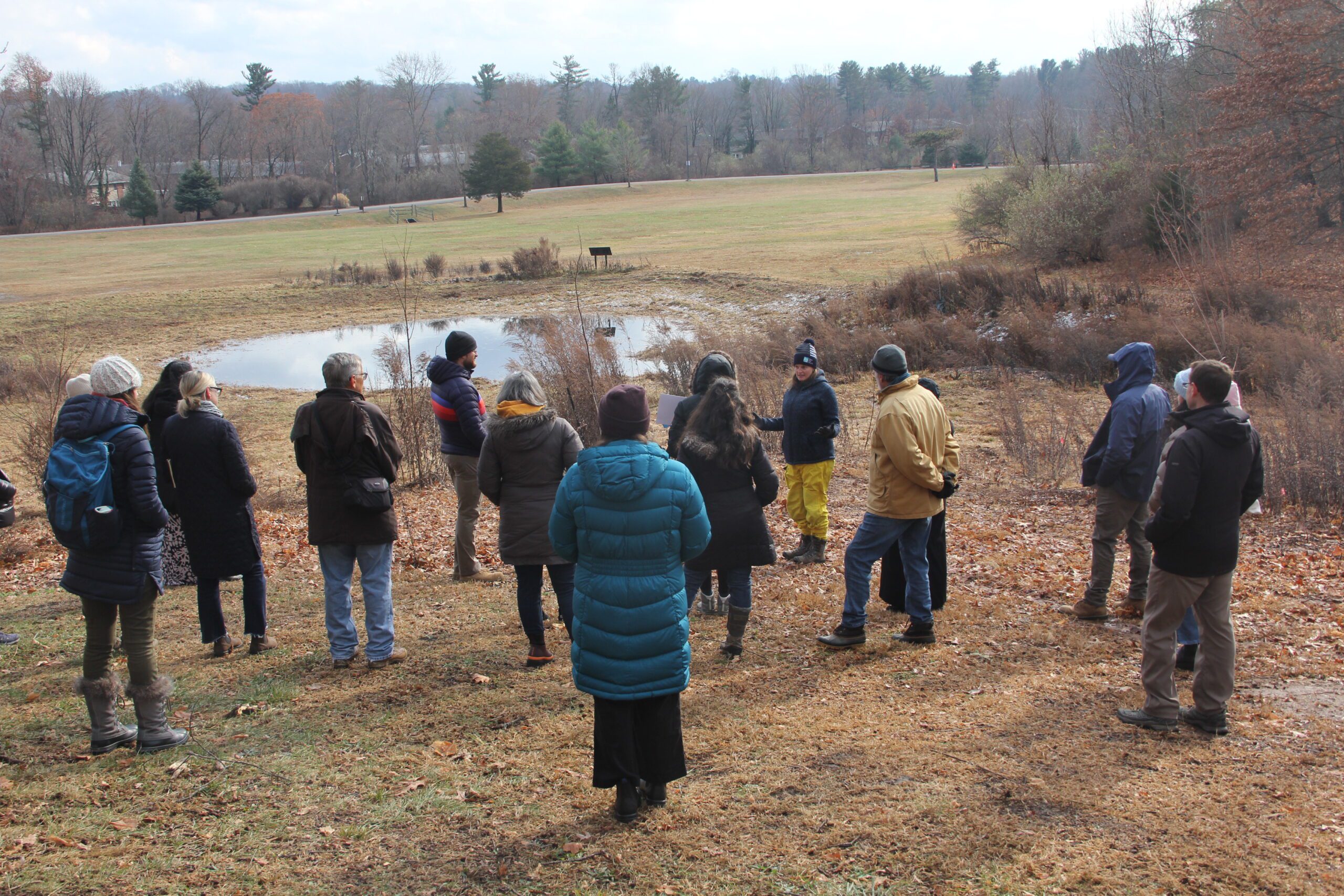 On December 5, 2024, the Sustainable and Resilient Communities (SRC) team of the Long Island Sound Study hosted a field trip featuring the Town of Hamden’s Bioretention Project – the largest municipally owned rain garden in the state! Participants began with a guided tour of the rain garden and bioretention areas at Town Center Park, where they heard from project planners and managers about its history, partnerships, challenges, and maintenance. Following this, participants gathered at the Hamden Government Center for a working lunch and presentations on topics including UConn’s Stormwater Corps, native plants, project engineering, and using nature-based solutions to advance climate resilience goals. The day concluded with a lively group discussion. Special thanks to our partners with the Town of Hamden, Save the Sound, the Hamden Land Trust, and UConn Extension.
Photo credit: Judy Benson




SRC Training
This field trip was part of a Community Resilience Project Showcase leading up to the 2024 Annual SRC Workshop.
Hamden Bioretention Project Tour & Workshop
On December 5, 2024, the Sustainable and Resilient Communities (SRC) team of the Long Island Sound Study hosted a field trip featuring the Town of Hamden’s Bioretention Project – the largest municipally owned rain garden in the state! Participants began with a guided tour of the rain garden and bioretention areas at Town Center Park, where they heard from project planners and managers about its history, partnerships, challenges, and maintenance. Following this, participants gathered at the Hamden Government Center for a working lunch and presentations on topics including UConn’s Stormwater Corps, native plants, project engineering, and using nature-based solutions to advance climate resilience goals. The day concluded with a lively group discussion. Special thanks to our partners with the Town of Hamden, Save the Sound, the Hamden Land Trust, and UConn Extension.
Photo credit: Judy Benson
$200,000-500,000
National Estuary Program Watersheds Grant Program
The NEP Coastal Watersheds Grant Program is a nationally competitive grants program designed to support projects that address urgent and challenging issues threatening the well-being of estuaries within the 28 NEP boundary areas.
This grant program funds projects aimed at addressing the following Congressionally-set priorities: • Loss of key habitats resulting in significant impacts on fisheries and water quality such as seagrass, mangroves, tidal and freshwater wetlands, forested wetlands, kelp beds, shellfish beds, and coral reefs; • Coastal resilience and extreme weather events including flooding and coastal erosion related to sea level rise, changing precipitation, warmer waters, or salt marsh, seagrass, or wetland degradation or loss and accelerated land loss; • Impacts of nutrients and warmer water temperatures on aquatic life and ecosystems, including low dissolved oxygen conditions in estuarine waters; • Stormwater runoff which not only can erode stream banks but can carry nutrients, sediment, and trash into rivers and streams that flow into estuaries; • Recurring harmful algae blooms; • Unusual or unexplained marine mammal mortalities; and • Proliferation or invasion of species that limit recreational uses, threaten wastewater systems, or cause other ecosystem damage.
$200,000-500,000
National Estuary Program Watersheds Grant Program
The NEP Coastal Watersheds Grant Program is a nationally competitive grants program designed to support projects that address urgent and challenging issues threatening the well-being of estuaries within the 28 NEP boundary areas.
Resource
Level of Effort:
Green Stormwater Infrastructure Workbook
This workbook made by Groundwork Bridgeport provides a thorough but accessible introduction to green stormwater infrastructure. The workbook explains the issues that green infrastructure can help solve, introduces several green infrastructure methods, and then provides definitions, explains why each is uses, and details how to build them.
Resource
Level of Effort:
Green Stormwater Infrastructure Workbook
This workbook made by Groundwork Bridgeport provides a thorough but accessible introduction to green stormwater infrastructure. The workbook explains the issues that green infrastructure can help solve, introduces several green infrastructure methods, and then provides definitions, explains why each is uses, and details how to build them.