

Resources for
Shellfish
Funding
: Aug 1 – Sep 15, 2026
$1,000 - $4,000
Grow Grants Program
The New England Grassroots Environment Fund awards small grants in support of grassroots efforts and community-based environmental work in New England. The GROW GRANTS program is actively accepting applications from grassroots groups across New England. These grants fund small, volunteer-driven groups in New England working on issues including food access, immigrant support, climate resilience, youth work, mutual aid, and more. This program is geared toward groups with experience organizing in their community and have at least THREE leaders who are actively involved in group decision-making. Grants support groups to deepen their work by further developing a community vision, lowering barriers to participation, identifying new stakeholders, and working to bring more voices and lived experiences into core decision-making processes.
Grow grants prioritize support for community groups who represent a broad range of voices in their community and who are not being reached by other funders. The Grassroots Fund interprets the word 'environment' broadly and provides funding for a wide range of activities.
Funding
: Aug 1 – Sep 15, 2026
$1,000 - $4,000
Grow Grants Program
The New England Grassroots Environment Fund awards small grants in support of grassroots efforts and community-based environmental work in New England. The GROW GRANTS program is actively accepting applications from grassroots groups across New England. These grants fund small, volunteer-driven groups in New England working on issues including food access, immigrant support, climate resilience, youth work, mutual aid, and more. This program is geared toward groups with experience organizing in their community and have at least THREE leaders who are actively involved in group decision-making. Grants support groups to deepen their work by further developing a community vision, lowering barriers to participation, identifying new stakeholders, and working to bring more voices and lived experiences into core decision-making processes.
Funding
: Oct 23 – Nov 21, 2025
$200,000-500,000
National Estuary Program Watersheds Grant Program
The National Estuary Program (NEP) Watersheds Grant Program is a nationally competitive grants addressing the most pressing threats to estuarine health within the 28 NEP boundary areas. This program is offered through Restore America’s Estuaries, with funding from the U.S. EPA.
Program priorities include: 1) Habitat loss (wetlands, seagrass, mangroves, reefs), 2) Coastal resilience and sea level rise, 3) Nutrient pollution, 4) Stormwater impacts and erosion, and 5) Invasive species and marine mammal mortalities.
Funding
: Oct 23 – Nov 21, 2025
$200,000-500,000
National Estuary Program Watersheds Grant Program
The National Estuary Program (NEP) Watersheds Grant Program is a nationally competitive grants addressing the most pressing threats to estuarine health within the 28 NEP boundary areas. This program is offered through Restore America’s Estuaries, with funding from the U.S. EPA.
Story Map
Level of Effort:
A StoryMap on Hypoxia
Success in the Urban Sea: Breathing Oxygen Back into the Long Island Sound’s Waters
This StoryMap describes how the Long Island Sound (LIS) Partnership has reduced hypoxia and improved nutrient management efforts in Long Island Sound and its watershed.
It includes an explanation of hypoxia, impacts from the region’s history, how LIS Partnership is addressing hypoxia, plans for the future, and how to use this information to inform meaningful action.
Story Map
Level of Effort:
A StoryMap on Hypoxia
Success in the Urban Sea: Breathing Oxygen Back into the Long Island Sound’s Waters
This StoryMap describes how the Long Island Sound (LIS) Partnership has reduced hypoxia and improved nutrient management efforts in Long Island Sound and its watershed.
It includes an explanation of hypoxia, impacts from the region’s history, how LIS Partnership is addressing hypoxia, plans for the future, and how to use this information to inform meaningful action.
Data
Level of Effort:
NYSDEC Division of Water Grants Data Portal
This portal contains the comprehensive dataset of awarded projects for the Water Quality Improvement Project Program (WQIP) and the Non-Agricultural Nonpoint Source Planning and MS4 Mapping Grant (NPG). Data is displayed simultaneously on a map and data table and can be filtered by Grant Program, Applicant, County, Project Type, and Funding Source.
Data
Level of Effort:
NYSDEC Division of Water Grants Data Portal
This portal contains the comprehensive dataset of awarded projects for the Water Quality Improvement Project Program (WQIP) and the Non-Agricultural Nonpoint Source Planning and MS4 Mapping Grant (NPG). Data is displayed simultaneously on a map and data table and can be filtered by Grant Program, Applicant, County, Project Type, and Funding Source.
$200,000-500,000
National Estuary Program Watersheds Grant Program
The NEP Coastal Watersheds Grant Program is a nationally competitive grants program designed to support projects that address urgent and challenging issues threatening the well-being of estuaries within the 28 NEP boundary areas.
This grant program funds projects aimed at addressing the following Congressionally-set priorities: • Loss of key habitats resulting in significant impacts on fisheries and water quality such as seagrass, mangroves, tidal and freshwater wetlands, forested wetlands, kelp beds, shellfish beds, and coral reefs; • Coastal resilience and extreme weather events including flooding and coastal erosion related to sea level rise, changing precipitation, warmer waters, or salt marsh, seagrass, or wetland degradation or loss and accelerated land loss; • Impacts of nutrients and warmer water temperatures on aquatic life and ecosystems, including low dissolved oxygen conditions in estuarine waters; • Stormwater runoff which not only can erode stream banks but can carry nutrients, sediment, and trash into rivers and streams that flow into estuaries; • Recurring harmful algae blooms; • Unusual or unexplained marine mammal mortalities; and • Proliferation or invasion of species that limit recreational uses, threaten wastewater systems, or cause other ecosystem damage.
$200,000-500,000
National Estuary Program Watersheds Grant Program
The NEP Coastal Watersheds Grant Program is a nationally competitive grants program designed to support projects that address urgent and challenging issues threatening the well-being of estuaries within the 28 NEP boundary areas.
Funding
: Oct 12, 2026
up to $1,000
Seed Grants Program
Awards small grants in support of grassroots efforts and community-based environmental work in New England. The Grassroots Fund utilizes participatory grantmaking to move resources to New England grassroots groups. Seed grants prioritize support for community groups who represent a broad range of voices in their community and who are not being reached by other funders.
The Seed grant program is geared towards groups launching new projects or starting to significantly change the direction of an existing project. Most often, groups have been working on the project less than a year and usually don't yet have much direct experience with implementing the idea. The Grassroots Fund interprets the word 'environment' broadly and provides funding for a wide range of activities.
Funding
: Oct 12, 2026
up to $1,000
Seed Grants Program
Awards small grants in support of grassroots efforts and community-based environmental work in New England. The Grassroots Fund utilizes participatory grantmaking to move resources to New England grassroots groups. Seed grants prioritize support for community groups who represent a broad range of voices in their community and who are not being reached by other funders.
Funding
: Jan 1 – Apr 15, 2023
~$1,500
EPOC 2022 Environmental Grant Program
The EPOC Grant Program provides non-profit and not-for-profit environmental advocacy groups, community based groups and environmental education organizations funding for local projects that benefit the environment.
Funding
: Jan 1 – Apr 15, 2023
~$1,500
EPOC 2022 Environmental Grant Program
The EPOC Grant Program provides non-profit and not-for-profit environmental advocacy groups, community based groups and environmental education organizations funding for local projects that benefit the environment.
Funding
: Oct 12 – Apr 12, 2023
$100,000 - $1,000,000
National Fish and Wildlife Foundation’s (NFWF) National Coastal Resilience Fund (NCRF)
NFWF will award up to $140 million in grants to create and restore natural systems in order to increase protection for communities from coastal hazards, such as storms, sea- and lake-level changes, inundation, and coastal erosion, while improving habitats for fish and wildlife species. NFWF prioritizes projects that are community led or incorporate direct community engagement and benefit underserved communities facing disproportionate harm from climate impacts.
Funding
: Oct 12 – Apr 12, 2023
$100,000 - $1,000,000
National Fish and Wildlife Foundation’s (NFWF) National Coastal Resilience Fund (NCRF)
NFWF will award up to $140 million in grants to create and restore natural systems in order to increase protection for communities from coastal hazards, such as storms, sea- and lake-level changes, inundation, and coastal erosion, while improving habitats for fish and wildlife species. NFWF prioritizes projects that are community led or incorporate direct community engagement and benefit underserved communities facing disproportionate harm from climate impacts.
Funding
: Mar 10 – May 19, 2026
$50K - $2M
Long Island Sound Futures Fund 2026
The Long Island Sound Futures Fund (LISFF) is seeking proposals to restore the health and living resources of Long Island Sound (Sound). The program is managed by National Fish and Wildlife Foundation (NFWF) in collaboration with the U.S. Environmental Protection Agency (EPA) and the Long Island Sound Partnership (LIS Partnership). Major funding is from EPA through the LIS Partnership.
There are multiple funding categories under the LISFF each with a different range of grant funding. 1) Implementation Projects: $50,000 to $2 million for projects with particularly high environmental community benefit relative to cost, including: a) Water quality, habitat restoration and resilience projects; b) Projects with the greatest promise to demonstrate, influence, pilot, innovate and/or provide a proof of concept with the aim of accelerating local and regional water quality improvements, natural resource restoration, coastal resilience and/or community and public outreach/engagement. 2) Design/Planning Projects: $50,000 to $500,000 for: a) Water quality or habitat restoration projects; b) Watershed plans; c) Community resilience/sustainability/natural hazard mitigation plans. 3) Outreach, Education and Public Participation Projects: $50,000 to $500,000.
Funding
: Mar 10 – May 19, 2026
$50K - $2M
Long Island Sound Futures Fund 2026
The Long Island Sound Futures Fund (LISFF) is seeking proposals to restore the health and living resources of Long Island Sound (Sound). The program is managed by National Fish and Wildlife Foundation (NFWF) in collaboration with the U.S. Environmental Protection Agency (EPA) and the Long Island Sound Partnership (LIS Partnership). Major funding is from EPA through the LIS Partnership.
Funding
: Oct 12 – Jan 31, 2024
no maximum
FY2024 Atlantic Coastal Fish Habitat Partnership Funding Cycle
The Atlantic Coastal Fish Habitat Partnership (ACFHP) is requesting project applications to restore and conserve habitat necessary to support coastal, estuarine-dependent, and diadromous fish species along the U.S. Atlantic Coast. Federal funding available through the National Fish Habitat Partnership (NFHP) program will be used to support the top ranked proposals. To ensure available funding is being directed most effectively, projects should be geared toward meeting ACFHP’s conservation objectives described in its Conservation Strategic Plan.
These funds can only be used for land acquisition or on-the-ground habitat conservation and restoration projects and associated design and monitoring activities. They may not be used for projects required as part of a regulatory action. At this time, ACFHP is not soliciting applications for research projects that do not include on-the-ground habitat restoration.
Funding
: Oct 12 – Jan 31, 2024
no maximum
FY2024 Atlantic Coastal Fish Habitat Partnership Funding Cycle
The Atlantic Coastal Fish Habitat Partnership (ACFHP) is requesting project applications to restore and conserve habitat necessary to support coastal, estuarine-dependent, and diadromous fish species along the U.S. Atlantic Coast. Federal funding available through the National Fish Habitat Partnership (NFHP) program will be used to support the top ranked proposals. To ensure available funding is being directed most effectively, projects should be geared toward meeting ACFHP’s conservation objectives described in its Conservation Strategic Plan.
Typically $40K-$150K (avg $75K)
11th Hour Racing Grants
11th Hour Racing envisions cleaner, healthier waterways through strong local stewardship and collective action around the world. They support local pilot programs that model best practices of sustainability, restore coastal ecosystems, and advance ocean stewardship, helping to create systemic change to restore ocean health.
Focus areas for 2026 are: 1) sustainability in the marine industry and 2) community-led ecosystem restoration projects. Projects led by 501(c)(3) organizations on the East Coast of the United States, Puerto Rice, Hawaii, and the Caribbean are prioritized.
Typically $40K-$150K (avg $75K)
11th Hour Racing Grants
11th Hour Racing envisions cleaner, healthier waterways through strong local stewardship and collective action around the world. They support local pilot programs that model best practices of sustainability, restore coastal ecosystems, and advance ocean stewardship, helping to create systemic change to restore ocean health.
Funding
: Jul 1 – Sep 25, 2026
$35K – $100K
FY2027 Atlantic Coastal Fish Habitat Partnership Funding Cycle
The Atlantic Coastal Fish Habitat Partnership (ACFHP) is requesting project applications to restore and conserve habitat necessary to support coastal, estuarine-dependent, and diadromous fish species along the U.S. Atlantic Coast. Federal funding available through the National Fish Habitat Partnership (NFHP) program will be used to support the top ranked proposals. To ensure available funding is being directed most effectively, projects should be geared toward meeting ACFHP’s conservation objectives described in its Conservation Strategic Plan.
These funds can only be used for land acquisition or on-the-ground habitat conservation and restoration projects and associated design and monitoring activities. This is a highly competitive opportunity that only anticipates supporting 2-3 projects.
Funding
: Jul 1 – Sep 25, 2026
$35K – $100K
FY2027 Atlantic Coastal Fish Habitat Partnership Funding Cycle
The Atlantic Coastal Fish Habitat Partnership (ACFHP) is requesting project applications to restore and conserve habitat necessary to support coastal, estuarine-dependent, and diadromous fish species along the U.S. Atlantic Coast. Federal funding available through the National Fish Habitat Partnership (NFHP) program will be used to support the top ranked proposals. To ensure available funding is being directed most effectively, projects should be geared toward meeting ACFHP’s conservation objectives described in its Conservation Strategic Plan.
Case Study
Project
Stratford, CT
Stratford Point Living Shoreline & Tidal Wetland Restoration
This project consists of 750 feet of shoreline in Stratford, CT. The goal of the project was to protect the beach from coastal erosion and to help combat sea level rise. The steps consisted of adding a smooth cordgrass marsh, artificial shellfish reefs (reef balls), high marsh, and a coastal dune area. The site was awarded the “Best Restored Shore Area” from the American Shore and Beach Preservation Association. To adaptively manage the site, a second restoration project is being developed to extend the marsh seaward by 0.35 acres over an additional 250 feet of shore using a combination of bagged slipper shell and small, modular oyster castles near the marsh edge, along with additional cordgrass plantings in the intertidal zone.
Project Lead:
Sacred Heart University
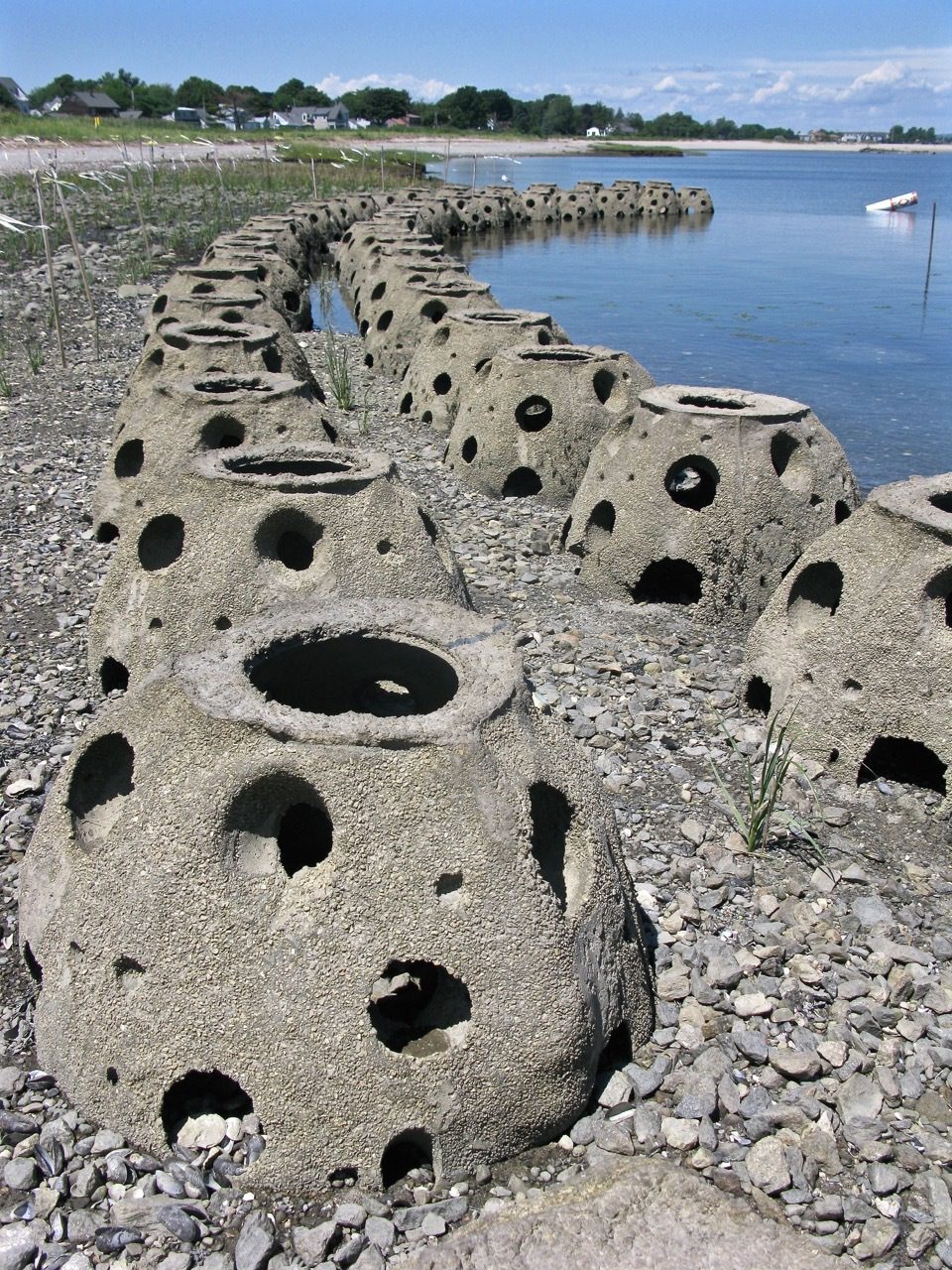
Thus far, the project has provided 750 feet of coastal erosion control, 4.5 acres of intertidal habitat, 1.5 acres of coastal dune habitat, and 25 acres of woodland/meadow mix. Monitoring has demonstrated that this living shoreline project has successfully prevented erosion, allowing sediment deposition, and salt marsh restoration. Increased horseshoe crab spawning and nursery habitat have also been observed.
LaTina Steele
203-396-8485
steelel@sacredheart.edu
Case Study
Project
Stratford, CT
Stratford Point Living Shoreline & Tidal Wetland Restoration
This project consists of 750 feet of shoreline in Stratford, CT. The goal of the project was to protect the beach from coastal erosion and to help combat sea level rise. The steps consisted of adding a smooth cordgrass marsh, artificial shellfish reefs (reef balls), high marsh, and a coastal dune area. The site was awarded the “Best Restored Shore Area” from the American Shore and Beach Preservation Association. To adaptively manage the site, a second restoration project is being developed to extend the marsh seaward by 0.35 acres over an additional 250 feet of shore using a combination of bagged slipper shell and small, modular oyster castles near the marsh edge, along with additional cordgrass plantings in the intertidal zone.
Project Lead:
Sacred Heart University
Mapper
Level of Effort:
NYSDEC Shellfish Mapper
This NYSDEC tool provides information on shellfish closures in NY’s marine waters and can be used to help resource users understand where it is safe to harvest to shellfish.
Mapper
Level of Effort:
NYSDEC Shellfish Mapper
This NYSDEC tool provides information on shellfish closures in NY’s marine waters and can be used to help resource users understand where it is safe to harvest to shellfish.
Mapper
Level of Effort:
Northeast Ocean Data Portal
User-friendly access to expert-reviewed interactive maps on key topics such as marine life and habitat, marine-based industry, use and resources in the northeastern United States. The Data Explorer allows the user to define and view any combination of data hosted on the Portal on one map.
Mapper
Level of Effort:
Northeast Ocean Data Portal
User-friendly access to expert-reviewed interactive maps on key topics such as marine life and habitat, marine-based industry, use and resources in the northeastern United States. The Data Explorer allows the user to define and view any combination of data hosted on the Portal on one map.
Mapper
Level of Effort:
New York & Connecticut Shellfish and Seaweed Aquaculture Viewer
The tool is designed to support shellfish and seaweed aquaculture siting in New York and Connecticut’s coastal waters.
Mapper
Level of Effort:
New York & Connecticut Shellfish and Seaweed Aquaculture Viewer
The tool is designed to support shellfish and seaweed aquaculture siting in New York and Connecticut’s coastal waters.
Mapper
Level of Effort:
CTECO: The Aquaculture Mapping Atlas
This resource provides a variety of Aquaculture geodata in CT and can be used to support the decision-making process for aquaculture permitting applications, but does not include authoritative content.
Mapper
Level of Effort:
CTECO: The Aquaculture Mapping Atlas
This resource provides a variety of Aquaculture geodata in CT and can be used to support the decision-making process for aquaculture permitting applications, but does not include authoritative content.
Guidance Tool
Level of Effort:
Connecticut’s Marine Shellfish
Resource guide for CT shellfish and aquaculture. It provides information and tools about all things shellfish and aquaculture in Connecticut with sections for businesses, consumers, recreational shellfishing, and shellfish restoration.
Guidance Tool
Level of Effort:
Connecticut’s Marine Shellfish
Resource guide for CT shellfish and aquaculture. It provides information and tools about all things shellfish and aquaculture in Connecticut with sections for businesses, consumers, recreational shellfishing, and shellfish restoration.
Mapper
Level of Effort:
Connecticut Shellfish Restoration Map Viewer
The Map Viewer is the state’s first geospatial collection of key ecological, biological, and human-use data intended to assess the viability of a coastal location to support shellfish restoration. Further, qualitative oyster habitat surveys characterize, for the first time, the condition of intertidal oyster populations across the state and establish a baseline to inform the planning of future quantitative assessments.
Mapper
Level of Effort:
Connecticut Shellfish Restoration Map Viewer
The Map Viewer is the state’s first geospatial collection of key ecological, biological, and human-use data intended to assess the viability of a coastal location to support shellfish restoration. Further, qualitative oyster habitat surveys characterize, for the first time, the condition of intertidal oyster populations across the state and establish a baseline to inform the planning of future quantitative assessments.
Guidance Tool
Level of Effort:
Connecticut Shellfish Restoration Guide
This Guide provides planning tools, regulatory information, and best management practices to jumpstart shellfish restoration-based project planning.
Guidance Tool
Level of Effort:
Connecticut Shellfish Restoration Guide
This Guide provides planning tools, regulatory information, and best management practices to jumpstart shellfish restoration-based project planning.
Guidance Tool
Level of Effort:
Connecticut Beach Association’s Guide to Coastal Activities and Permitting
Guide that lists various beach-related actions/activities, permitting pathways, and other considerations
Guidance Tool
Level of Effort:
Connecticut Beach Association’s Guide to Coastal Activities and Permitting
Guide that lists various beach-related actions/activities, permitting pathways, and other considerations
Mapper
Level of Effort:
Long Island Sound Blue Plan
The purpose of the Long Island Sound Blue Plan is to identify and protect places of traditional use and ecological significance, and to minimize conflicts, now and in the future. Contains data layers with policy and planning areas, ecologically significant areas, and significant human use areas.
Mapper
Level of Effort:
Long Island Sound Blue Plan
The purpose of the Long Island Sound Blue Plan is to identify and protect places of traditional use and ecological significance, and to minimize conflicts, now and in the future. Contains data layers with policy and planning areas, ecologically significant areas, and significant human use areas.