

Resources for
Project
Case Study
Project
Rye, NY
Edith G. Read Wildlife Sanctuary Living Shoreline
Shoreline erosion problems had been noted at Edith G. Read Wildlife Sanctuary in Rye, NY in the early 2000s, and after the devastation caused by Hurricane Sandy in 2012 and subsequent storms, it was clear there was a need for restoration. Westchester County decided to create a 900 foot living shoreline in order to restore the shoreline, reduce erosion, and support aquatic life in Long Island Sound. The project, designed by SLR, used two types of structures – boulder sills and reef balls – to slow wave action and provide aquatic habitat. A total of 43 reef balls were installed along with 40 types of native grasses, shrubs, and trees to further stabilize the shoreline. Additional native ecotype-specific plantings will be added periodically throughout the next five years of monitoring (2025-2030).



This is the only Long Island Sound living shoreline project in Westchester County and it serves as a model for other communities - in Westchester, Long Island Sound, and beyond.
Suzette Lopane, PLA, ASLA, sbl1@westchestergov.com
Matthew Castro, mvc1@westchestercountyny.gov
Case Study
Project
Rye, NY
Edith G. Read Wildlife Sanctuary Living Shoreline
Shoreline erosion problems had been noted at Edith G. Read Wildlife Sanctuary in Rye, NY in the early 2000s, and after the devastation caused by Hurricane Sandy in 2012 and subsequent storms, it was clear there was a need for restoration. Westchester County decided to create a 900 foot living shoreline in order to restore the shoreline, reduce erosion, and support aquatic life in Long Island Sound. The project, designed by SLR, used two types of structures – boulder sills and reef balls – to slow wave action and provide aquatic habitat. A total of 43 reef balls were installed along with 40 types of native grasses, shrubs, and trees to further stabilize the shoreline. Additional native ecotype-specific plantings will be added periodically throughout the next five years of monitoring (2025-2030).
GWA Case Study
Project
Halesite, NY
Halesite Park Shoreline Restoration
With support from the Long Island Sound Resilience Grant Writing Assistance Program, in December 2024 1653 Foundation was awarded $549,955 from the NYSDEC Water Quality Improvement Project (WQIP) Program to fund the Final design and implementation of habitat improvements and green infrastructure at Halesite Park, NY.
1653 Foundation Inc. will restore degrading shoreline at Halesite Park on the eastern shore of Huntington Harbor. The project will remove a failing seawall to expand shallow water habitat, install an offshore rock sill and oyster reef, and expand salt marsh vegetation, and upland plantings.
LIS Resilience Grant Writing Assistance Program Details:
Grant Writing Consultant: DLB Planning, LLC.
Grant Writing Assistance Award: $9,900
GWA Case Study
Project
Halesite, NY
Halesite Park Shoreline Restoration
With support from the Long Island Sound Resilience Grant Writing Assistance Program, in December 2024 1653 Foundation was awarded $549,955 from the NYSDEC Water Quality Improvement Project (WQIP) Program to fund the Final design and implementation of habitat improvements and green infrastructure at Halesite Park, NY.
1653 Foundation Inc. will restore degrading shoreline at Halesite Park on the eastern shore of Huntington Harbor. The project will remove a failing seawall to expand shallow water habitat, install an offshore rock sill and oyster reef, and expand salt marsh vegetation, and upland plantings.
LIS Resilience Grant Writing Assistance Program Details:
Grant Writing Consultant: DLB Planning, LLC.
Grant Writing Assistance Award: $9,900
GWA Case Study
Project
Fairfield, CT
Mill River Wetland Committee’s River-Lab programs in Bridgeport, CT
With support from the Long Island Sound Resilience Grant Writing Assistance (GWA) Program, in 2024 the Mill River Wetland Committee (MRWC) was awarded $26,987 from the Long Island Sound Community Impact Fund to support MRWC to lead the 5th Grade classes (2) at Barnum School in Bridgeport, CT through the Groundwater Study Trip in the fall of 2024 and Water Monitoring training in the spring of 2025.
LIS Resilience Grant Writing Assistance Program Details:
Grant Writing Consultant: CT Grant Writers
Grant Writing Assistance Award: $1,912.50

GWA Case Study
Project
Fairfield, CT
Mill River Wetland Committee’s River-Lab programs in Bridgeport, CT
With support from the Long Island Sound Resilience Grant Writing Assistance (GWA) Program, in 2024 the Mill River Wetland Committee (MRWC) was awarded $26,987 from the Long Island Sound Community Impact Fund to support MRWC to lead the 5th Grade classes (2) at Barnum School in Bridgeport, CT through the Groundwater Study Trip in the fall of 2024 and Water Monitoring training in the spring of 2025.
LIS Resilience Grant Writing Assistance Program Details:
Grant Writing Consultant: CT Grant Writers
Grant Writing Assistance Award: $1,912.50
GWA Case Study
Project
Nassau & Suffolk County, NY
ReWild Long Island Community Gardens Program
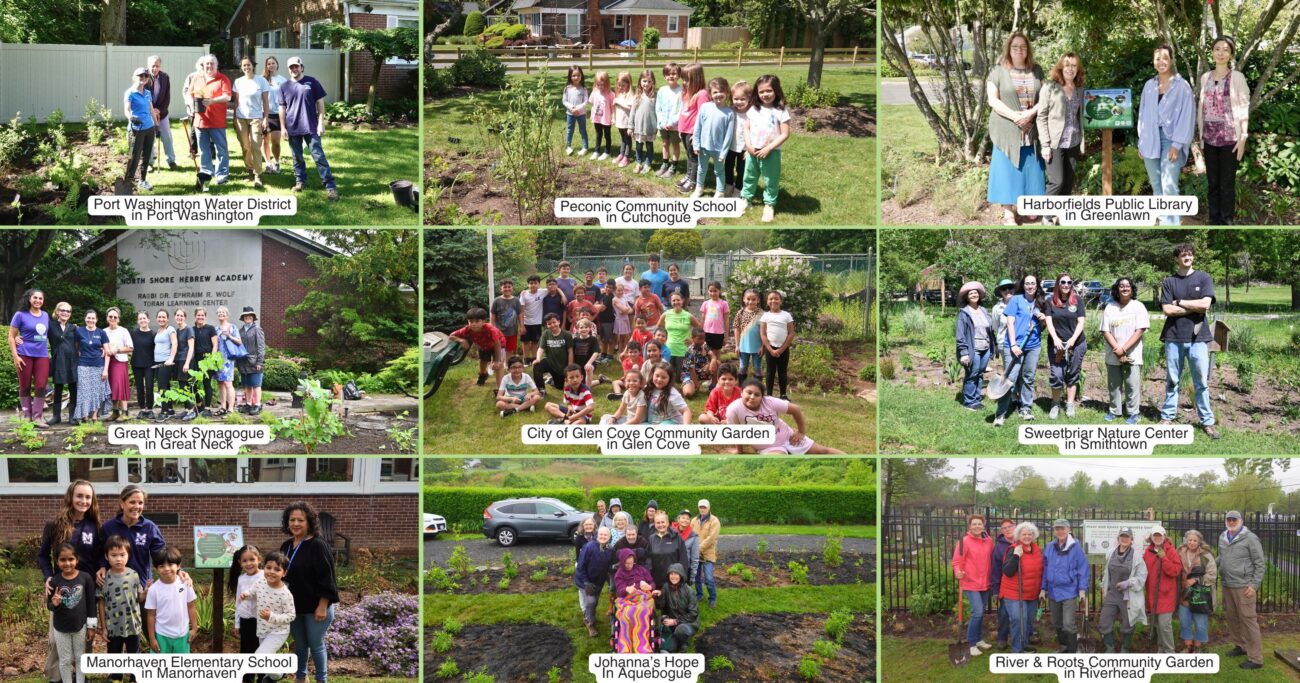
With support from the Long Island Sound Resilience Grant Writing Assistance (GWA) Program, in December 2023 ReWild Long Island was awarded $230,300 from the Long Island Sound Futures Fund to fund the project – ReWild Gardens for Long Island Sound: Implementation of an expanded community garden program Long Island within the LISS watershed.
The Community Gardens Program installs native plant gardens with community partners who plant & maintain them. The Summer Program to Fight Hunger and Climate Change supports high school students to plant & tend gardens with local nonprofit partners.
LIS Resilience Grant Writing Assistance Program Details:
Grant Writing Consultant: Elizabeth Skolnick
Grant Writing Assistance Award: $7,500
GWA Case Study
Project
Nassau & Suffolk County, NY
ReWild Long Island Community Gardens Program
With support from the Long Island Sound Resilience Grant Writing Assistance (GWA) Program, in December 2023 ReWild Long Island was awarded $230,300 from the Long Island Sound Futures Fund to fund the project – ReWild Gardens for Long Island Sound: Implementation of an expanded community garden program Long Island within the LISS watershed.
The Community Gardens Program installs native plant gardens with community partners who plant & maintain them. The Summer Program to Fight Hunger and Climate Change supports high school students to plant & tend gardens with local nonprofit partners.
LIS Resilience Grant Writing Assistance Program Details:
Grant Writing Consultant: Elizabeth Skolnick
Grant Writing Assistance Award: $7,500
GWA Case Study
Project
Cold Spring Harbor, NY
North Shore Land Alliance Shore Road Sanctuary Habitat Restoration Project
With support from the Long Island Sound Resilience Grant Writing Assistance (GWA) Program, in December 2023, North Shore Land Alliance was awarded $192,969 from the NYSDEC Water Quality Improvement Project (WQIP) Program to fund the implementation of green infrastructure at the North Shore Land Alliance Shore Road Sanctuary in Cold Spring Harbor, NY. The North Shore Land Alliance will install an upland infiltration system to reduce the volume and velocity of stormwater on a 40-acre parcel and replace invasive plants along the shoreline with a native plant community. The project will restore habitat and reduce the amount stormwater and pollutants entering Cold Spring Harbor and Long Island Sound.
LIS Resilience Grant Writing Assistance Program Details:
Grant Writing Consultant: Nelson Pope & Voorhis
Grant Writing Assistance Award: $9,900

Jane Jackson, Director of Stewardship, North Shore Land Alliance, jjackson@northshorelandalliance.org
GWA Case Study
Project
Cold Spring Harbor, NY
North Shore Land Alliance Shore Road Sanctuary Habitat Restoration Project
With support from the Long Island Sound Resilience Grant Writing Assistance (GWA) Program, in December 2023, North Shore Land Alliance was awarded $192,969 from the NYSDEC Water Quality Improvement Project (WQIP) Program to fund the implementation of green infrastructure at the North Shore Land Alliance Shore Road Sanctuary in Cold Spring Harbor, NY. The North Shore Land Alliance will install an upland infiltration system to reduce the volume and velocity of stormwater on a 40-acre parcel and replace invasive plants along the shoreline with a native plant community. The project will restore habitat and reduce the amount stormwater and pollutants entering Cold Spring Harbor and Long Island Sound.
LIS Resilience Grant Writing Assistance Program Details:
Grant Writing Consultant: Nelson Pope & Voorhis
Grant Writing Assistance Award: $9,900
Case Study
Project
East Haddam, CT
East Haddam Community Resilience Building Summary of Findings
With support from the Nature Conservancy and Sustainable CT, East Haddam organized a Community Resilience Building process and workshop, the results of which were compiled into this summary. The team engaged with community members to determine the present hazards and vulnerabilities and identify resilient solutions.
Case Study
Project
East Haddam, CT
East Haddam Community Resilience Building Summary of Findings
With support from the Nature Conservancy and Sustainable CT, East Haddam organized a Community Resilience Building process and workshop, the results of which were compiled into this summary. The team engaged with community members to determine the present hazards and vulnerabilities and identify resilient solutions.
Case Study
Project
Wilton, CT
Strong Pond Dam Removal at Merwin Meadows
Dana Dam (aka Strong Pond Dam) at Merwin Meadows Park in Wilton, CT was the first barrier to upstream fish migration from Long Island Sound on the Norwalk River. A series of dams along the Norwalk River (historically, and presently) prevented fish from reaching their historic spawning grounds, have posed safety risks, and disconnected the river from its natural floodplain. On September 11, 2023, demolition of this dam began! In addition to restoring habitat and allowing fish passage, the removal restored natural floodplain connectivity, realigned 200 feet of river channel away from an active railroad embankment, and removed a known safety hazard.
Partners
- Save the Sound, CT DEEP, Trout Unlimited, Town of Wilton


The project was designed to restore aquatic connectivity on the Norwalk River, particularly for diadromous fish species (such as river herring, American eel, and sea lamprey) that migrate upstream from Long Island Sound. Nearly 10 upstream miles have been reopened for aquatic organism passage, creating a 20+ mile stretch of free-flowing river from Long Island Sound. The project restored 1,400 feet of natural flow, reconstructed 800 feet of pool-riffle channel, and restored 1 acre of riparian floodplains, wetlands, and vegetated upland. The project improved habitat for riverine fish including brook trout, as well as birds, mammals, amphibians and other wildlife. Removal of Dana Dam improves water quality (primarily temperature and dissolved oxygen), protects 200-foot section of railroad embankment, and eliminates a public safety hazard.
Alex Krofta, akrofta@savethesound.org
Case Study
Project
Wilton, CT
Strong Pond Dam Removal at Merwin Meadows
Dana Dam (aka Strong Pond Dam) at Merwin Meadows Park in Wilton, CT was the first barrier to upstream fish migration from Long Island Sound on the Norwalk River. A series of dams along the Norwalk River (historically, and presently) prevented fish from reaching their historic spawning grounds, have posed safety risks, and disconnected the river from its natural floodplain. On September 11, 2023, demolition of this dam began! In addition to restoring habitat and allowing fish passage, the removal restored natural floodplain connectivity, realigned 200 feet of river channel away from an active railroad embankment, and removed a known safety hazard.
Partners
- Save the Sound, CT DEEP, Trout Unlimited, Town of Wilton
Case Study
Project
Old Saybrook, CT
Fenwick Living Shoreline
The purpose of this project was to mitigate 450 ft of coastal erosion on the Long Island Sound. A part of Crab Creek was moved further inland, thus allowing for beach and dune migration over time. New rock sills, plants, and sand sills were also positioned along the shore.
Case Study
Project
Old Saybrook, CT
Fenwick Living Shoreline
The purpose of this project was to mitigate 450 ft of coastal erosion on the Long Island Sound. A part of Crab Creek was moved further inland, thus allowing for beach and dune migration over time. New rock sills, plants, and sand sills were also positioned along the shore.
Case Study
Project
Hoffman Evergreen Preserve
This Avalonia and Sea Grant effort in Stonington, CT restored the preserve using native, well-researched plant species that would thrive in the forest and offer biodiversity. First, the area was cut down precisely to allow for new, ground-level growth. Then the preserve was seeded with plants chosen by the field team.
Juliana Barrett, CT Sea Grant Extension, 860-405-9106 & juliana.barrett@uconn.edu. Beth Sullivan, Avalonia
Case Study
Project
Hoffman Evergreen Preserve
This Avalonia and Sea Grant effort in Stonington, CT restored the preserve using native, well-researched plant species that would thrive in the forest and offer biodiversity. First, the area was cut down precisely to allow for new, ground-level growth. Then the preserve was seeded with plants chosen by the field team.
Case Study
Project
Stonington, CT
Dodge Paddock/Beal Preserve
This public greenspace was suffering from mosquito overpopulation, invasion from Phragmites, and poor tidal/stormwater drainage. The Wetland’s Habitat and Mosquito Management Program (WHAMM) created a new drainage area and tunnels, while also eliminating invasive plants. Then organizations and volunteers banded together to remove and replace invasive plant species with native plants.


Juliana Barrett, CT Sea Grant Extension, 860-405-9106, juliana.barrett@uconn.edu
Journal of Extension Article: Moving With the Marsh: Encouraging Property Owner Adaptation to Marsh Migration
Case Study
Project
Stonington, CT
Dodge Paddock/Beal Preserve
This public greenspace was suffering from mosquito overpopulation, invasion from Phragmites, and poor tidal/stormwater drainage. The Wetland’s Habitat and Mosquito Management Program (WHAMM) created a new drainage area and tunnels, while also eliminating invasive plants. Then organizations and volunteers banded together to remove and replace invasive plant species with native plants.
Case Study
Project
New Haven, CT
New Haven Bioswales
The City of New Haven has installed 286 right-of-way bioswales throughout the city as part of a multifaceted approach to reducing flooding in the downtown area. Right-of-way bioswales are engineered planted areas that are located on sidewalks. They are designed to capture and infiltrate stormwater into the ground that would otherwise directly enter a storm drain. These bioswales were installed as the result of various partnerships and funding opportunities related to flood prevention, localized drainage solutions, combined sewer overflow mitigation, research, and traffic calming projects.
Project Lead
City of New Haven, Dept of Engineering
Project Partners
Urban Resources Initiative, EMERGE Inc., Save the Sound, Yale School of the Environment, and Quinnipiac University, among others.

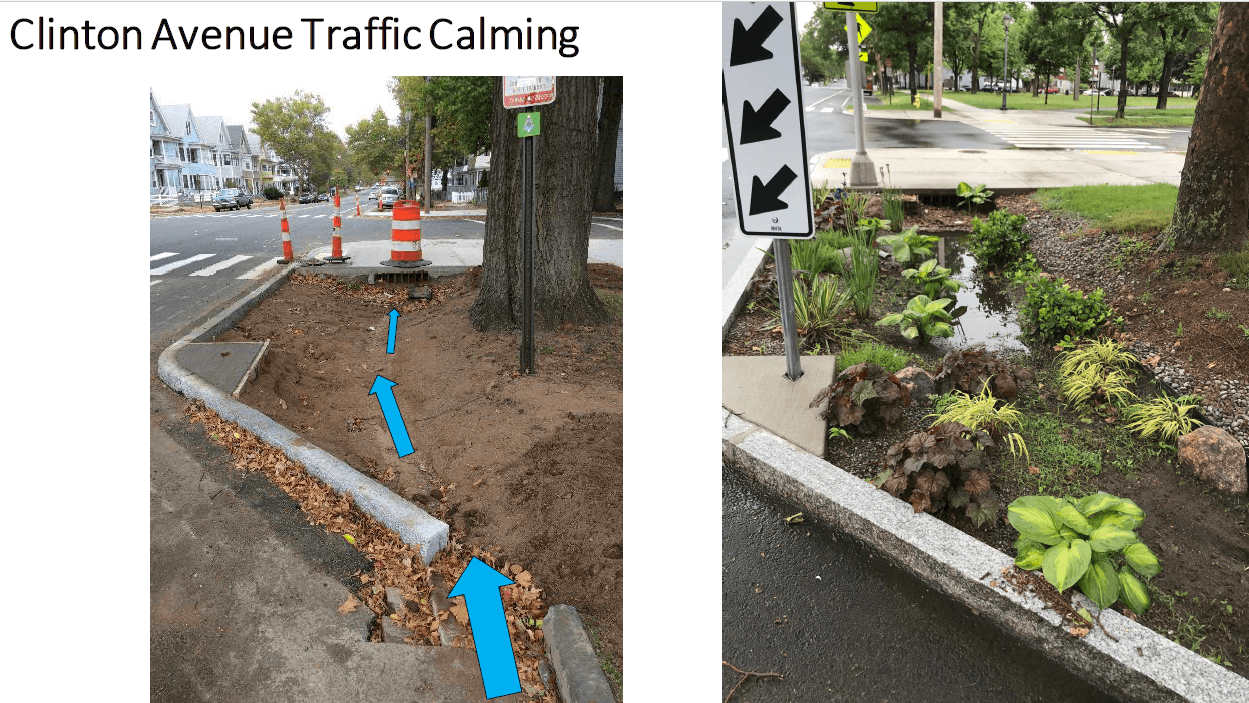

Monitoring performed by Yale School of the Environment researchers (led by Prof. Gaboury Benoit) have demonstrated that the bioswales have captured 70-75% of stormwater runoff in two locations. These results indicate that the bioswales are highly effective in diverting stormwater and thus, preventing pollution.
Dawn Henning
dhenning@newhavenct.gov
475-434-1643
Case Study
Project
New Haven, CT
New Haven Bioswales
The City of New Haven has installed 286 right-of-way bioswales throughout the city as part of a multifaceted approach to reducing flooding in the downtown area. Right-of-way bioswales are engineered planted areas that are located on sidewalks. They are designed to capture and infiltrate stormwater into the ground that would otherwise directly enter a storm drain. These bioswales were installed as the result of various partnerships and funding opportunities related to flood prevention, localized drainage solutions, combined sewer overflow mitigation, research, and traffic calming projects.
Project Lead
City of New Haven, Dept of Engineering
Project Partners
Urban Resources Initiative, EMERGE Inc., Save the Sound, Yale School of the Environment, and Quinnipiac University, among others.
Case Study
Project
Mamaroneck, NY
Coastal Forest Restoration at Otter Creek Preserve
Otter Creek Preserve is located along a three-mile stretch of coastline on Long Island Sound in Mamaroneck, NY. It contains 90% of the remaining productive salt marshes in Westchester County, and is an important site for migratory birds, marine life, and other wildlife. The 35-acre preserve is the largest privately-owned tidal wetland designated and protected as a nature sanctuary in Westchester County.
Following improvements made to the coastal forest and tidal marsh in 2015 and 2016 with support from the Westchester Community Foundation, in 2017 Westchester Land Trust (WLT) received NFWF LISFF funding to continue removing non-native trees, shrubs, and vines, replant with native species, and conduct expanded outreach and educational programming at the preserve.

12 acres of forest were restored by 2018 with the LISFF funds.
Westchester Land Trust
403 Harris Road
Bedford Hills, NY 10507
www.westchesterlandtrust.org
Case Study
Project
Mamaroneck, NY
Coastal Forest Restoration at Otter Creek Preserve
Otter Creek Preserve is located along a three-mile stretch of coastline on Long Island Sound in Mamaroneck, NY. It contains 90% of the remaining productive salt marshes in Westchester County, and is an important site for migratory birds, marine life, and other wildlife. The 35-acre preserve is the largest privately-owned tidal wetland designated and protected as a nature sanctuary in Westchester County.
Following improvements made to the coastal forest and tidal marsh in 2015 and 2016 with support from the Westchester Community Foundation, in 2017 Westchester Land Trust (WLT) received NFWF LISFF funding to continue removing non-native trees, shrubs, and vines, replant with native species, and conduct expanded outreach and educational programming at the preserve.
Case Study
Project
Stratford, CT
Stratford Point Living Shoreline & Tidal Wetland Restoration
This project consists of 750 feet of shoreline in Stratford, CT. The goal of the project was to protect the beach from coastal erosion and to help combat sea level rise. The steps consisted of adding a smooth cordgrass marsh, artificial shellfish reefs (reef balls), high marsh, and a coastal dune area. The site was awarded the “Best Restored Shore Area” from the American Shore and Beach Preservation Association. To adaptively manage the site, a second restoration project is being developed to extend the marsh seaward by 0.35 acres over an additional 250 feet of shore using a combination of bagged slipper shell and small, modular oyster castles near the marsh edge, along with additional cordgrass plantings in the intertidal zone.
Project Lead:
Sacred Heart University
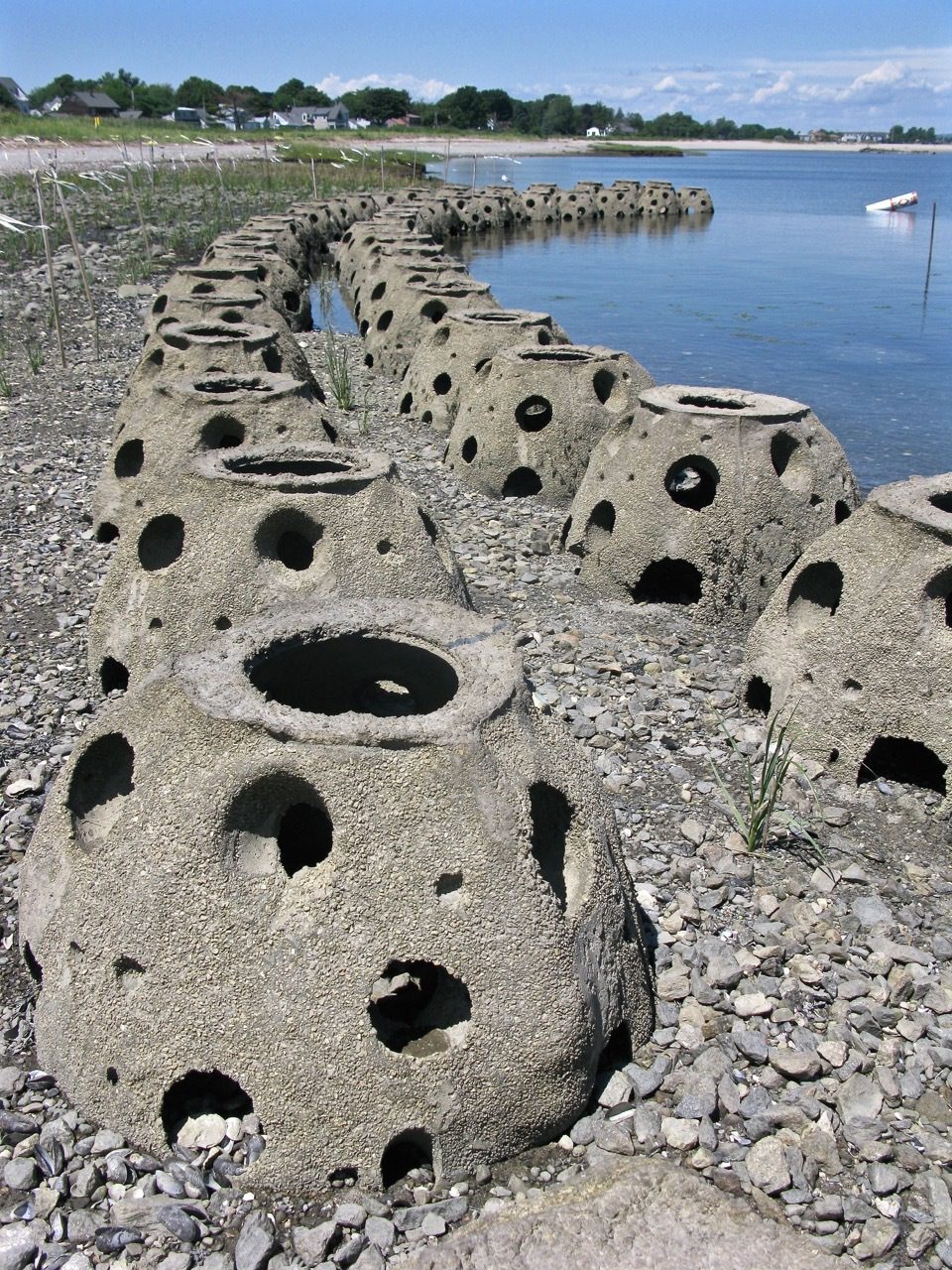
Thus far, the project has provided 750 feet of coastal erosion control, 4.5 acres of intertidal habitat, 1.5 acres of coastal dune habitat, and 25 acres of woodland/meadow mix. Monitoring has demonstrated that this living shoreline project has successfully prevented erosion, allowing sediment deposition, and salt marsh restoration. Increased horseshoe crab spawning and nursery habitat have also been observed.
LaTina Steele
203-396-8485
steelel@sacredheart.edu
Case Study
Project
Stratford, CT
Stratford Point Living Shoreline & Tidal Wetland Restoration
This project consists of 750 feet of shoreline in Stratford, CT. The goal of the project was to protect the beach from coastal erosion and to help combat sea level rise. The steps consisted of adding a smooth cordgrass marsh, artificial shellfish reefs (reef balls), high marsh, and a coastal dune area. The site was awarded the “Best Restored Shore Area” from the American Shore and Beach Preservation Association. To adaptively manage the site, a second restoration project is being developed to extend the marsh seaward by 0.35 acres over an additional 250 feet of shore using a combination of bagged slipper shell and small, modular oyster castles near the marsh edge, along with additional cordgrass plantings in the intertidal zone.
Project Lead:
Sacred Heart University
Case Study
Project
Stratford, CT
Restoration of the Great Meadows Marsh
This project restored 46 acres of the Great Meadows Marsh in Connecticut that was degraded from dredge material that was dumped on site, poor drainage, and sea level rise. The marsh was also overrun with invasive plants and mosquitoes. A controlled fire was started to kill the invasive reeds growing in the marsh. Then a construction crew removed invasive plants and the dumped dredge material. Lastly, channels were carefully dug for tidal flushing which will allow the marsh to keep pace with sea level rise. Soil hummocks were constructed for Salt Marsh Sparrow habitat. Now the area continues to be monitored, assessed for resiliency, and provides a field for innovative solutions to be tested in.
Partners
Trustees: USFWS, NOAA, State of Connecticut; Project Partners: Audubon Connecticut, Town of Stratford
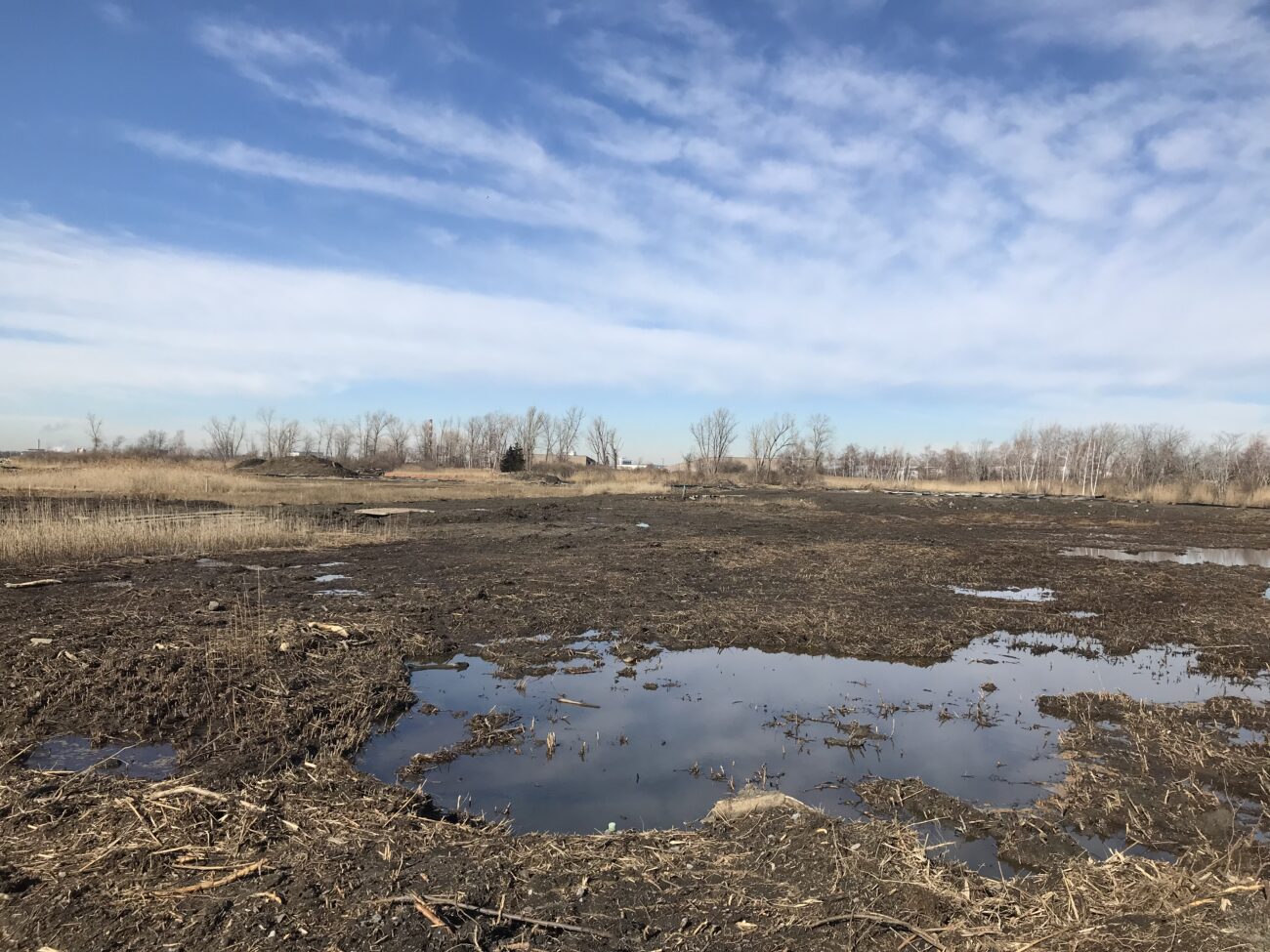


Monitoring immediately following the restoration revealed at least 12 saltmarsh sparrows returned to their annual nesting areas near the experimental hummocks, despite the disruptive activities taking place earlier in the year. University students will survey vegetation on the hummocks and throughout the restoration area, measuring and counting individual plants to see how different species grow at different elevations and in different types of soil, and to determine if additional plantings are needed. Audubon Connecticut will manage and control invasive plant species across the restoration area for three years, periodically removing and chemically treating the ever-persistent common reed. The project team will also monitor saltwater flooding of the marsh and carve runnels (short channels), if needed, to connect more areas to saltwater.
Molly Sperduto at molly_sperduto@fws.gov;
Corrie Folsom-O’Keefe cfolsom.okeefe@audubon.org;
Jack Matthias jack.matthias@audubon.org
Case Study
Project
Stratford, CT
Restoration of the Great Meadows Marsh
This project restored 46 acres of the Great Meadows Marsh in Connecticut that was degraded from dredge material that was dumped on site, poor drainage, and sea level rise. The marsh was also overrun with invasive plants and mosquitoes. A controlled fire was started to kill the invasive reeds growing in the marsh. Then a construction crew removed invasive plants and the dumped dredge material. Lastly, channels were carefully dug for tidal flushing which will allow the marsh to keep pace with sea level rise. Soil hummocks were constructed for Salt Marsh Sparrow habitat. Now the area continues to be monitored, assessed for resiliency, and provides a field for innovative solutions to be tested in.
Partners
Trustees: USFWS, NOAA, State of Connecticut; Project Partners: Audubon Connecticut, Town of Stratford
Case Study
Project
Norwalk, CT
Webster Street Parking Lot Green Infrastructure Project
In 2019, the City of Norwalk secured a LIS Future Fund grant to install green infrastructure in the Webster Street Parking to reduce the impacts of stormwater on the Norwalk River and Harbor and mitigate local flooding of surrounding businesses through the installation of four different types of infiltration and bio-retention structures:
1) Underground infiltration systems.
2) Retention basins and curb inlet planters in eight different areas.
3) Porous pavement with storage in two areas.
4) Infiltration gutters and tree filters in two other areas.
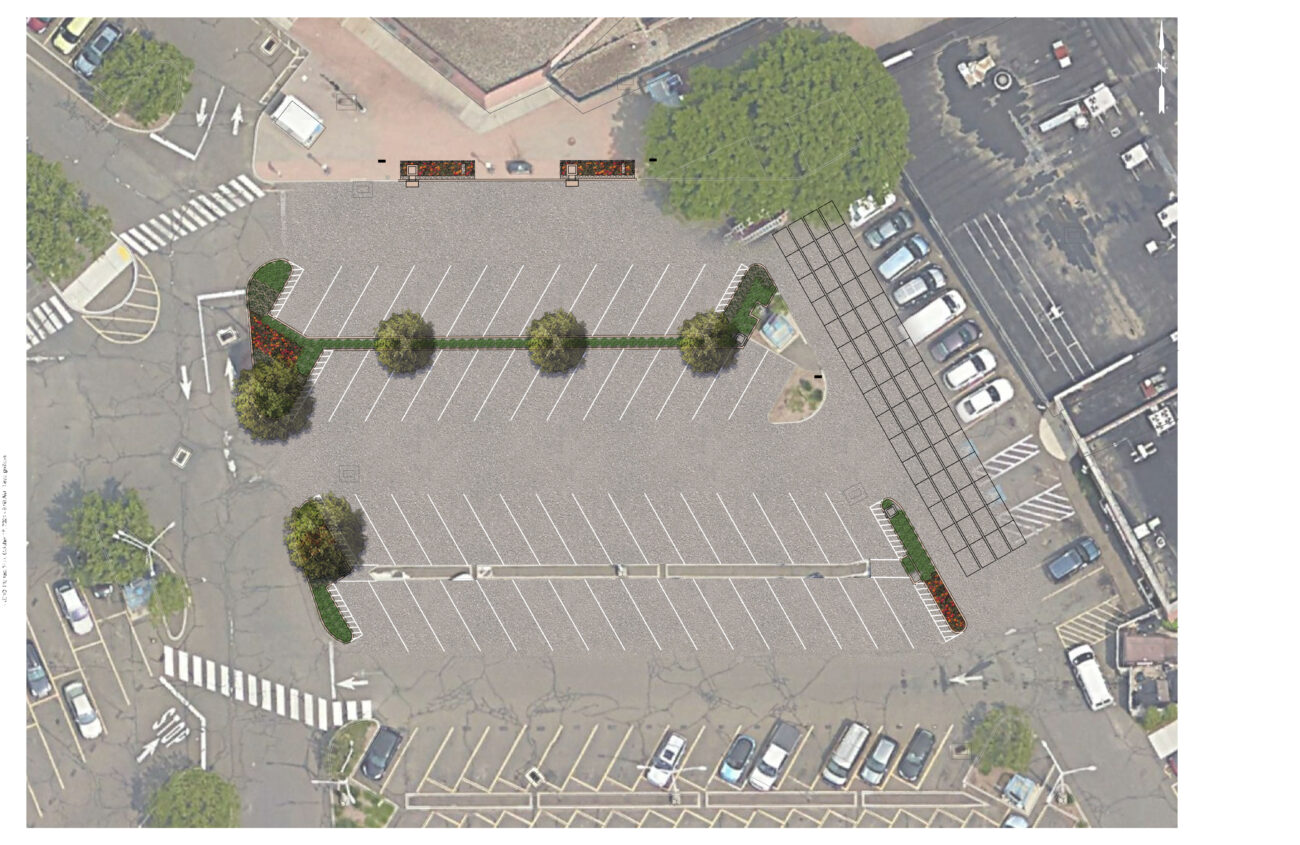

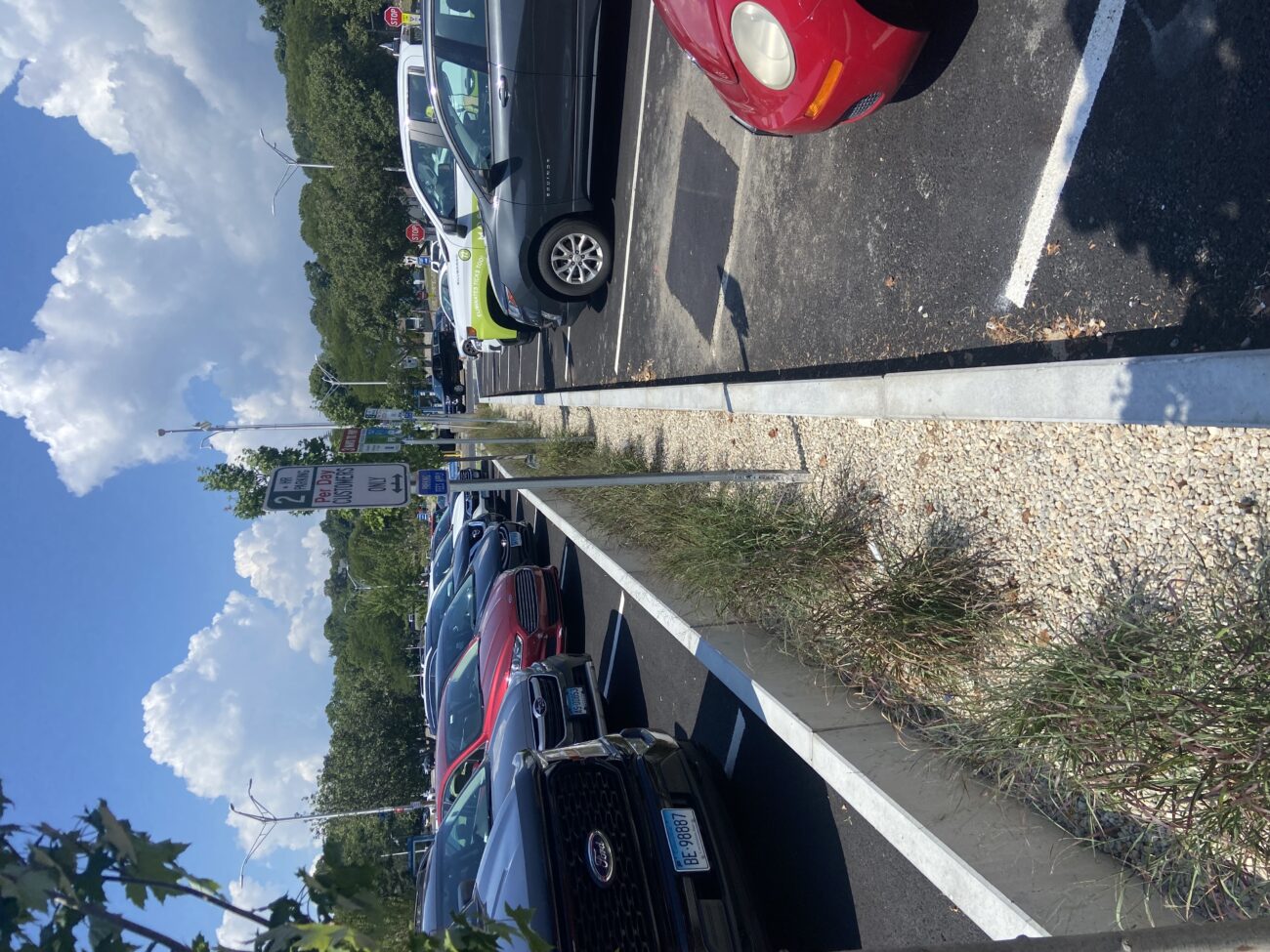


The project is estimated to remove 12 lbs. of nitrogen and preventing over 6 million gallons of stormwater from entering Norwalk Harbor annually. Since it's installation, the site has not experienced any flooding incidents (as of 2024), indicating that it seems to be functioning well.
Bryan Lutz
Assistant Director of Parking
blutz@norwalkct.gov; 203-854-7253
Case Study
Project
Norwalk, CT
Webster Street Parking Lot Green Infrastructure Project
In 2019, the City of Norwalk secured a LIS Future Fund grant to install green infrastructure in the Webster Street Parking to reduce the impacts of stormwater on the Norwalk River and Harbor and mitigate local flooding of surrounding businesses through the installation of four different types of infiltration and bio-retention structures:
1) Underground infiltration systems.
2) Retention basins and curb inlet planters in eight different areas.
3) Porous pavement with storage in two areas.
4) Infiltration gutters and tree filters in two other areas.
Case Study
Project
Rain Gardens on Western Waterfront
Friends of the Bay installed two raingardens at the Western Waterfront, which was done in October 2021 with the help of volunteers.


The main ways Friends of the Bay measured outcomes was by observing the absorption of water into the gardens after rain storms and seeing pollinators just a day or two after planting. The biggest benefit though was the engagement by the Town of Oyster Bay in fixing another rain garden at the Western Waterfront with help from a grant they received as well as plans to install more rain gardens in the area. Friends of the Bay was also able to engage a corps. of dedicated volunteers from the community. The long-term impact of the work is the continuation of stormwater runoff mitigation to the bay.
Friends of the Bay, info@friendsofthebay.org
Case Study
Project
Rain Gardens on Western Waterfront
Friends of the Bay installed two raingardens at the Western Waterfront, which was done in October 2021 with the help of volunteers.
Case Study
Project
Stabilization of Bluff at Sands Point Preserve
In partnership with Sands Point Preserve Conservancy, an innovative cliff face stabilization system, engineered by Long Island based company Coastal Technologies Corp (CTC), was deployed as a pilot on Oct. 30th, 2022 at a steep & loose coastal moraine bluff located at The Sands Point Preserve, NY. The pilot project was designed to test the efficacy of this system to secure and stabilize sediment under constant erosive pressure preventing vegetation from taking hold. This bluff was selected due to its very high rate of stormwater & aeolian erosion. American beach grass, bayberry, beach plum & rose plugs, all protected from erosive forces, have thrived. Slope erosion was prevented by the devices, and all plants were successfully held against the slope, exactly as designed.
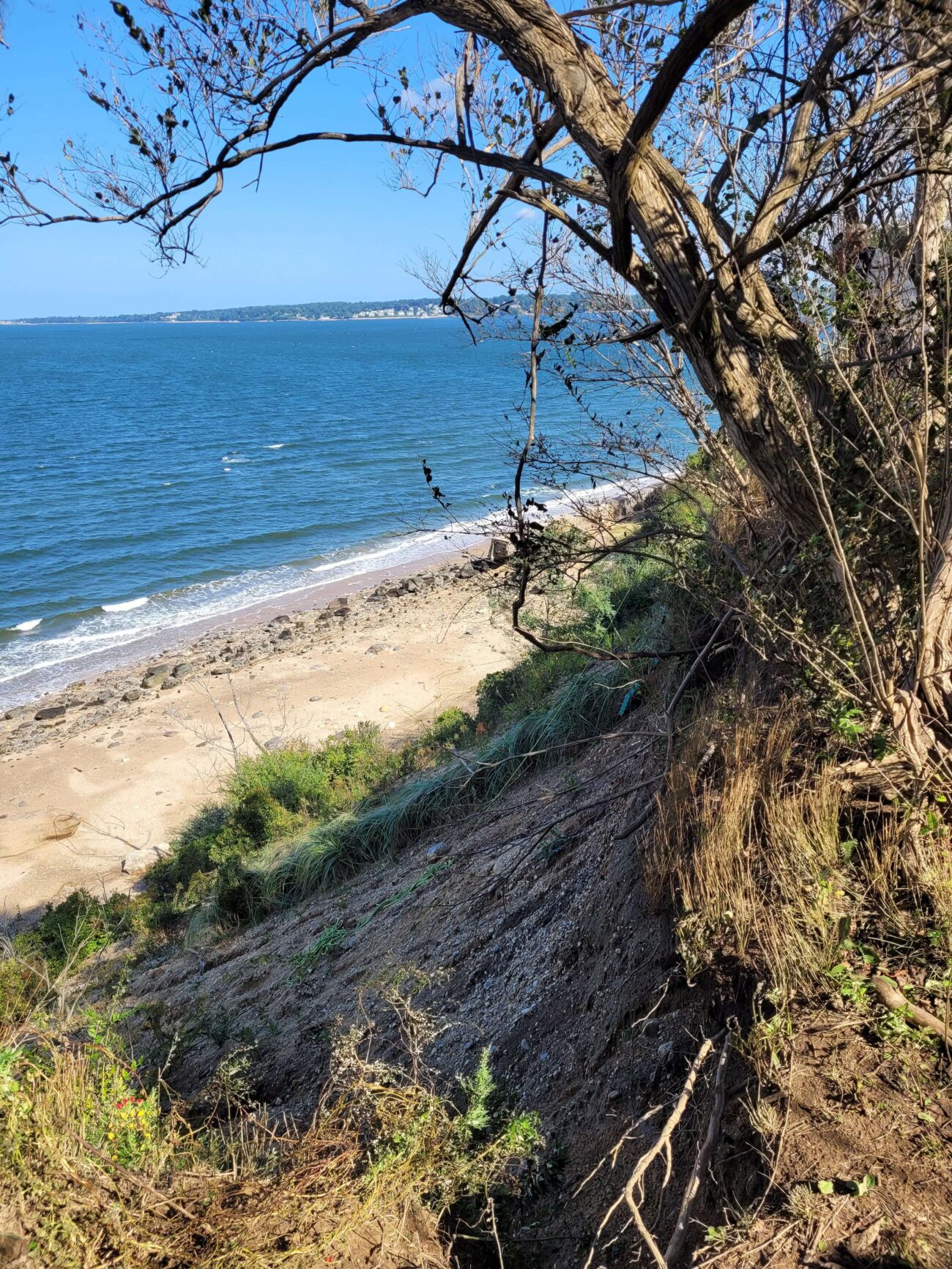
Eighteen (18) Cliff Stabilizer devices were driven into the escarpment using a battery-powered tool and plant plugs were planted into the cubbies. The test field was then coincidentally subjected to three days of storms caused by Hurricane Ian. All Cliff Stabilizer devices remained firmly in place, as did all the planted vegetation. No erosion occurred in the device footprint. Stormwater erosion was evident at control areas, with all control test plugs planted outside the cubby devices being washed away. The site was left unattended, with zero maintenance. The site was accessed on May 30, 2023, six months after initial deployment for preliminary readout - Slope erosion was prevented by the devices, and all plants were successfully held against the slope, exactly as designed. On September 27th, 2023 the site was assessed and the established vegetation was assessed after some of the devices were removed, stable vegetation was left behind. The pilot project seems to be a success and Sands Point Preserve Conservancy is looking for additional funding to expand the project at the site.
Case Study
Project
Stabilization of Bluff at Sands Point Preserve
In partnership with Sands Point Preserve Conservancy, an innovative cliff face stabilization system, engineered by Long Island based company Coastal Technologies Corp (CTC), was deployed as a pilot on Oct. 30th, 2022 at a steep & loose coastal moraine bluff located at The Sands Point Preserve, NY. The pilot project was designed to test the efficacy of this system to secure and stabilize sediment under constant erosive pressure preventing vegetation from taking hold. This bluff was selected due to its very high rate of stormwater & aeolian erosion. American beach grass, bayberry, beach plum & rose plugs, all protected from erosive forces, have thrived. Slope erosion was prevented by the devices, and all plants were successfully held against the slope, exactly as designed.
Case Study
Project
Roslyn Harbor, NY
Restoring Coastal Grassland at the William Cullen Bryant Preserve
The Nassau County Museum of Art restored coastal grassland and use the restored grassland to educate visitors about the environment at the William Cullen Bryant Preserve, Roslyn Harbor, New York. The project will restore an important coastal habitat of Long Island Sound. The whole area was seeded mid-October 2023 and the meadow growth began in the spring of 2024, although it will take 2-3 years to resemble a meadow. See photos below of the established grassland approximately 2 years after the seeding.


8 acres of coastal grassland restored, 1000 people reached through education and outreach. Grasslands absorb and maintain more carbon within the root system and absorb more water into the aquifer than forests.
Jean Henning, Conservation Project Coordinator, William Cullen Bryant Preserve
jdshenning@gmail.com
Case Study
Project
Roslyn Harbor, NY
Restoring Coastal Grassland at the William Cullen Bryant Preserve
The Nassau County Museum of Art restored coastal grassland and use the restored grassland to educate visitors about the environment at the William Cullen Bryant Preserve, Roslyn Harbor, New York. The project will restore an important coastal habitat of Long Island Sound. The whole area was seeded mid-October 2023 and the meadow growth began in the spring of 2024, although it will take 2-3 years to resemble a meadow. See photos below of the established grassland approximately 2 years after the seeding.
Case Study
Project
Sea Cliff, NY
Scudders Pond Subwatershed Improvements
The Hempstead Harbor Protection Committee and Village of Sea Cliff completed subwatershed improvements at Scudders Pond to address stormwater drainage problems impacting the water quality of the pond and Hempstead Harbor, highlighted as a priority in the 1998 Hempstead Harbor Water Quality Improvement Plan. The improvements included dredging the pond, installing a hydrodynamic separator to intercept sediment, removing invasive Phragmites australis and replacing with native plants, realigning the stream to reduce erosion, redirecting the stormwater from residences to the bioswale, creation of a biofilter wetland area, replacement of the weir between the upper and lower ponds and weir at Shore Road.

Water quality improvements in Scudders Pond and Hempstead Harbor, views of the Pond have been restored.
Eric Swenson, Hempstead Harbor Protection Committee, hempsteadharbor@gmail.com
Case Study
Project
Sea Cliff, NY
Scudders Pond Subwatershed Improvements
The Hempstead Harbor Protection Committee and Village of Sea Cliff completed subwatershed improvements at Scudders Pond to address stormwater drainage problems impacting the water quality of the pond and Hempstead Harbor, highlighted as a priority in the 1998 Hempstead Harbor Water Quality Improvement Plan. The improvements included dredging the pond, installing a hydrodynamic separator to intercept sediment, removing invasive Phragmites australis and replacing with native plants, realigning the stream to reduce erosion, redirecting the stormwater from residences to the bioswale, creation of a biofilter wetland area, replacement of the weir between the upper and lower ponds and weir at Shore Road.
Case Study
Project
Maidstone Landing Bluff Restoration
The Maidstone Landing Association, situated between Town of Riverhead Iron Pier Beach and Hallock State Park, wanted to take action to mitigate erosion of their bluff. First they worked with Town of Riverhead to put up signage and fencing to stop beachgoers from climbing and driving on or near the bluff, which was causing significant destruction. Next they opted for a small-scale, nature-based approach to help stabilize the bluff. They purchased snow fencing from Home Depot and native beachgrass from Long Island Natives. They engaged Riverhead Charter High School to help with putting up the snow fencing and the plantings. The Maidstone Landing Association is using their bluff as an “outdoor classroom” to teach students and the public about the importance of conserving our coastal habitats and best practices.


The beachgrass is now thriving, and the both the fencing and plants have held up during recent storms. Maidstone Landing Association recently received approval to expand the project across their entire bluff. The Association plans to continue to collaborate with New York Sea Grant, Long Island Sound Study, and Suffolk Soil & Water Conservation District, to use this project to educate students and the public on best practices and the importance of protecting our coastal bluffs.
Tom Mohrman mustangtpm@gmail.com; Corey Humphrey corey.humphrey@suffolkcountyny.gov
Case Study
Project
Maidstone Landing Bluff Restoration
The Maidstone Landing Association, situated between Town of Riverhead Iron Pier Beach and Hallock State Park, wanted to take action to mitigate erosion of their bluff. First they worked with Town of Riverhead to put up signage and fencing to stop beachgoers from climbing and driving on or near the bluff, which was causing significant destruction. Next they opted for a small-scale, nature-based approach to help stabilize the bluff. They purchased snow fencing from Home Depot and native beachgrass from Long Island Natives. They engaged Riverhead Charter High School to help with putting up the snow fencing and the plantings. The Maidstone Landing Association is using their bluff as an “outdoor classroom” to teach students and the public about the importance of conserving our coastal habitats and best practices.
Case Study
Project
Sunken Meadow State Park Restoration
Increased development and the historic construction of a dam on Sunken Meadow Creek in the 1950’s led to reduced tidal exchange, increased water levels in the creek, poor water quality, and the proliferation of invasive species. In 2008 a number of partners (NYS OPRHP, NOAA, NYSDEC, LISS, TNC, Save the Sound, USFWS, LI Botanical Society) came together to work to restore the degraded marsh habitat around Sunken Meadow Creek, increase tidal flow, improve aquatic organism passage, limit invasives, and improve water quality. A restoration feasibility study was completed in 2010. In 2012 Superstorm Sandy blew out the dam on Sunken Meadow Creek, naturally kick-starting restoration. Following Superstorm Sandy, the project partners were able to quickly capitalize on available funding and grants, due to their prior planning efforts. A bridge was built across the Creek where the dam blew out, salt marsh habitat was restored at three locations, green infrastructure was installed in one of the parking areas to capture and treat stormwater runoff, fish passage feasibility on the creek was investigated, and education and outreach was conducted to thousands of people. These projects were completed in 2019. Now, with funding through Long Island Sound Futures Fund, Audubon NY is leading a large-scale marsh restoration project at Sunken Meadow Creek to restore important high-marsh habitat for at risk species, like the Saltmarsh Sparrow, and to increase the resilience of the marsh in the face of rising sea levels. Audubon will be working to finalize the designs and secure permits over the next two years, with on-the-ground restoration expected in 2026.
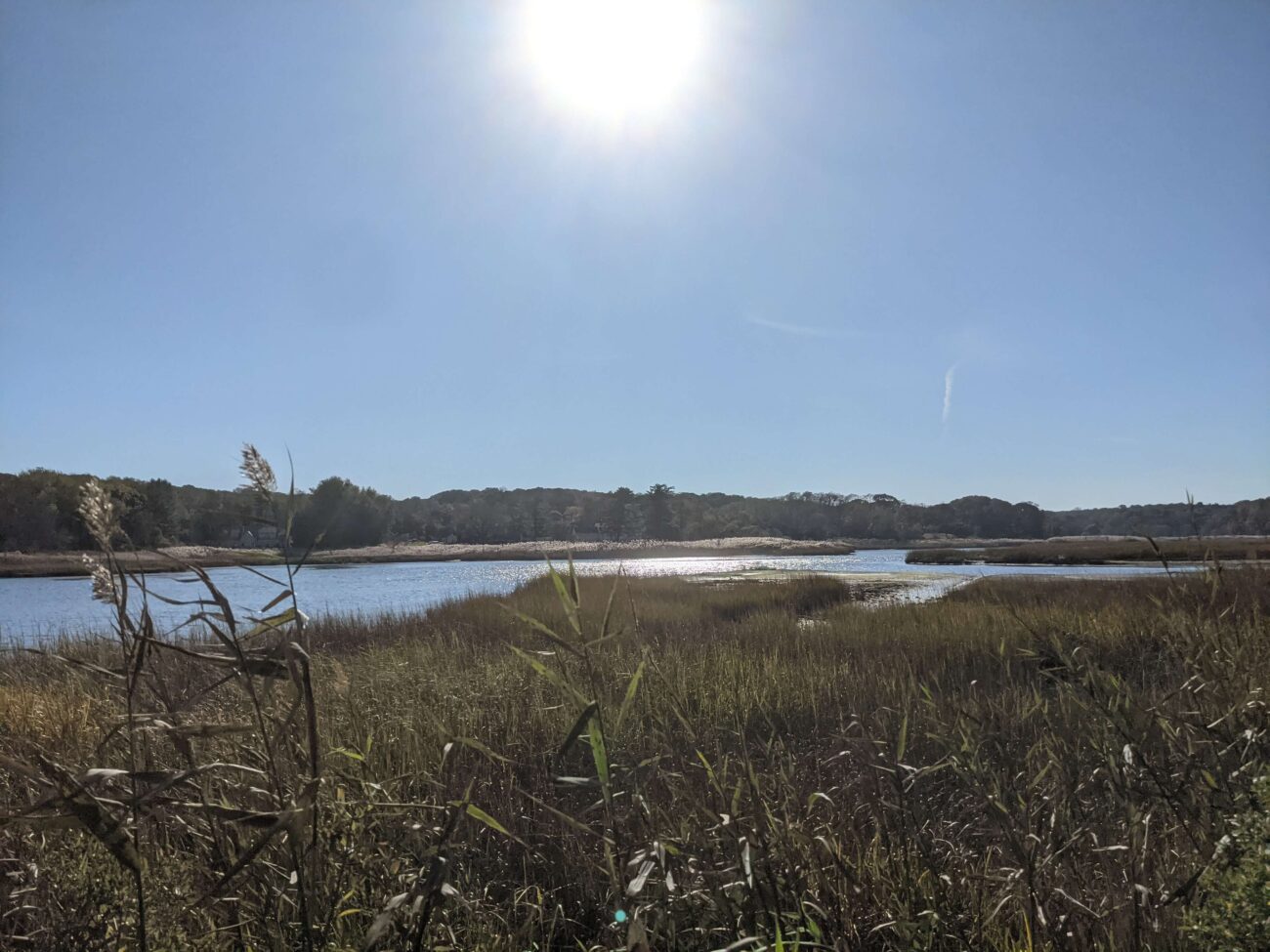


Overall the project has been highly successful, reducing flooding, polluted runoff, and invasives, as well as increasing the recreational value and beauty of the Park. There has been positive feedback from the public following the restoration projects. Some challenges remain with dealing with invasive species. It was determined that proceeding with the fish passage plans was not worthwhile, following the feasibility assessment.
Sean Cruickshank Sean.Cruickshank@parks.ny.gov, Jon Vander Werff jvanderwerff@savethesound.org, Phoebe Clark phoebe.clark@audubon.org, Vicky O’Neill victoria.oneill@audubon.org
Case Study
Project
Sunken Meadow State Park Restoration
Increased development and the historic construction of a dam on Sunken Meadow Creek in the 1950’s led to reduced tidal exchange, increased water levels in the creek, poor water quality, and the proliferation of invasive species. In 2008 a number of partners (NYS OPRHP, NOAA, NYSDEC, LISS, TNC, Save the Sound, USFWS, LI Botanical Society) came together to work to restore the degraded marsh habitat around Sunken Meadow Creek, increase tidal flow, improve aquatic organism passage, limit invasives, and improve water quality. A restoration feasibility study was completed in 2010. In 2012 Superstorm Sandy blew out the dam on Sunken Meadow Creek, naturally kick-starting restoration. Following Superstorm Sandy, the project partners were able to quickly capitalize on available funding and grants, due to their prior planning efforts. A bridge was built across the Creek where the dam blew out, salt marsh habitat was restored at three locations, green infrastructure was installed in one of the parking areas to capture and treat stormwater runoff, fish passage feasibility on the creek was investigated, and education and outreach was conducted to thousands of people. These projects were completed in 2019. Now, with funding through Long Island Sound Futures Fund, Audubon NY is leading a large-scale marsh restoration project at Sunken Meadow Creek to restore important high-marsh habitat for at risk species, like the Saltmarsh Sparrow, and to increase the resilience of the marsh in the face of rising sea levels. Audubon will be working to finalize the designs and secure permits over the next two years, with on-the-ground restoration expected in 2026.