

Resources for
Stormwater Management
Training
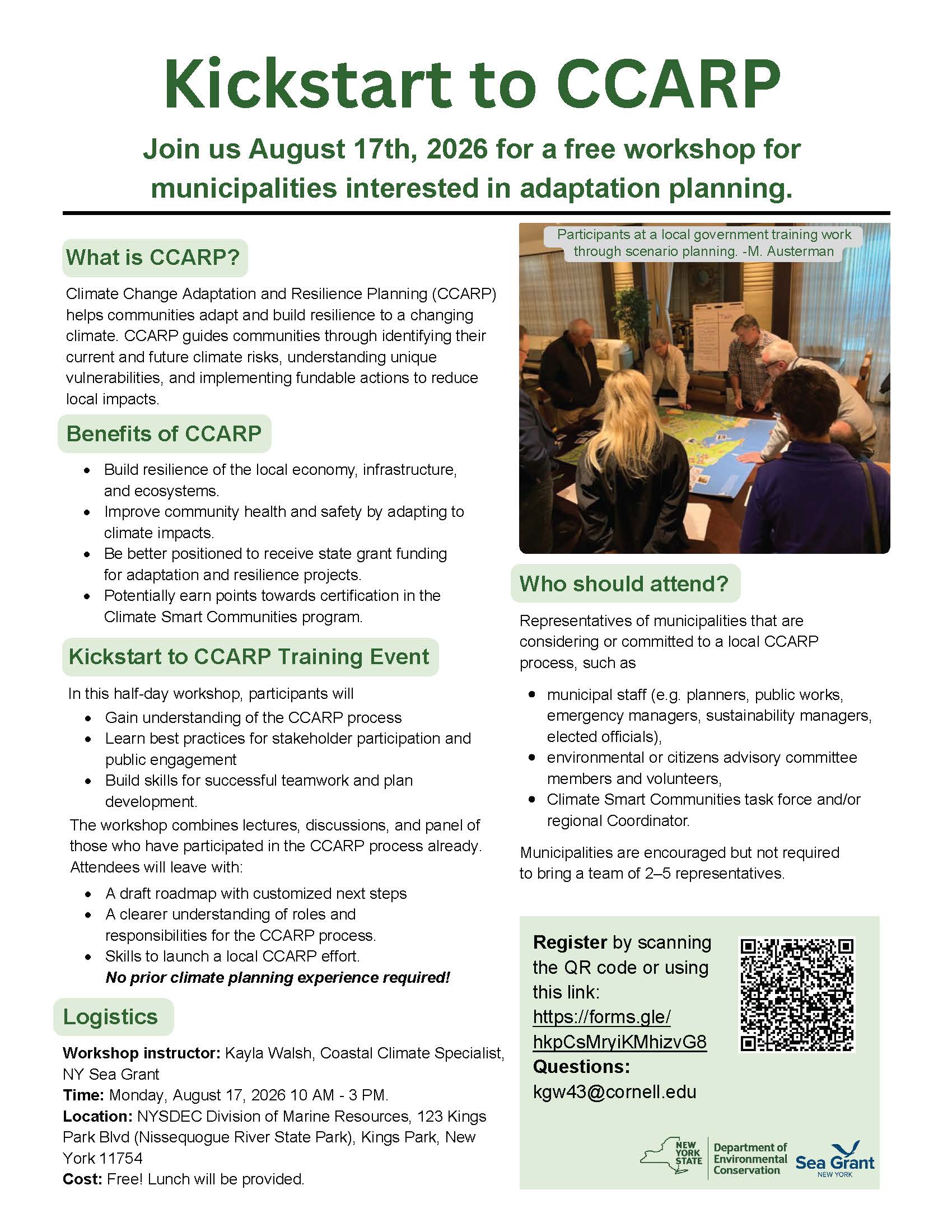
Kickstart to CCARP Training for Long Island Municipalities
Join us August 17 at the NYSDEC Division of Marine Resources for a FREE training for municipalities starting out or working towards adapting to climate impacts! Learn how a Climate Change Adaptation and Resilience Plan (CCARP) can help your community build resilience to a changing climate and extreme weather. Lunch will be provided.
Through this training, attendees will:
- Gain an Understanding of the CCARP process
- Learn best practices for stakeholder participation and public engagement
- Build skills for successful teamwork and plan development
Municipalities are encouraged (but not required) to bring a team of 2-5 representatives, including municipal staff, environmental or citizens advisory committee members, and/or Climate Smart Communities task force members.
Training
Kickstart to CCARP Training for Long Island Municipalities
Join us August 17 at the NYSDEC Division of Marine Resources for a FREE training for municipalities starting out or working towards adapting to climate impacts! Learn how a Climate Change Adaptation and Resilience Plan (CCARP) can help your community build resilience to a changing climate and extreme weather. Lunch will be provided.
Through this training, attendees will:
- Gain an Understanding of the CCARP process
- Learn best practices for stakeholder participation and public engagement
- Build skills for successful teamwork and plan development
Municipalities are encouraged (but not required) to bring a team of 2-5 representatives, including municipal staff, environmental or citizens advisory committee members, and/or Climate Smart Communities task force members.
Resource
Level of Effort:
UConn Extension Fact Sheet
Reducing Flood Risk in our Communities Fact Sheet
Severe rain events and flooding in our municipalities and communities is becoming more common. Flood risk reduction involves adapting infrastructure and land use to increasing flood frequency and intensity along with mitigating human impacts. While strategies must be place specific, this fact sheet provides starting point guidance on how different stakeholders in Connecticut’s land and infrastructure can contribute to reducing floods.
Resource
Level of Effort:
UConn Extension Fact Sheet
Reducing Flood Risk in our Communities Fact Sheet
Severe rain events and flooding in our municipalities and communities is becoming more common. Flood risk reduction involves adapting infrastructure and land use to increasing flood frequency and intensity along with mitigating human impacts. While strategies must be place specific, this fact sheet provides starting point guidance on how different stakeholders in Connecticut’s land and infrastructure can contribute to reducing floods.
SRC Training
USGS Compound Flood Hazard Assessment Mapper Webinar
This virtual webinar featured the U.S. Geological Survey’s (USGS) new Compound Flood Hazard Assessment Mapper. Municipal staff, state agencies, and other partners joined to learn how USGS developed this new tool and how they could utilize it in planning and decision-making.
This webinar was hosted by New York Sea Grant, Connecticut Sea Grant, and the U.S. Geological Survey, with funding from Long Island Sound Partnership.
For questions or more information, email Kathleen Fallon.
A recording of the webinar along with webinar slides and a Q&A and references document is available below.


SRC Training
USGS Compound Flood Hazard Assessment Mapper Webinar
This virtual webinar featured the U.S. Geological Survey’s (USGS) new Compound Flood Hazard Assessment Mapper. Municipal staff, state agencies, and other partners joined to learn how USGS developed this new tool and how they could utilize it in planning and decision-making.
This webinar was hosted by New York Sea Grant, Connecticut Sea Grant, and the U.S. Geological Survey, with funding from Long Island Sound Partnership.
For questions or more information, email Kathleen Fallon.
A recording of the webinar along with webinar slides and a Q&A and references document is available below.
SRC Events
Compound Flood Hazard Assessment Mapper Webinar
Join us to learn about the U.S. Geological Survey’s (USGS) new Compound Flood Hazard Assessment Mapper. During this virtual webinar, geared towards municipal staff, state agencies, and other partners, you will learn how USGS developed this new tool and how to utilize it in planning and decision-making.
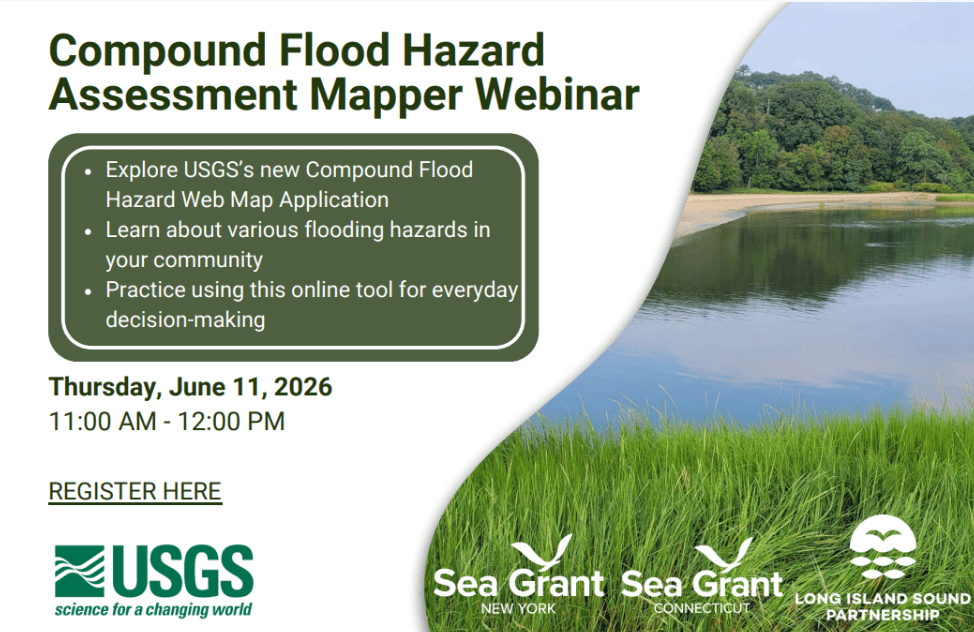
This webinar is hosted by New York Sea Grant, Connecticut Sea Grant, and the U.S. Geological Survey, with funding from Long Island Sound Partnership.
For questions or more information, email Kathleen Fallon.
SRC Events
Compound Flood Hazard Assessment Mapper Webinar
Join us to learn about the U.S. Geological Survey’s (USGS) new Compound Flood Hazard Assessment Mapper. During this virtual webinar, geared towards municipal staff, state agencies, and other partners, you will learn how USGS developed this new tool and how to utilize it in planning and decision-making.
This webinar is hosted by New York Sea Grant, Connecticut Sea Grant, and the U.S. Geological Survey, with funding from Long Island Sound Partnership.
For questions or more information, email Kathleen Fallon.
Guidance Tool
Level of Effort:
Climate Action Tool
The 2025 expansion of the Climate Action Tool (CAT) allows you to:
1) Access information on climate impacts and vulnerability of species and habitats; and
2) Explore adaptation strategies and actions, related to connectivity, conservation planning, and forestry, among other relevant areas.
This tool was developed by the Northeast Climate Adaptation Science Center and the University of Massachusetts Amherst (UMass) Center for Agriculture, Food, and the Environment.
Guidance Tool
Level of Effort:
Climate Action Tool
The 2025 expansion of the Climate Action Tool (CAT) allows you to:
1) Access information on climate impacts and vulnerability of species and habitats; and
2) Explore adaptation strategies and actions, related to connectivity, conservation planning, and forestry, among other relevant areas.
This tool was developed by the Northeast Climate Adaptation Science Center and the University of Massachusetts Amherst (UMass) Center for Agriculture, Food, and the Environment.
Funding
: Mar 26 – Jun 26, 2026
NYSDOS Community Resilience & Flood Risk Reduction Grants
$40 million is available through the NYS Department of State (DOS) in two categories — $20 million for Coastal Rehabilitation and Resilience, which includes projects that will strengthen climate resiliency within, and draining into, the New York State Coastal Area and the Coastal Nonpoint Source Boundary; and $20 million for Inland Flooding and Local Waterfront Revitalization Program Implementation, which includes climate resiliency projects for eligible communities that have participated in the DOS Local Waterfront Revitalization Program (LWRP). Grants are available for final design and construction, or construction-only. Projects should prioritize nature-based and natural solutions where feasible and co-benefits. Applicants are encouraged to submit projects that address and utilize the NYSDOS Resilience Principles in their development. The minimum grant request is $300,000 per Coastal Rehabilitation and Restoration Projects grant application and $150,000 per Inland Flooding and LWRP Implementation Projects grant application.
Funding
: Mar 26 – Jun 26, 2026
NYSDOS Community Resilience & Flood Risk Reduction Grants
$40 million is available through the NYS Department of State (DOS) in two categories — $20 million for Coastal Rehabilitation and Resilience, which includes projects that will strengthen climate resiliency within, and draining into, the New York State Coastal Area and the Coastal Nonpoint Source Boundary; and $20 million for Inland Flooding and Local Waterfront Revitalization Program Implementation, which includes climate resiliency projects for eligible communities that have participated in the DOS Local Waterfront Revitalization Program (LWRP). Grants are available for final design and construction, or construction-only. Projects should prioritize nature-based and natural solutions where feasible and co-benefits. Applicants are encouraged to submit projects that address and utilize the NYSDOS Resilience Principles in their development. The minimum grant request is $300,000 per Coastal Rehabilitation and Restoration Projects grant application and $150,000 per Inland Flooding and LWRP Implementation Projects grant application.
Story Map
Level of Effort:
Long Island Sound Lawn Fertilizer Outreach Targeting Tool
Nitrogen (N) from residential lawn fertilizer is one of the most challenging and persistent problems impacting the health of Long Island Sound (LIS). An interdisciplinary team of researchers from Clark University, the University of Connecticut, the University of Maryland, and the University of Miami collaborated on an effort to better target education and outreach campaigns to reduce the use of lawn fertilizer in areas of greatest impact.
This Story Map and the associated Lawn Fertilizer Outreach Targeting Tool can help identify areas of the watershed for which interventions to reduce lawn fertilizer may have greater impacts.
Story Map
Level of Effort:
Long Island Sound Lawn Fertilizer Outreach Targeting Tool
Nitrogen (N) from residential lawn fertilizer is one of the most challenging and persistent problems impacting the health of Long Island Sound (LIS). An interdisciplinary team of researchers from Clark University, the University of Connecticut, the University of Maryland, and the University of Miami collaborated on an effort to better target education and outreach campaigns to reduce the use of lawn fertilizer in areas of greatest impact.
This Story Map and the associated Lawn Fertilizer Outreach Targeting Tool can help identify areas of the watershed for which interventions to reduce lawn fertilizer may have greater impacts.
Funding
: Mar 25 – May 22, 2026
FY24 & 25 Building Resilient Infrastructure and Communities Grants (BRIC) – New York
The Federal Emergency Management Agency (FEMA) Building Resilient Infrastructure and Communities (BRIC) grant program makes federal funds available to states, U.S. territories, federally recognized tribal governments, and local governments for hazard mitigation activities. It does so by recognizing the need to upgrade and modernize the nation’s infrastructure against the growing risks to communities and the need for natural hazard risk mitigation activities that promote resilience with respect to natural hazards. $1B total is available.
The New York State Division of Homeland Security and Emergency Services (DHSES) is pleased to announce the availability of the Federal Emergency Management Agency (FEMA) Fiscal Year 2024 & 2025 Building Resilient Infrastructure and Communities (BRIC) funding opportunity. Subapplications are due, submitted within FEMAGO (FEMAGO – Login), no later than May 22nd, 2026.
Prioritizes comprehensive, long-term risk reduction strategies that improve public infrastructure, mitigate risk to one or more community lifelines, and support adoption and enforcement of improved/modernized building codes. The following project types are eligible: construction, scoping, planning related activities. Communities and local governments can apply as subapplicants or subawardees. There have been a number of significant changes made to eligibility, documentation requirements, maximum project funding amounts, and terms and conditions within this federal Notice of Funding Opportunity (NOFO) compared to previous years, please read through the NOFO carefully. If you have any questions about the above noted funding opportunity, please send them via email to hazardmitigation@dhses.ny.gov.
Funding
: Mar 25 – May 22, 2026
FY24 & 25 Building Resilient Infrastructure and Communities Grants (BRIC) – New York
The Federal Emergency Management Agency (FEMA) Building Resilient Infrastructure and Communities (BRIC) grant program makes federal funds available to states, U.S. territories, federally recognized tribal governments, and local governments for hazard mitigation activities. It does so by recognizing the need to upgrade and modernize the nation’s infrastructure against the growing risks to communities and the need for natural hazard risk mitigation activities that promote resilience with respect to natural hazards. $1B total is available.
The New York State Division of Homeland Security and Emergency Services (DHSES) is pleased to announce the availability of the Federal Emergency Management Agency (FEMA) Fiscal Year 2024 & 2025 Building Resilient Infrastructure and Communities (BRIC) funding opportunity. Subapplications are due, submitted within FEMAGO (FEMAGO – Login), no later than May 22nd, 2026.
Funding
: Mar 25 – Jul 1, 2026
max $1-$25M depending on category
FY24 & 25 Building Resilient Infrastructure and Communities Grants (BRIC) – Connecticut
The Federal Emergency Management Agency (FEMA) Building Resilient Infrastructure and Communities (BRIC) grant program makes federal funds available to states, U.S. territories, federally recognized tribal governments, and local governments for hazard mitigation activities. It does so by recognizing the need to upgrade and modernize the nation’s infrastructure against the growing risks to communities and the need for natural hazard risk mitigation activities that promote resilience with respect to natural hazards. $1B total is available.
CT DEMHS is pleased to announce that the application period is now open for the Fiscal Year (FY) 2024/2025 BRIC grant program under the FEMA Hazard Mitigation Assistance Program. All sub-applications must be submitted to the State via the FEMA GO system no later than July 1, 2026. DEMHS will host weekly office hours via Microsoft Teams for application assistance. Please contact DEMHS.HMGP@ct.gov with any project-specific questions or to discuss your application strategy under the new requirements.
FEMA has introduced major programmatic shifts this cycle, strictly prioritizing construction-ready physical infrastructure. Federal Program Priorities include: Activities that incentivize natural hazard risk reduction activities that mitigate risk to public infrastructure; Activities that prioritize benefits to disadvantaged communities; Activities that incorporate nature-based solutions; Activities that enhance climate resilience and adaptation; Activities that facilitate the adoption and enforcement of the latest published editions of building codes.
Funding
: Mar 25 – Jul 1, 2026
max $1-$25M depending on category
FY24 & 25 Building Resilient Infrastructure and Communities Grants (BRIC) – Connecticut
The Federal Emergency Management Agency (FEMA) Building Resilient Infrastructure and Communities (BRIC) grant program makes federal funds available to states, U.S. territories, federally recognized tribal governments, and local governments for hazard mitigation activities. It does so by recognizing the need to upgrade and modernize the nation’s infrastructure against the growing risks to communities and the need for natural hazard risk mitigation activities that promote resilience with respect to natural hazards. $1B total is available.
CT DEMHS is pleased to announce that the application period is now open for the Fiscal Year (FY) 2024/2025 BRIC grant program under the FEMA Hazard Mitigation Assistance Program. All sub-applications must be submitted to the State via the FEMA GO system no later than July 1, 2026. DEMHS will host weekly office hours via Microsoft Teams for application assistance. Please contact DEMHS.HMGP@ct.gov with any project-specific questions or to discuss your application strategy under the new requirements.
Funding
: Mar 6 – Apr 6, 2026
typically $100K-$2M
FY27 Congressionally Directed Spending / Community Project Funding
Congressionally Directed Spending requests, also known as Community Project Funding or Earmarks, are funding requests for high-impact, Connecticut-based projects that can be completed with assistance from the federal government. In Connecticut, applications go through the offices of Senator Blumenthal and Senator Murphy. The project must meet the eligibility requirements for at least one of the accounts listed.
Please note, you only need to submit one application for each project and it will be sent to both offices. Requests may be made for the following bills: 1) Agriculture, Rural Development, Food and Drug Administration, and Related Agencies; 2) Commerce, Justice, Science, and Related Agencies; 3) Energy and Water Development; 4) Financial Services and General Government; 5) Homeland Security; 6) Interior, Environment, and Related Agencies; 7) Labor, Health, and Human Services, Education, and Related Agencies; 8) Transportation, Housing and Urban Development, and Related Agencies; 9) Military Construction, Veteran Affairs, and Related Agencies.
Funding
: Mar 6 – Apr 6, 2026
typically $100K-$2M
FY27 Congressionally Directed Spending / Community Project Funding
Congressionally Directed Spending requests, also known as Community Project Funding or Earmarks, are funding requests for high-impact, Connecticut-based projects that can be completed with assistance from the federal government. In Connecticut, applications go through the offices of Senator Blumenthal and Senator Murphy. The project must meet the eligibility requirements for at least one of the accounts listed.
SRC Events
3rd Annual SRC Regional Funding Workshop: Connecticut
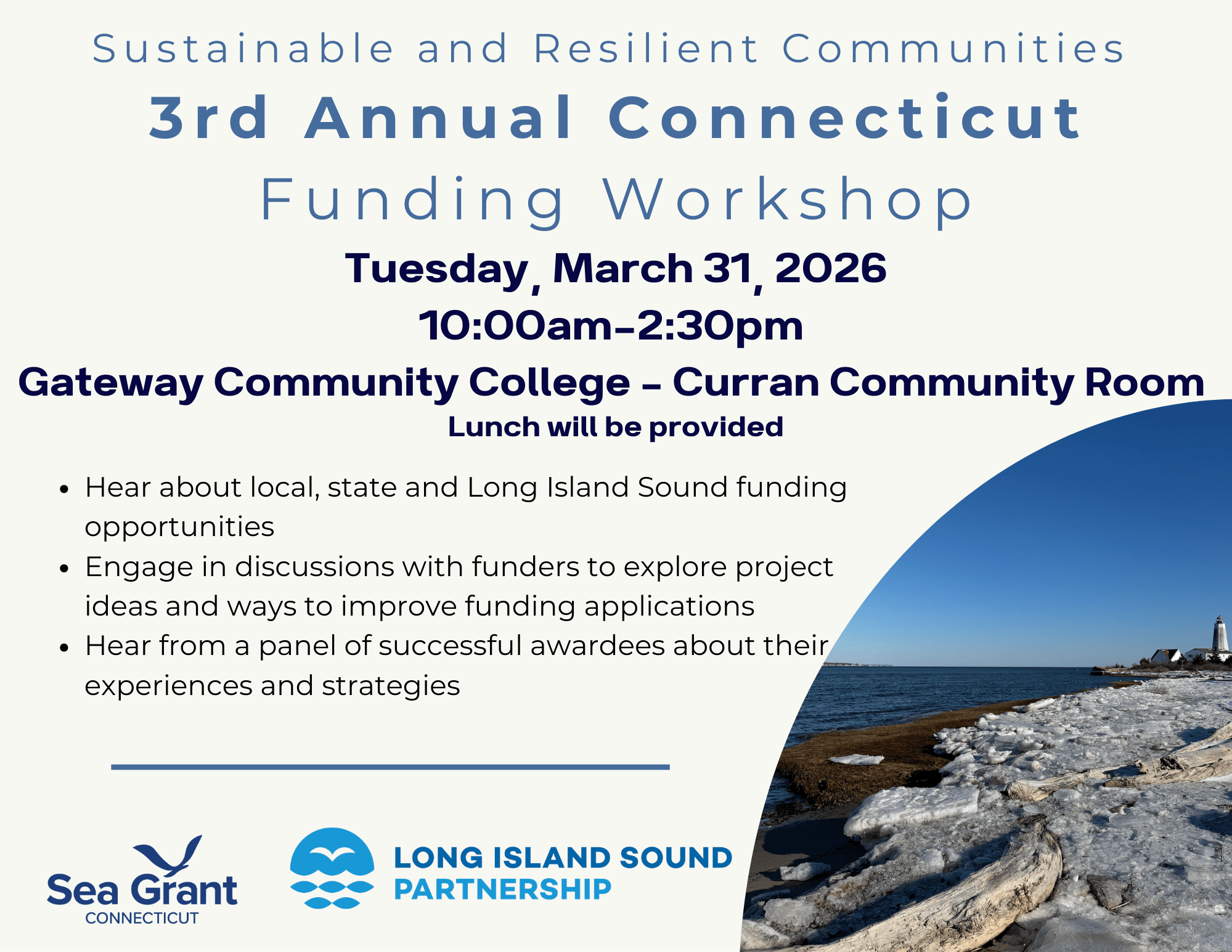
Please join the Long Island Sound Partnership and the CT Sea Grant Sustainable and Resilient Communities (SRC) team at the 3rd Annual SRC Funding Workshop for Connecticut! The event is free and lunch will be provided.
Date: Tuesday, March 31, 2026
Time: 9:30am – 2:30pm (lunch will be provided)
Location: Gateway Community College – Curran Community Room (N100), 20 Church St, New Haven, CT 06510
Registration will be required by March 26th
Attendees will hear from program officers representing various local, state, and regional funding organizations and be able to engage in discussions with funders to explore project ideas and ways to improve funding applications. Attendees will also hear from a panel of successful awardees about their experiences and strategies. The workshop is intended for municipal officials and staff, nonprofits, community organizations, and other interested groups in the Long Island Sound region.
Draft Agenda:
- Lightning Talk Presentations from Funders – local, state, federal, and Long Island Sound-focused funding opportunities
- Lunch (provided)
- Successful Awardees Panel – Hear from communities that have been successful in applying to these grant opportunities
- Roundtable Discussions – Participants encouraged to interact with funders and panelists
Featured Funding Opportunities:
- Community Foundation of Eastern Connecticut
- Congressionally Directed Spending
- CT Bipartisan Infrastructure Law Team (CTBILT) & CT Fed Funds Team
- CT DECD Community Investment Fund
- CT DECD Office of Brownfield Remediation & Development
- CT DEEP CERCLA 128(a) Brownfield Grant Program
- CT DEEP Climate Resilience Fund
- CT DEEP Open Space and Watershed Land Acquisition Grant Program
- CT DEEP Recreational Trails
- CT DEEP Section 319 Nonpoint Source Grants
- CT DEEP Urban Green & Community Gardens Grant Program
- CT Federal Funding Planning Team
- CT Land Conservation Council
- Long Island Sound Community Impact Fund
- Long Island Sound Futures Fund
- Long Island Sound Stewardship Fund
- New England Environmental Finance Center
- UConn Technical Assistance to Brownfields (TAB)
Email lisresilience@gmail.com with questions.
SRC Events
3rd Annual SRC Regional Funding Workshop: Connecticut
Please join the Long Island Sound Partnership and the CT Sea Grant Sustainable and Resilient Communities (SRC) team at the 3rd Annual SRC Funding Workshop for Connecticut! The event is free and lunch will be provided.
Date: Tuesday, March 31, 2026
Time: 9:30am – 2:30pm (lunch will be provided)
Location: Gateway Community College – Curran Community Room (N100), 20 Church St, New Haven, CT 06510
Registration will be required by March 26th
Attendees will hear from program officers representing various local, state, and regional funding organizations and be able to engage in discussions with funders to explore project ideas and ways to improve funding applications. Attendees will also hear from a panel of successful awardees about their experiences and strategies. The workshop is intended for municipal officials and staff, nonprofits, community organizations, and other interested groups in the Long Island Sound region.
Draft Agenda:
- Lightning Talk Presentations from Funders – local, state, federal, and Long Island Sound-focused funding opportunities
- Lunch (provided)
- Successful Awardees Panel – Hear from communities that have been successful in applying to these grant opportunities
- Roundtable Discussions – Participants encouraged to interact with funders and panelists
Featured Funding Opportunities:
- Community Foundation of Eastern Connecticut
- Congressionally Directed Spending
- CT Bipartisan Infrastructure Law Team (CTBILT) & CT Fed Funds Team
- CT DECD Community Investment Fund
- CT DECD Office of Brownfield Remediation & Development
- CT DEEP CERCLA 128(a) Brownfield Grant Program
- CT DEEP Climate Resilience Fund
- CT DEEP Open Space and Watershed Land Acquisition Grant Program
- CT DEEP Recreational Trails
- CT DEEP Section 319 Nonpoint Source Grants
- CT DEEP Urban Green & Community Gardens Grant Program
- CT Federal Funding Planning Team
- CT Land Conservation Council
- Long Island Sound Community Impact Fund
- Long Island Sound Futures Fund
- Long Island Sound Stewardship Fund
- New England Environmental Finance Center
- UConn Technical Assistance to Brownfields (TAB)
Email lisresilience@gmail.com with questions.
Funding
: Feb 3 – Mar 26, 2026
typically $150,000-350,000
DEEP Clean Water Act Section 319 Nonpoint Source Grants
The Connecticut Department of Energy and Environmental Protection (DEEP) is now accepting proposals for fiscal year 2025 Clean Water Section 319 grants. Section 319 of the Federal Clean Water Act (Section 319) is a Federal program to control nonpoint sources (NPS) of water pollution. Connecticut receives funds from EPA for Section 319 grants that can be passed onto communities, local conservation groups, and other organizations for NPS implementation projects, plans, and statewide NPS management efforts.
Priority projects for FY26 include: Watershed Based Plan Implementation Projects, Watershed Based Plan (WBP) Development, Natural Hazards, and Advancing the Connecticut NPS Management Program Plan.
Funding
: Feb 3 – Mar 26, 2026
typically $150,000-350,000
DEEP Clean Water Act Section 319 Nonpoint Source Grants
The Connecticut Department of Energy and Environmental Protection (DEEP) is now accepting proposals for fiscal year 2025 Clean Water Section 319 grants. Section 319 of the Federal Clean Water Act (Section 319) is a Federal program to control nonpoint sources (NPS) of water pollution. Connecticut receives funds from EPA for Section 319 grants that can be passed onto communities, local conservation groups, and other organizations for NPS implementation projects, plans, and statewide NPS management efforts.
Funding
: Feb 6 – Mar 17, 2026
$1,000 - $4,000
Grow Grants Program
The New England Grassroots Environment Fund awards small grants in support of grassroots efforts and community-based environmental work in New England. The GROW GRANTS program is actively accepting applications from grassroots groups across New England. These grants fund small, volunteer-driven groups in New England working on issues including food access, immigrant support, climate resilience, youth work, mutual aid, and more. This program is geared toward groups with experience organizing in their community and have at least THREE leaders who are actively involved in group decision-making. Grants support groups to deepen their work by further developing a community vision, lowering barriers to participation, identifying new stakeholders, and working to bring more voices and lived experiences into core decision-making processes.
Grow grants prioritize support for community groups who represent a broad range of voices in their community and who are not being reached by other funders. The Grassroots Fund interprets the word 'environment' broadly and provides funding for a wide range of activities.
Funding
: Feb 6 – Mar 17, 2026
$1,000 - $4,000
Grow Grants Program
The New England Grassroots Environment Fund awards small grants in support of grassroots efforts and community-based environmental work in New England. The GROW GRANTS program is actively accepting applications from grassroots groups across New England. These grants fund small, volunteer-driven groups in New England working on issues including food access, immigrant support, climate resilience, youth work, mutual aid, and more. This program is geared toward groups with experience organizing in their community and have at least THREE leaders who are actively involved in group decision-making. Grants support groups to deepen their work by further developing a community vision, lowering barriers to participation, identifying new stakeholders, and working to bring more voices and lived experiences into core decision-making processes.
SRC Events
3rd Annual SRC Regional Funding Workshop: Long Island
Please join the Long Island Sound Partnership and NY Sea Grant Sustainable and Resilient Communities (SRC) team at the 3rd Annual Long Island Funding Workshop! The event is free and lunch will be provided.
Date: Wednesday, March 18, 2026
Time: 9:30 AM – 2:30 PM (lunch will be provided)
Location: Hyatt Regency Long Island (1717 Motor Parkway Hauppauge, NY)
Registration is required
Attendees will hear from program officers representing various local, state, and Long Island Sound funding organizations and be able to engage in discussions with funders to explore project ideas and ways to improve funding applications. Attendees will also hear from a panel of successful awardees about their experiences and strategies. The workshop is intended for municipal officials and staff, nonprofits, community organizations, and other interested parties.
View the Draft Agenda for the list of featured funding opportunities!
Email lisresilience@gmail.com with questions.
SRC Events
3rd Annual SRC Regional Funding Workshop: Long Island
Please join the Long Island Sound Partnership and NY Sea Grant Sustainable and Resilient Communities (SRC) team at the 3rd Annual Long Island Funding Workshop! The event is free and lunch will be provided.
Date: Wednesday, March 18, 2026
Time: 9:30 AM – 2:30 PM (lunch will be provided)
Location: Hyatt Regency Long Island (1717 Motor Parkway Hauppauge, NY)
Registration is required
Attendees will hear from program officers representing various local, state, and Long Island Sound funding organizations and be able to engage in discussions with funders to explore project ideas and ways to improve funding applications. Attendees will also hear from a panel of successful awardees about their experiences and strategies. The workshop is intended for municipal officials and staff, nonprofits, community organizations, and other interested parties.
View the Draft Agenda for the list of featured funding opportunities!
Email lisresilience@gmail.com with questions.
Events
LISCIF’s Annual Region-Wide Learning Exchange
The 3rd Annual Learning Exchange hosted by the Long Island Sound Community Impact Fund (LISCIF) is a collaborative, in person event designed to bring together current and past grant recipients, partners, and community stakeholders working to improve the Long Island Sound region. The event focuses on knowledge sharing, peer learning, and strengthening connections among organizations engaged in environmental justice, climate resilience, and community based solutions. Through facilitated discussions and interactive sessions, participants will have the opportunity to reflect on their work, exchange best practices, and explore shared challenges and successes.
This free event is intended specifically for LISCIF grantees and invited partners and emphasizes accessibility and inclusion, with accommodations available upon request. By fostering dialogue and collaboration across diverse organizations, the Learning Exchange aims to build capacity, encourage cross sector partnerships, and support long term, community driven impact throughout the Long Island Sound watershed.
Events
LISCIF’s Annual Region-Wide Learning Exchange
The 3rd Annual Learning Exchange hosted by the Long Island Sound Community Impact Fund (LISCIF) is a collaborative, in person event designed to bring together current and past grant recipients, partners, and community stakeholders working to improve the Long Island Sound region. The event focuses on knowledge sharing, peer learning, and strengthening connections among organizations engaged in environmental justice, climate resilience, and community based solutions. Through facilitated discussions and interactive sessions, participants will have the opportunity to reflect on their work, exchange best practices, and explore shared challenges and successes.
This free event is intended specifically for LISCIF grantees and invited partners and emphasizes accessibility and inclusion, with accommodations available upon request. By fostering dialogue and collaboration across diverse organizations, the Learning Exchange aims to build capacity, encourage cross sector partnerships, and support long term, community driven impact throughout the Long Island Sound watershed.
Funding
: Dec 3 – Jan 21, 2026
Announcing the 2026 Climate Solutions Challenge
The Trust for Governors Island has announced the launch of the 2026 Climate Solutions Challenge, the third annual cycle of its Climate Piloting Program designed to support early stage climate innovators. This year’s Challenge focuses on the theme of urban climate adaptation, asking how new solutions can help communities remain safe and healthy, reduce disruptions to essential services, and improve overall quality of life in cities. Selected participants will have the opportunity to pilot their climate products and services on Governors Island in New York Harbor, gaining access to rent-free physical space, technical support, visibility through events and marketing, and connections to investors, funders, and public-sector partners.
The Climate Piloting Program runs for 3–18 months and provides a real-world testing environment across Governors Island’s 172-acre campus, including historic buildings and extensive waterfront areas that host more than one million visitors annually. Since launching in 2023, the program has supported projects in living shorelines, clean water, sustainable buildings, circular economy, energy, air quality, and urban agriculture. Applications for the 2026 Challenge are due January 21, 2026, with informational webinars scheduled for December 16 and January 7 and winners expected to be announced in March 2026.
Funding
: Dec 3 – Jan 21, 2026
Announcing the 2026 Climate Solutions Challenge
The Trust for Governors Island has announced the launch of the 2026 Climate Solutions Challenge, the third annual cycle of its Climate Piloting Program designed to support early stage climate innovators. This year’s Challenge focuses on the theme of urban climate adaptation, asking how new solutions can help communities remain safe and healthy, reduce disruptions to essential services, and improve overall quality of life in cities. Selected participants will have the opportunity to pilot their climate products and services on Governors Island in New York Harbor, gaining access to rent-free physical space, technical support, visibility through events and marketing, and connections to investors, funders, and public-sector partners.
Mapper
Level of Effort:
USGS Compound Flood Hazard Web Map
The USGS Long Island Sound Partnership Compound Flood Hazard Web Map Application is an interactive tool developed by the U.S. Geological Survey’s New York Water Science Center that helps users explore the combined impacts of multiple flooding drivers across the New York and Connecticut coastal regions. Drivers of compound flooding included in the assessment were precipitation, coastal (storm surge, tidal), and groundwater emergence, which when combined can lead to more severe and widespread inundation than from any single cause alone.
The map visually displays hazard rankings and spatial patterns of flood drivers so that planners, emergency managers, researchers, and the public can better understand where these flood hazards are most likely to coincide, thus supporting local decision making for flood mitigation, coastal planning, and resilience strategies. The application is based on USGS models and ongoing research into regional flood processes.
Mapper
Level of Effort:
USGS Compound Flood Hazard Web Map
The USGS Long Island Sound Partnership Compound Flood Hazard Web Map Application is an interactive tool developed by the U.S. Geological Survey’s New York Water Science Center that helps users explore the combined impacts of multiple flooding drivers across the New York and Connecticut coastal regions. Drivers of compound flooding included in the assessment were precipitation, coastal (storm surge, tidal), and groundwater emergence, which when combined can lead to more severe and widespread inundation than from any single cause alone.
The map visually displays hazard rankings and spatial patterns of flood drivers so that planners, emergency managers, researchers, and the public can better understand where these flood hazards are most likely to coincide, thus supporting local decision making for flood mitigation, coastal planning, and resilience strategies. The application is based on USGS models and ongoing research into regional flood processes.
Funding
: Jan 5 – Feb 12, 2026
~50-100K
Building Community Capacity for Resiliency
The NY-NJ Harbor & Estuary Program (HEP), housed at the Hudson River Foundation, is offering funding to help local governments and nonprofit organizations strengthen community resilience to recurring extreme weather across the Hudson Raritan Estuary watershed. This Request for Proposals supports projects that advance research, planning, and on the ground infrastructure aimed at reducing climate driven risks such as flooding, storm impacts, and related water quality challenges. A total of $350,000 will be distributed across approximately four to six grants for projects that can be completed by June 30, 2027.
Eligible applicants must be local governments or nonprofits located in or directly serving communities within the Hudson Raritan Estuary region and aligned with HEP’s 2025-2035 Action Agenda. Priority is given to efforts that deliver tangible community benefits. Letters of Inquiry are due February 12, 2026, with selected applicants invited to submit full proposals afterward.
Funding
: Jan 5 – Feb 12, 2026
~50-100K
Building Community Capacity for Resiliency
The NY-NJ Harbor & Estuary Program (HEP), housed at the Hudson River Foundation, is offering funding to help local governments and nonprofit organizations strengthen community resilience to recurring extreme weather across the Hudson Raritan Estuary watershed. This Request for Proposals supports projects that advance research, planning, and on the ground infrastructure aimed at reducing climate driven risks such as flooding, storm impacts, and related water quality challenges. A total of $350,000 will be distributed across approximately four to six grants for projects that can be completed by June 30, 2027.
Funding
: Dec 18 – Jan 16, 2026
Water Resources Development Act (WRDA) 2026
This opportunity allows Connecticut communities to submit water resource project priorities for consideration in the Water Resources Development Act (WRDA) 2026. WRDA is a federal process led by the U.S. Army Corps of Engineers that authorizes studies and projects related to flood risk management, coastal and shoreline protection, dredging and navigation, and ecosystem restoration. Authorization through WRDA is an important first step toward potential federal funding, though it does not guarantee that funding will be awarded. Projects typically require a non-federal cost share and must fall within the mission of the U.S. Army Corps of Engineers. General information is available here: Water Resources Development Acts: Primer and Action in the 119th Congress | Congress.gov | Library of Congress. See the Solicitation Letter at the link for Connecticut-specific guidance.
Connecticut is looking for projects that municipal and state leaders believe are: (1) appropriate for a feasibility study, (2) a priority for the community, and (3) able to allocate a 50 percent local match of the total cost of the study. For projects that have already had a WRDA feasibility study, Connecticut is also accepting construction, operations and maintenance, and other project requests.
Funding
: Dec 18 – Jan 16, 2026
Water Resources Development Act (WRDA) 2026
This opportunity allows Connecticut communities to submit water resource project priorities for consideration in the Water Resources Development Act (WRDA) 2026. WRDA is a federal process led by the U.S. Army Corps of Engineers that authorizes studies and projects related to flood risk management, coastal and shoreline protection, dredging and navigation, and ecosystem restoration. Authorization through WRDA is an important first step toward potential federal funding, though it does not guarantee that funding will be awarded. Projects typically require a non-federal cost share and must fall within the mission of the U.S. Army Corps of Engineers. General information is available here: Water Resources Development Acts: Primer and Action in the 119th Congress | Congress.gov | Library of Congress. See the Solicitation Letter at the link for Connecticut-specific guidance.
Funding
: Nov 26 – Feb 24, 2026
up to $25M
Better Utilizing Investments to Leverage Development (BUILD) Grant Program
The U.S. DOT’s BUILD grant program provides grants for surface transportation infrastructure projects with significant local or regional impact. The eligibility requirements of BUILD allow project sponsors, including state and local governments, counties, Tribal governments, transit agencies, and port authorities, to pursue multi-modal and multi-jurisdictional projects that are more difficult to fund through other grant programs. Projects can be for planning or construction and are evaluated by their ability to address: safety; environmental sustainability; quality of life; mobility and community connectivity; economic competitiveness and opportunity including tourism; state of good repair; partnership and collaboration; and innovation.
The BUILD program was previously known as the Rebuilding American Infrastructure with Sustainability and Equity (RAISE) and Transportation Investment Generating Economic Recovery (TIGER) discretionary grants.
Eligible Capital Project activities include: (1) Highway, bridge, or other road projects eligible under title 23; (2) Public transportation projects eligible under chapter 53 title 49; (3) Passenger and freight rail transportation projects; (4) Port infrastructure investments; (5) Surface transportation components of eligible airport projects; (6) Projects investing in surface transportation facilities located on Tribal land; (7) Projects to replace or rehabilitate a culvert or prevent stormwater runoff for the purpose of improving habitat for aquatic species that will advance the goal of the program; (8) Intermodal projects whose components are otherwise an eligible project type; and (9) Any other surface transportation infrastructure project that the Secretary considers to be necessary to advance the goals of the program. Eligible Planning Project activities include: (1) Planning, preparation, design, or engineering (e.g., feasibility studies, benefit-cost analysis, environmental analysis, permitting, and other pre-construction activities) of eligible surface transportation Capital Projects that will not result in construction with this funding; (2) Development of master plans, comprehensive plans, transportation corridor plans, and integrated economic development, land use, housing, and transportation plans; (3) Planning activities related to the development of a multimodal freight corridor; (4) Development of port and regional port planning, including State-wide or multi-port planning within a single jurisdiction or region; (5) Risk assessments and planning to identify vulnerabilities and address the transportation system’s ability to withstand probable occurrence or recurrence of an emergency or major disaster. Note that applications must be submitted through Valid Eval, not Grants.gov.
Funding
: Nov 26 – Feb 24, 2026
up to $25M
Better Utilizing Investments to Leverage Development (BUILD) Grant Program
The U.S. DOT’s BUILD grant program provides grants for surface transportation infrastructure projects with significant local or regional impact. The eligibility requirements of BUILD allow project sponsors, including state and local governments, counties, Tribal governments, transit agencies, and port authorities, to pursue multi-modal and multi-jurisdictional projects that are more difficult to fund through other grant programs. Projects can be for planning or construction and are evaluated by their ability to address: safety; environmental sustainability; quality of life; mobility and community connectivity; economic competitiveness and opportunity including tourism; state of good repair; partnership and collaboration; and innovation.
The BUILD program was previously known as the Rebuilding American Infrastructure with Sustainability and Equity (RAISE) and Transportation Investment Generating Economic Recovery (TIGER) discretionary grants.
SRC Training
4th Annual SRC Workshop: Session 3 – LIS Resilience Planning Support Program
The Long Island Sound Sustainable and Resilient Communities (SRC) Team held our 2025 Annual Workshop virtually as three sessions over two days. Session topics focused on resources and tools available to help take advantage of state resilience funds, a panel discussion on why and how to incorporate nature-based solutions into resilience planning, and an overview of our available assistance programs.
Session 3 – LIS Resilience Planning Support Program: New Round Available & Showcase of Completed Projects was held on Friday, December 5, 2025. Participants learned about the newly available 3rd round of the LIS Resilience Planning Support Program and heard from three communities who received awards through the first round of the Program. Video of the session along with supporting materials is available below.

SRC Training
4th Annual SRC Workshop: Session 3 – LIS Resilience Planning Support Program
The Long Island Sound Sustainable and Resilient Communities (SRC) Team held our 2025 Annual Workshop virtually as three sessions over two days. Session topics focused on resources and tools available to help take advantage of state resilience funds, a panel discussion on why and how to incorporate nature-based solutions into resilience planning, and an overview of our available assistance programs.
Session 3 – LIS Resilience Planning Support Program: New Round Available & Showcase of Completed Projects was held on Friday, December 5, 2025. Participants learned about the newly available 3rd round of the LIS Resilience Planning Support Program and heard from three communities who received awards through the first round of the Program. Video of the session along with supporting materials is available below.
SRC Training
4th Annual SRC Workshop: Session 2 – Using Nature-Based Solutions for Resilience
The Long Island Sound Sustainable and Resilient Communities (SRC) Team held our 2025 Annual Workshop virtually as three sessions over two days. Session topics focused on resources and tools available to help take advantage of state resilience funds, a panel discussion on why and how to incorporate nature-based solutions into resilience planning, and an overview of our available assistance programs.
Session 2 – Using Nature-Based Solutions for Resilience: A Panel Discussion on Common Challenges & Strategies for Success was held on Thursday, December 4, 2025. In this interactive session, practitioners and experts discussed techniques for integrating nature-based solutions into resilience initiatives. The panel highlighted common challenges and shared successful strategies from projects in the Long Island Sound region. Video of the session along with supporting materials is available below.
SRC Training
4th Annual SRC Workshop: Session 2 – Using Nature-Based Solutions for Resilience
The Long Island Sound Sustainable and Resilient Communities (SRC) Team held our 2025 Annual Workshop virtually as three sessions over two days. Session topics focused on resources and tools available to help take advantage of state resilience funds, a panel discussion on why and how to incorporate nature-based solutions into resilience planning, and an overview of our available assistance programs.
Session 2 – Using Nature-Based Solutions for Resilience: A Panel Discussion on Common Challenges & Strategies for Success was held on Thursday, December 4, 2025. In this interactive session, practitioners and experts discussed techniques for integrating nature-based solutions into resilience initiatives. The panel highlighted common challenges and shared successful strategies from projects in the Long Island Sound region. Video of the session along with supporting materials is available below.
SRC Training
4th Annual SRC Workshop: Session 1 – Resilience 101
The Long Island Sound Sustainable and Resilient Communities (SRC) Team held our 2025 Annual Workshop virtually as three sessions over two days. Session topics focused on resources and tools available to help take advantage of state resilience funds, a panel discussion on why and how to incorporate nature-based solutions into resilience planning, and an overview of our available assistance programs.
Session 1 – Resilience 101: Helpful Tools and Strategies for Building Community Resilience was held on Thursday, December 4, 2025. Participants learned about available resilience resources and tools and then moved into breakout rooms to hear about state climate certification programs and resilience funds in both NY and CT. Videos of the main session and both breakout rooms are available below, along with supporting materials.
SRC Training
4th Annual SRC Workshop: Session 1 – Resilience 101
The Long Island Sound Sustainable and Resilient Communities (SRC) Team held our 2025 Annual Workshop virtually as three sessions over two days. Session topics focused on resources and tools available to help take advantage of state resilience funds, a panel discussion on why and how to incorporate nature-based solutions into resilience planning, and an overview of our available assistance programs.
Session 1 – Resilience 101: Helpful Tools and Strategies for Building Community Resilience was held on Thursday, December 4, 2025. Participants learned about available resilience resources and tools and then moved into breakout rooms to hear about state climate certification programs and resilience funds in both NY and CT. Videos of the main session and both breakout rooms are available below, along with supporting materials.
Events
UConn CLEAR Webinar: Connecticut’s Lidar and Orthoimagery
UConn CLEAR is offering a series of engaging webinars this winter, including an in-depth session on Connecticut’s ongoing Lidar and orthoimagery project. This presentation will explore the statewide effort that began in 2022 and continues through 2026. Speakers from Dewberry will explain the data products created from the 2023 acquisition and highlight how these datasets are being used in planning, mapping, environmental analysis, and other geospatial applications. The session is designed to help participants understand the importance of high quality elevation and imagery data in supporting statewide decision making.
The webinar will also discuss potential uses for these datasets in the coming years and provide a preview of the planned 2026 acquisition and delivery. Participants will gain insight into how Lidar and orthoimagery support climate resilience work, infrastructure planning, land use analysis, and broader environmental assessments. This session is open to anyone interested in geospatial data, statewide imagery, or Connecticut’s evolving GIS resources, and registration is available through UConn CLEAR.
Events
UConn CLEAR Webinar: Connecticut’s Lidar and Orthoimagery
UConn CLEAR is offering a series of engaging webinars this winter, including an in-depth session on Connecticut’s ongoing Lidar and orthoimagery project. This presentation will explore the statewide effort that began in 2022 and continues through 2026. Speakers from Dewberry will explain the data products created from the 2023 acquisition and highlight how these datasets are being used in planning, mapping, environmental analysis, and other geospatial applications. The session is designed to help participants understand the importance of high quality elevation and imagery data in supporting statewide decision making.
The webinar will also discuss potential uses for these datasets in the coming years and provide a preview of the planned 2026 acquisition and delivery. Participants will gain insight into how Lidar and orthoimagery support climate resilience work, infrastructure planning, land use analysis, and broader environmental assessments. This session is open to anyone interested in geospatial data, statewide imagery, or Connecticut’s evolving GIS resources, and registration is available through UConn CLEAR.
Events
UConn CLEAR Webinar
This UConn CLEAR webinar provides an updated overview of Connecticut’s ongoing statewide Lidar and orthoimagery project. Dewberry’s technical team will introduce the data products generated from the 2023 acquisition and explain how these datasets are being used across environmental planning, land management, infrastructure mapping, and community decision-making. The session is designed to help participants understand the value of high resolution elevation and imagery data and how these resources support public agencies, researchers, and local communities.
The webinar will also look ahead to the 2026 phase of the project, offering insight into expected updates, new deliverables, and potential applications for longterm statewide planning. Attendees will gain a stronger understanding of how Lidar and orthoimagery fit into Connecticut’s geospatial data strategy and how these datasets can support climate resilience, hazard mapping, and improved environmental analysis. This session is open to anyone interested in GIS, remote sensing, or the state’s evolving geospatial data resources.
Events
UConn CLEAR Webinar
This UConn CLEAR webinar provides an updated overview of Connecticut’s ongoing statewide Lidar and orthoimagery project. Dewberry’s technical team will introduce the data products generated from the 2023 acquisition and explain how these datasets are being used across environmental planning, land management, infrastructure mapping, and community decision-making. The session is designed to help participants understand the value of high resolution elevation and imagery data and how these resources support public agencies, researchers, and local communities.
The webinar will also look ahead to the 2026 phase of the project, offering insight into expected updates, new deliverables, and potential applications for longterm statewide planning. Attendees will gain a stronger understanding of how Lidar and orthoimagery fit into Connecticut’s geospatial data strategy and how these datasets can support climate resilience, hazard mapping, and improved environmental analysis. This session is open to anyone interested in GIS, remote sensing, or the state’s evolving geospatial data resources.
Mapper
Level of Effort:
NYC Stormwater Flood Maps
The NYC Stormwater Flood Maps show areas in New York City that are at risk of flooding during heavy rain. The tool provides interactive maps that let users explore neighborhood-level flood risk and understand how stormwater might affect streets, homes, and critical infrastructure. It helps residents, planners, and local organizations identify vulnerable areas and make decisions about preparedness, emergency planning, and long-term resilience.
These maps also bring together important environmental and social data, making it easier to compare neighborhoods, see patterns, and understand which communities may face the greatest challenges during extreme weather.
Mapper
Level of Effort:
NYC Stormwater Flood Maps
The NYC Stormwater Flood Maps show areas in New York City that are at risk of flooding during heavy rain. The tool provides interactive maps that let users explore neighborhood-level flood risk and understand how stormwater might affect streets, homes, and critical infrastructure. It helps residents, planners, and local organizations identify vulnerable areas and make decisions about preparedness, emergency planning, and long-term resilience.
These maps also bring together important environmental and social data, making it easier to compare neighborhoods, see patterns, and understand which communities may face the greatest challenges during extreme weather.
Mapper
Level of Effort:
NYC Flood Hazard Mapper
The NYC Flood Hazard Mapper is an interactive tool created by the NYC Department of City Planning to help residents, businesses, and planners understand flood risks across New York City. It provides maps showing current coastal flood hazards, FEMA flood zones, and areas that may be affected by sea level rise in the future. By searching an address or exploring different map layers, users can see how flooding may impact specific neighborhoods today and under future climate conditions.
This resource is designed to support safer decision making as the frequency and severity of flooding increases. While the mapper offers valuable visual data and projections, it is meant for general information only and should not replace official FEMA resources or professional guidance. Users are encouraged to use this tool as a starting point to learn about local flood exposure and to explore how environmental changes may affect communities throughout the city.
Mapper
Level of Effort:
NYC Flood Hazard Mapper
The NYC Flood Hazard Mapper is an interactive tool created by the NYC Department of City Planning to help residents, businesses, and planners understand flood risks across New York City. It provides maps showing current coastal flood hazards, FEMA flood zones, and areas that may be affected by sea level rise in the future. By searching an address or exploring different map layers, users can see how flooding may impact specific neighborhoods today and under future climate conditions.
This resource is designed to support safer decision making as the frequency and severity of flooding increases. While the mapper offers valuable visual data and projections, it is meant for general information only and should not replace official FEMA resources or professional guidance. Users are encouraged to use this tool as a starting point to learn about local flood exposure and to explore how environmental changes may affect communities throughout the city.
Funding
: Oct 23 – Nov 21, 2025
$200,000-500,000
National Estuary Program Watersheds Grant Program
The National Estuary Program (NEP) Watersheds Grant Program is a nationally competitive grants addressing the most pressing threats to estuarine health within the 28 NEP boundary areas. This program is offered through Restore America’s Estuaries, with funding from the U.S. EPA.
Program priorities include: 1) Habitat loss (wetlands, seagrass, mangroves, reefs), 2) Coastal resilience and sea level rise, 3) Nutrient pollution, 4) Stormwater impacts and erosion, and 5) Invasive species and marine mammal mortalities.
Funding
: Oct 23 – Nov 21, 2025
$200,000-500,000
National Estuary Program Watersheds Grant Program
The National Estuary Program (NEP) Watersheds Grant Program is a nationally competitive grants addressing the most pressing threats to estuarine health within the 28 NEP boundary areas. This program is offered through Restore America’s Estuaries, with funding from the U.S. EPA.
Funding
: Aug 19, 2026
Emergency Watershed Protection (EWP) & EWP Floodplain Easement Programs
The USDA Emergency Watershed Protection (EWP) and Floodplain Easement Programs provide post-disaster assistance to reduce risks to life and property in damaged watersheds. These programs fund immediate and long-term recovery actions such as debris removal, streambank stabilization, drainage system repair, levee restoration, and floodplain easements. Assistance is available to help communities recover after natural disasters and strengthen resilience against future flooding impacts. Grant Fact Sheet.
Eligible entities must submit applications within 60 days of the disaster event. Funding supports activities including debris removal, erosion reduction, vegetative restoration, repair of damaged infrastructure, and voluntary property buyouts or easements to restore natural floodplain function. The 60-day deadline may be waived for property acquisitions in NRCS-designated limited-resource areas. Applicants must work with a local sponsor, and most projects include a local cost-share component. These programs are administered by the USDA Natural Resources Conservation Service (NRCS) to reduce watershed hazards and improve long-term resilience.
Funding
: Aug 19, 2026
Emergency Watershed Protection (EWP) & EWP Floodplain Easement Programs
The USDA Emergency Watershed Protection (EWP) and Floodplain Easement Programs provide post-disaster assistance to reduce risks to life and property in damaged watersheds. These programs fund immediate and long-term recovery actions such as debris removal, streambank stabilization, drainage system repair, levee restoration, and floodplain easements. Assistance is available to help communities recover after natural disasters and strengthen resilience against future flooding impacts. Grant Fact Sheet.
Mapper
Level of Effort:
Resilience and Adaptation in New England (RAINE) Database
Explore a range of tools and guidance to support climate adaptation planning through EPA New England’s Resilience and Adaptation in New England (RAINE) initiative, which supports users in exploring climate resilience planning across the New England. These resources include more than 1,200 climate adaptation plans. Practitioners can use the Featured Locations Interactive Map to view climate action examples or explore additional climate visualization platforms through the Mapping Climate Change Impacts Tools page. The database also highlights Tribal Climate Adaptation Resources, featuring plans from federally recognized tribes in New England. Users can view recorded webinars and trainings for technical guidance.
Mapper
Level of Effort:
Resilience and Adaptation in New England (RAINE) Database
Explore a range of tools and guidance to support climate adaptation planning through EPA New England’s Resilience and Adaptation in New England (RAINE) initiative, which supports users in exploring climate resilience planning across the New England. These resources include more than 1,200 climate adaptation plans. Practitioners can use the Featured Locations Interactive Map to view climate action examples or explore additional climate visualization platforms through the Mapping Climate Change Impacts Tools page. The database also highlights Tribal Climate Adaptation Resources, featuring plans from federally recognized tribes in New England. Users can view recorded webinars and trainings for technical guidance.
Website
Level of Effort:
GSI Impact Hub
The GSI Impact Hub is an interactive platform that provides tools, research, and data to help communities plan and evaluate green stormwater infrastructure (GSI) projects. GSI uses natural systems like plants, soil, and stone to manage stormwater on-site reducing flooding, improving water quality, and creating healthier, more resilient neighborhoods. The Hub includes a benefits calculator, educational resources, and guidance to support city planners, advocates, and policymakers in designing projects that maximize environmental, social, and economic benefits.
Explore the GSI Impact Calculator, Detailed Resource Library, and Project Background to better understand how GSI can reduce flooding, improve water quality, and build climate-resilient neighborhoods.
Website
Level of Effort:
GSI Impact Hub
The GSI Impact Hub is an interactive platform that provides tools, research, and data to help communities plan and evaluate green stormwater infrastructure (GSI) projects. GSI uses natural systems like plants, soil, and stone to manage stormwater on-site reducing flooding, improving water quality, and creating healthier, more resilient neighborhoods. The Hub includes a benefits calculator, educational resources, and guidance to support city planners, advocates, and policymakers in designing projects that maximize environmental, social, and economic benefits.
Explore the GSI Impact Calculator, Detailed Resource Library, and Project Background to better understand how GSI can reduce flooding, improve water quality, and build climate-resilient neighborhoods.
SRC Events
4th Annual SRC Workshop – Session 3
LIS Resilience Planning Support Program: New Round Available & Showcase of Completed Projects
The Long Island Sound Sustainable and Resilient Communities Team is excited to announce that for our 2025 Annual Workshop we are holding a series of three virtual sessions over two days focused on resources and tools available to help in taking advantage of state resilience funds, a panel discussion on why and how to incorporate nature-based solutions into resilience planning, and an overview of our available assistance programs.
Join us on Friday, December 5 from 10-11:30 AM to learn about the Long Island Sound Resilience Planning Support Program. This assistance opportunity has been available to communities on a yearly basis since Fall 2023, and the next round will open on December 1, 2025 – so this is your chance to get all the details! This session will also feature communities who received support through the first round, who will share about their experience and planned next steps.
More information, including panelist bios, will be provided to all registrants closer to the Workshop.
SRC Events
4th Annual SRC Workshop – Session 3
LIS Resilience Planning Support Program: New Round Available & Showcase of Completed Projects
The Long Island Sound Sustainable and Resilient Communities Team is excited to announce that for our 2025 Annual Workshop we are holding a series of three virtual sessions over two days focused on resources and tools available to help in taking advantage of state resilience funds, a panel discussion on why and how to incorporate nature-based solutions into resilience planning, and an overview of our available assistance programs.
Join us on Friday, December 5 from 10-11:30 AM to learn about the Long Island Sound Resilience Planning Support Program. This assistance opportunity has been available to communities on a yearly basis since Fall 2023, and the next round will open on December 1, 2025 – so this is your chance to get all the details! This session will also feature communities who received support through the first round, who will share about their experience and planned next steps.
More information, including panelist bios, will be provided to all registrants closer to the Workshop.
SRC Events
4th Annual SRC Workshop – Session 2
Using Nature-Based Solutions for Resilience: A Panel Discussion on Common Challenges & Strategies for Success
The Long Island Sound Sustainable and Resilient Communities Team is excited to announce that for our 2025 Annual Workshop we are holding a series of three virtual sessions over two days focused on resources and tools available to help in taking advantage of state resilience funds, a panel discussion on why and how to incorporate nature-based solutions into resilience planning, and an overview of our available assistance programs.
Join us on Thursday, December 4 from 1-3 PM to learn why and how to incorporate nature-based solutions into resilience planning and projects. This interactive session will feature communities and practitioners who have encountered challenges and found success using nature-based solutions in the Long Island Sound region.
More information, including panelist bios, will be provided to all registrants closer to the Workshop.
SRC Events
4th Annual SRC Workshop – Session 2
Using Nature-Based Solutions for Resilience: A Panel Discussion on Common Challenges & Strategies for Success
The Long Island Sound Sustainable and Resilient Communities Team is excited to announce that for our 2025 Annual Workshop we are holding a series of three virtual sessions over two days focused on resources and tools available to help in taking advantage of state resilience funds, a panel discussion on why and how to incorporate nature-based solutions into resilience planning, and an overview of our available assistance programs.
Join us on Thursday, December 4 from 1-3 PM to learn why and how to incorporate nature-based solutions into resilience planning and projects. This interactive session will feature communities and practitioners who have encountered challenges and found success using nature-based solutions in the Long Island Sound region.
More information, including panelist bios, will be provided to all registrants closer to the Workshop.
SRC Events
4th Annual SRC Workshop – Session 1
Resilience 101: Helpful Tools & Strategies for Building Community Resilience
The Long Island Sound Sustainable and Resilient Communities Team is excited to announce that for our 2025 Annual Workshop we are holding a series of three virtual sessions over two days focused on resources and tools available to help in taking advantage of state resilience funds, a panel discussion on why and how to incorporate nature-based solutions into resilience planning, and an overview of our available assistance programs.
Join us on Thursday, December 4 from 10 AM-12 PM to learn more about resilience planning basics, including local climate impacts and projections, state climate certification programs, and available tools & resources.
More information, including panelist bios, will be provided to all registrants closer to the Workshop.
SRC Events
4th Annual SRC Workshop – Session 1
Resilience 101: Helpful Tools & Strategies for Building Community Resilience
The Long Island Sound Sustainable and Resilient Communities Team is excited to announce that for our 2025 Annual Workshop we are holding a series of three virtual sessions over two days focused on resources and tools available to help in taking advantage of state resilience funds, a panel discussion on why and how to incorporate nature-based solutions into resilience planning, and an overview of our available assistance programs.
Join us on Thursday, December 4 from 10 AM-12 PM to learn more about resilience planning basics, including local climate impacts and projections, state climate certification programs, and available tools & resources.
More information, including panelist bios, will be provided to all registrants closer to the Workshop.
Resource
Long Island Watershed Action Agenda
The Long Island Watershed Action Agenda is a clear-cut blueprint for water quality improvements, aquatic habitat conservation, groundwater protection, and the public engagement necessary to ensure success for the surface, coastal, and ground waters of Nassau and Suffolk counties. The Long Island Watershed Action Agenda is an evolution of the success of the Long Island Nitrogen Action Plan (LINAP) and will expand the scope of its work beyond nitrogen reduction.
Resource
Long Island Watershed Action Agenda
The Long Island Watershed Action Agenda is a clear-cut blueprint for water quality improvements, aquatic habitat conservation, groundwater protection, and the public engagement necessary to ensure success for the surface, coastal, and ground waters of Nassau and Suffolk counties. The Long Island Watershed Action Agenda is an evolution of the success of the Long Island Nitrogen Action Plan (LINAP) and will expand the scope of its work beyond nitrogen reduction.
SRC Training
Suffolk County Coastal Resilience Forum & Field Trip – 2025
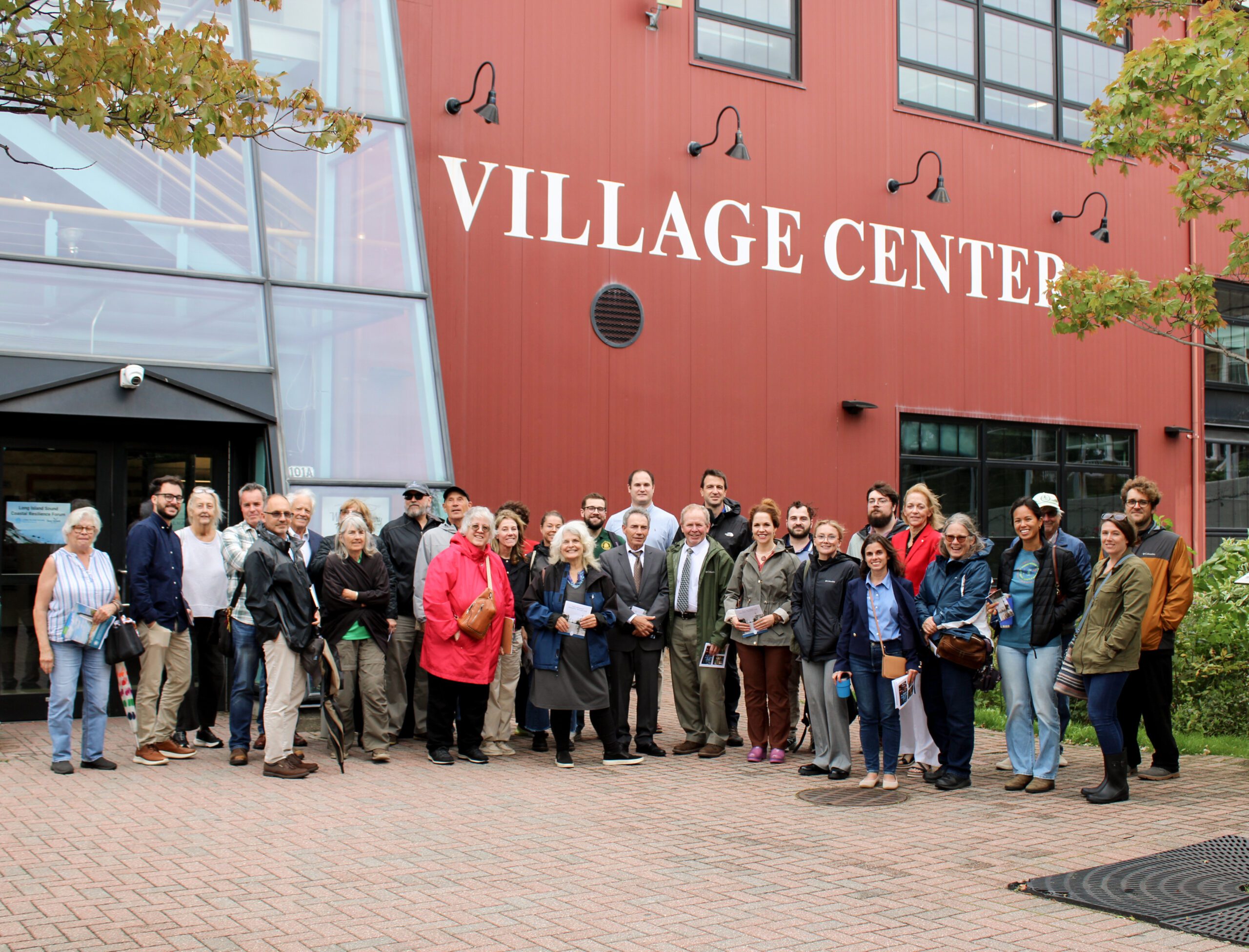
On October 8, 2025 state and local decision makers, municipal staff, and other interested parties working to address flooding, shoreline erosion and other coastal issues gathered at the Port Jefferson Village Center in Port Jefferson, NY for the 3rd Annual Suffolk County Coastal Resilience Forum. The Forum provided a chance to share information on best practices, discuss challenges, identify opportunities to increase resilience, and enhance coordination across communities. Forum attendees heard updates on State resilience initiatives from the NYS Department of Environmental Conservation and NYS Division of Homeland Security and Emergency Services, as well as presentations on new resilience tools and resources from Seatuck Environmental Association, the U.S. Geological Survey, New York Sea Grant, and Suffolk County Soil and Water Conservation District. In the afternoon, Village of Port Jefferson Mayor, Lauren Sheprow, presented on the Village’s resilience issues and initiatives and then led attendees on a walking tour of the Village highlighting flooding hotspots, challenges faced by local businesses and residents, and efforts to help mitigate flooding and increase community resilience.
The event was hosted by Long Island Sound Partnership and New York Sea Grant, in partnership with the Village of Port Jefferson and Suffolk County Soil and Water Conservation District.

SRC Training
Suffolk County Coastal Resilience Forum & Field Trip – 2025
On October 8, 2025 state and local decision makers, municipal staff, and other interested parties working to address flooding, shoreline erosion and other coastal issues gathered at the Port Jefferson Village Center in Port Jefferson, NY for the 3rd Annual Suffolk County Coastal Resilience Forum. The Forum provided a chance to share information on best practices, discuss challenges, identify opportunities to increase resilience, and enhance coordination across communities. Forum attendees heard updates on State resilience initiatives from the NYS Department of Environmental Conservation and NYS Division of Homeland Security and Emergency Services, as well as presentations on new resilience tools and resources from Seatuck Environmental Association, the U.S. Geological Survey, New York Sea Grant, and Suffolk County Soil and Water Conservation District. In the afternoon, Village of Port Jefferson Mayor, Lauren Sheprow, presented on the Village’s resilience issues and initiatives and then led attendees on a walking tour of the Village highlighting flooding hotspots, challenges faced by local businesses and residents, and efforts to help mitigate flooding and increase community resilience.
The event was hosted by Long Island Sound Partnership and New York Sea Grant, in partnership with the Village of Port Jefferson and Suffolk County Soil and Water Conservation District.
Funding
: Oct 3 – Jan 15, 2026
$25-250K for Planning, $200-650K for Advancement, up to $4M for Deployment
DEEP Climate Resilience Fund 2025
The Connecticut Department of Energy and Environmental Protection (DEEP) is accepting applications for the next round of the DEEP Climate Resilience Fund (DCRF). DEEP is making available up to $44 million in state and federal funds to support planning, project advancement, and construction to help Connecticut’s communities build resilience to extreme weather. The current Notice of Funding Opportunity opens the next application period for Planning (resilience planning) and Advancement (project design) and introduces a Deployment (project implementation) category that includes an expanded matching funds program and a Request for Proposals for the construction of energy resilience infrastructure.
DCRF 2025 priorities: For this round of funding, DEEP encourages applicants to develop projects that use innovative approaches that increase community resilience by addressing multiple natural hazards. DEEP encourages applicants to consider how nature-based solutions can play a central role in cost-effective risk reduction while providing additional benefits to communities. Meaningful and inclusive community engagement is a cornerstone of all projects funded by DCRF. The DCRF also includes state and federal funding to support energy resilience projects. Note that Letters of Intent for the Deployment category are due October 31, 2025.
Funding
: Oct 3 – Jan 15, 2026
$25-250K for Planning, $200-650K for Advancement, up to $4M for Deployment
DEEP Climate Resilience Fund 2025
The Connecticut Department of Energy and Environmental Protection (DEEP) is accepting applications for the next round of the DEEP Climate Resilience Fund (DCRF). DEEP is making available up to $44 million in state and federal funds to support planning, project advancement, and construction to help Connecticut’s communities build resilience to extreme weather. The current Notice of Funding Opportunity opens the next application period for Planning (resilience planning) and Advancement (project design) and introduces a Deployment (project implementation) category that includes an expanded matching funds program and a Request for Proposals for the construction of energy resilience infrastructure.
Case Study
Project
Hamden, CT
Town of Hamden’s Bioretention Project
The Town of Hamden’s Bioretention Project is the largest municipally owned rain garden in the state! Save the Sound, in partnership with the Town of Hamden, completed this large-scale rain garden project at Hamden Town Center Park to improve local water quality, restore habitat, and enhance community resilience. The project transformed approximately 2.5 acres of lawn into a functioning green infrastructure system that now manages runoff from an 88-acre urban watershed draining Dixwell Avenue and surrounding neighborhoods. Prior to the project, stormwater often overflowed directly into Pardee Brook and the Mill River, carrying pollutants and inundating the park.
The newly constructed rain garden was engineered with layers of soil, sand, and rock, and planted with more than 7,000 native grasses, flowers, and shrubs thanks to additional support from the Land Trust of Hamden. These plantings naturally filter pollutants such as fertilizers, road salt, and chemicals. Community volunteers helped complete the planting, strengthening local stewardship in the Town of Hamden.


A 40,000 sq ft rain garden was installed and included restoration of an acre of park land. The system now treats over 20 million gallons of stormwater annually, reducing flooding and restoring more natural hydrology to Shepard Brook and the Mill River. Beyond its environmental benefits, the project created valuable wildlife habitat and a welcoming green space for residents to enjoy. Adaptive management, more planting, and stewardship is planned for 2025 and 2026.
Nicole Davis, Save the Sound
Jim Sirch, Hamden Land Conservation Trust
Stephen White, PE, Town of Hamden Engineer/LTA
Case Study
Project
Hamden, CT
Town of Hamden’s Bioretention Project
The Town of Hamden’s Bioretention Project is the largest municipally owned rain garden in the state! Save the Sound, in partnership with the Town of Hamden, completed this large-scale rain garden project at Hamden Town Center Park to improve local water quality, restore habitat, and enhance community resilience. The project transformed approximately 2.5 acres of lawn into a functioning green infrastructure system that now manages runoff from an 88-acre urban watershed draining Dixwell Avenue and surrounding neighborhoods. Prior to the project, stormwater often overflowed directly into Pardee Brook and the Mill River, carrying pollutants and inundating the park.
The newly constructed rain garden was engineered with layers of soil, sand, and rock, and planted with more than 7,000 native grasses, flowers, and shrubs thanks to additional support from the Land Trust of Hamden. These plantings naturally filter pollutants such as fertilizers, road salt, and chemicals. Community volunteers helped complete the planting, strengthening local stewardship in the Town of Hamden.
Funding
: Oct 1 – Dec 16, 2025
$100K - $1.5M
CT DEEP Long Island Sound Ecosystems Grant
The Connecticut Department of Energy and Environmental Protection’s (DEEP’s) Land and Water Resources Division requests proposals for the new CT DEEP Long Island Sound Ecosystems Grant, made possible by financial support provided by the Long Island Sound Partnership from the U.S. EPA. There are two primary goals of the program: 1) to promote large-scale habitat restoration and enhance restoration planning, while also helping coastal communities and ecosystems adapt to changing environmental conditions; and 2) to further promote the application of green stormwater infrastructure techniques to reduce nonpoint source pollution, improving water resource quality.
There is approximately $7 million available, and no match is required. Eligible projects include: 1) Habitat Restoration (planning/engineering/design and construction for habitat restoration projects); and 2) Green Stormwater Infrastructure (planning/engineering/design and construction for green stormwater infrastructure projects).
Funding
: Oct 1 – Dec 16, 2025
$100K - $1.5M
CT DEEP Long Island Sound Ecosystems Grant
The Connecticut Department of Energy and Environmental Protection’s (DEEP’s) Land and Water Resources Division requests proposals for the new CT DEEP Long Island Sound Ecosystems Grant, made possible by financial support provided by the Long Island Sound Partnership from the U.S. EPA. There are two primary goals of the program: 1) to promote large-scale habitat restoration and enhance restoration planning, while also helping coastal communities and ecosystems adapt to changing environmental conditions; and 2) to further promote the application of green stormwater infrastructure techniques to reduce nonpoint source pollution, improving water resource quality.
Events
Connecticut Sustainability & Resilience Week
CT DEEP is convening Sustainability & Resiliency Week, an initiative designed to bring together State agencies, external partners, and individuals to celebrate the work being done across Connecticut. A variety of organizations are holding workshops, panel discussions, academic lectures, and more. To stay informed and get involved:
Sign Up for Updates: Subscribe to the newsletter for featured events and special announcements related to the week.
Visit the Events Page: Keep an eye on the dedicated events page (linked below) for the latest updates and schedules. This page has detailed information and registration for all the activities taking place throughout the week.
Events
Connecticut Sustainability & Resilience Week
CT DEEP is convening Sustainability & Resiliency Week, an initiative designed to bring together State agencies, external partners, and individuals to celebrate the work being done across Connecticut. A variety of organizations are holding workshops, panel discussions, academic lectures, and more. To stay informed and get involved:
Sign Up for Updates: Subscribe to the newsletter for featured events and special announcements related to the week.
Visit the Events Page: Keep an eye on the dedicated events page (linked below) for the latest updates and schedules. This page has detailed information and registration for all the activities taking place throughout the week.
Events
Connecticut Association of Floodplain Managers 12th Annual Conference
The Connecticut Association of Flood Managers (CAFM) will convene its 12th Annual Conference and Meeting at the Central Connecticut State University Student Center in New Britain, Connecticut on Thursday, November 20, 2025. A cornerstone of CAFM’s mission is to educate a broad range of professionals regarding recent flooding concerns and other issues and problems associated with managing flood risk, making communities more resilient, disaster recovery, and the protection of floodplains. Our goal for this conference is to examine the current challenges facing Connecticut and share experiences and lessons learned as flood managers and municipal officials.
Save the Date – Registration coming soon!
Events
Connecticut Association of Floodplain Managers 12th Annual Conference
The Connecticut Association of Flood Managers (CAFM) will convene its 12th Annual Conference and Meeting at the Central Connecticut State University Student Center in New Britain, Connecticut on Thursday, November 20, 2025. A cornerstone of CAFM’s mission is to educate a broad range of professionals regarding recent flooding concerns and other issues and problems associated with managing flood risk, making communities more resilient, disaster recovery, and the protection of floodplains. Our goal for this conference is to examine the current challenges facing Connecticut and share experiences and lessons learned as flood managers and municipal officials.
Save the Date – Registration coming soon!
Guidance Tool
Level of Effort:
CT DEEP Grants Database
CT DEEP recently released a new tool allowing users to search for DEEP financial assistance programs based on a variety of parameters such as eligibility requirements, grant cycle status, project types, and more. This resource and offers “one-stop shopping” for many DEEP funding opportunities.
Guidance Tool
Level of Effort:
CT DEEP Grants Database
CT DEEP recently released a new tool allowing users to search for DEEP financial assistance programs based on a variety of parameters such as eligibility requirements, grant cycle status, project types, and more. This resource and offers “one-stop shopping” for many DEEP funding opportunities.
Funding
: Jul 14 – Sep 19, 2025
up to $50K
Extreme Weather and Natural Hazards Solutions
National Geographic Society is seeking to fund impactful projects driving science-based solutions to the growing threat of extreme weather events and natural hazards such as wildfires, hurricanes, tornados, droughts, floods, heatwaves and severe storms. Projects should aim to increase adaptability and resilience to these events and demonstrate tangible positive impacts on people and nature. Successful projects will demonstrate sufficient engagement with relevant stakeholders to ensure that project development and implementation are carried out for at-risk human communities and natural systems. Proposals for both new and ongoing projects will be considered. We encourage projects in regions most vulnerable to extreme weather events and natural hazards, as well as regions that currently have limited capacity for research and implementation.
Potentially relevant topic areas could include: 1) Extreme Weather Field Research – collecting in-situ meteorological and environmental data from extreme weather events and natural hazards to inform modeling, prediction, rapid response and adaptation. 2) Nature Based Solutions – conserving, protecting and restoring ecological systems that naturally increase resilience to extreme weather events and natural hazards or are especially at risk. 3) Technological Solutions – developing and leveraging new technologies, including autonomous vehicles and artificial intelligence, to improve prediction and response to extreme weather events and natural hazards. 4) Developing and strengthening local-level strategies – innovative local-level solutions, tools, and approaches to help people and nature prepare for, respond to, and recover from extreme weather events and natural hazards, increasing the resilience of those local communities within their capabilities and priorities.
Funding
: Jul 14 – Sep 19, 2025
up to $50K
Extreme Weather and Natural Hazards Solutions
National Geographic Society is seeking to fund impactful projects driving science-based solutions to the growing threat of extreme weather events and natural hazards such as wildfires, hurricanes, tornados, droughts, floods, heatwaves and severe storms. Projects should aim to increase adaptability and resilience to these events and demonstrate tangible positive impacts on people and nature. Successful projects will demonstrate sufficient engagement with relevant stakeholders to ensure that project development and implementation are carried out for at-risk human communities and natural systems. Proposals for both new and ongoing projects will be considered. We encourage projects in regions most vulnerable to extreme weather events and natural hazards, as well as regions that currently have limited capacity for research and implementation.
Funding
: Sep 2 – Nov 21, 2025
$5K-100K
Long Island Sound Community Impact Fund (LISCIF)
Restore America’s Estuaries is excited to announce the third round of funding for the Long Island Sound Community Impact Fund. Up to $1,200,000 in competitive funding will be awarded to support projects in New York and Connecticut in 2026. The Long Island Sound Community Impact Fund (LISCIF) is a partnership among Restore America’s Estuaries, the U.S. Environmental Protection Agency, and the Long Island Sound Partnership. The purpose of LISCIF is to provide technical and financial assistance to communities for addressing environmental issues and to improve the quality and accessibility of the Long Island Sound.
The Long Island Sound Community Impact Fund aims to build capacity for organizations located in communities affected by environmental and human health risks. The Fund seeks to provide technical assistance for communities and support proposals which ultimately improve access to the Long Island Sound, while reducing overall environmental health risks. Eligible projects and activities will be community-driven and address one of the funding priorities below: 1) Projects that result in quantifiable pollutant prevention or reduction; 2) Restoring habitat within the Important Coastal Habitat Types targeted by LIS Partnership; 3) Projects that foster a diverse balance and abundant populations of fish, birds, and wildlife; 4) Public engagement, knowledge, and stewardship; 5) Projects that enhance community resilience and sustainability; 6) Planning and design that set-the-stage for implementation of water quality projects, eligible habitat restoration projects and resilience projects; 7) Community-based science projects; 8) Data management and integration projects; 9) Other similar activities that the applicant proposes, and EPA approves, that are consistent with Section 119 of the Clean Water Act.
Funding
: Sep 2 – Nov 21, 2025
$5K-100K
Long Island Sound Community Impact Fund (LISCIF)
Restore America’s Estuaries is excited to announce the third round of funding for the Long Island Sound Community Impact Fund. Up to $1,200,000 in competitive funding will be awarded to support projects in New York and Connecticut in 2026. The Long Island Sound Community Impact Fund (LISCIF) is a partnership among Restore America’s Estuaries, the U.S. Environmental Protection Agency, and the Long Island Sound Partnership. The purpose of LISCIF is to provide technical and financial assistance to communities for addressing environmental issues and to improve the quality and accessibility of the Long Island Sound.
Events
RAE 2025 Living Shorelines Tech Transfer Workshop
Join Restore America’s Estuaries (RAE) for the 2025 Living Shorelines Tech Transfer Workshop taking place from October 29 – 30 in New Haven, Connecticut. This event, hosted by Restore America’s Estuaries and Doherty Climate and Resilience Institute at Save the Sound, will present a unique platform to learn, engage, and exchange knowledge with professionals, experts, and stakeholders in the field of coastal and estuarine habitat restoration. Our focus will be on Living Shorelines – an innovative and nature-based solution to shoreline stabilization and ecosystem conservation.
Events
RAE 2025 Living Shorelines Tech Transfer Workshop
Join Restore America’s Estuaries (RAE) for the 2025 Living Shorelines Tech Transfer Workshop taking place from October 29 – 30 in New Haven, Connecticut. This event, hosted by Restore America’s Estuaries and Doherty Climate and Resilience Institute at Save the Sound, will present a unique platform to learn, engage, and exchange knowledge with professionals, experts, and stakeholders in the field of coastal and estuarine habitat restoration. Our focus will be on Living Shorelines – an innovative and nature-based solution to shoreline stabilization and ecosystem conservation.
SRC Events
Suffolk County Coastal Resilience Forum and Field Trip
Join us at the Long Island Sound Suffolk County Coastal Resilience Forum for an opportunity to connect, learn and be inspired!
Date: Wednesday, October 8, 2025 (rain or shine)
Time: 9:30 AM – 3:30 PM
Location: Port Jefferson Village Center (101-A East Broadway, Port Jefferson , NY 11777)
Register by September 30. Contact elizabeth.hornstein@cornell.edu for more information.
This forum will bring together state and local decision makers, municipal staff, and other interested parties working to address coastal issues to share information on best practices, identify opportunities to increase resilience, and enhance coordination across communities. Participants will hear from NY state, regional, and local partners about resilience initiatives and learn about new tools and resources. We will end the forum with a walking tour of Port Jefferson Village to hear about the Village’s resilience initiatives, successes, and challenges.
The event is free. Refreshments and lunch will be provided.
Please note, most parking lots in the Village have metered parking. We can reimburse travel expenses and parking fees, up to $150/person (for those that do not have travel budgets through their employers) on a first come first serve basis.
This event is hosted by Long Island Sound Partnership and New York Sea Grant, in partnership with Nassau & Suffolk Soil and Water Conservation District.
*The event is intended as a learning experience for adults 18 years of age or older.
Click here to register for the Nassau County Coastal Resilience Forum (October 9, 2025) or other events happening during Long Island Sound Coastal Resilience Month!
SRC Events
Suffolk County Coastal Resilience Forum and Field Trip
Join us at the Long Island Sound Suffolk County Coastal Resilience Forum for an opportunity to connect, learn and be inspired!
Date: Wednesday, October 8, 2025 (rain or shine)
Time: 9:30 AM – 3:30 PM
Location: Port Jefferson Village Center (101-A East Broadway, Port Jefferson , NY 11777)
Register by September 30. Contact elizabeth.hornstein@cornell.edu for more information.
This forum will bring together state and local decision makers, municipal staff, and other interested parties working to address coastal issues to share information on best practices, identify opportunities to increase resilience, and enhance coordination across communities. Participants will hear from NY state, regional, and local partners about resilience initiatives and learn about new tools and resources. We will end the forum with a walking tour of Port Jefferson Village to hear about the Village’s resilience initiatives, successes, and challenges.
The event is free. Refreshments and lunch will be provided.
Please note, most parking lots in the Village have metered parking. We can reimburse travel expenses and parking fees, up to $150/person (for those that do not have travel budgets through their employers) on a first come first serve basis.
This event is hosted by Long Island Sound Partnership and New York Sea Grant, in partnership with Nassau & Suffolk Soil and Water Conservation District.
*The event is intended as a learning experience for adults 18 years of age or older.
Click here to register for the Nassau County Coastal Resilience Forum (October 9, 2025) or other events happening during Long Island Sound Coastal Resilience Month!
SRC Training
Nassau County Coastal Resilience Forum & Field Trip – 2025
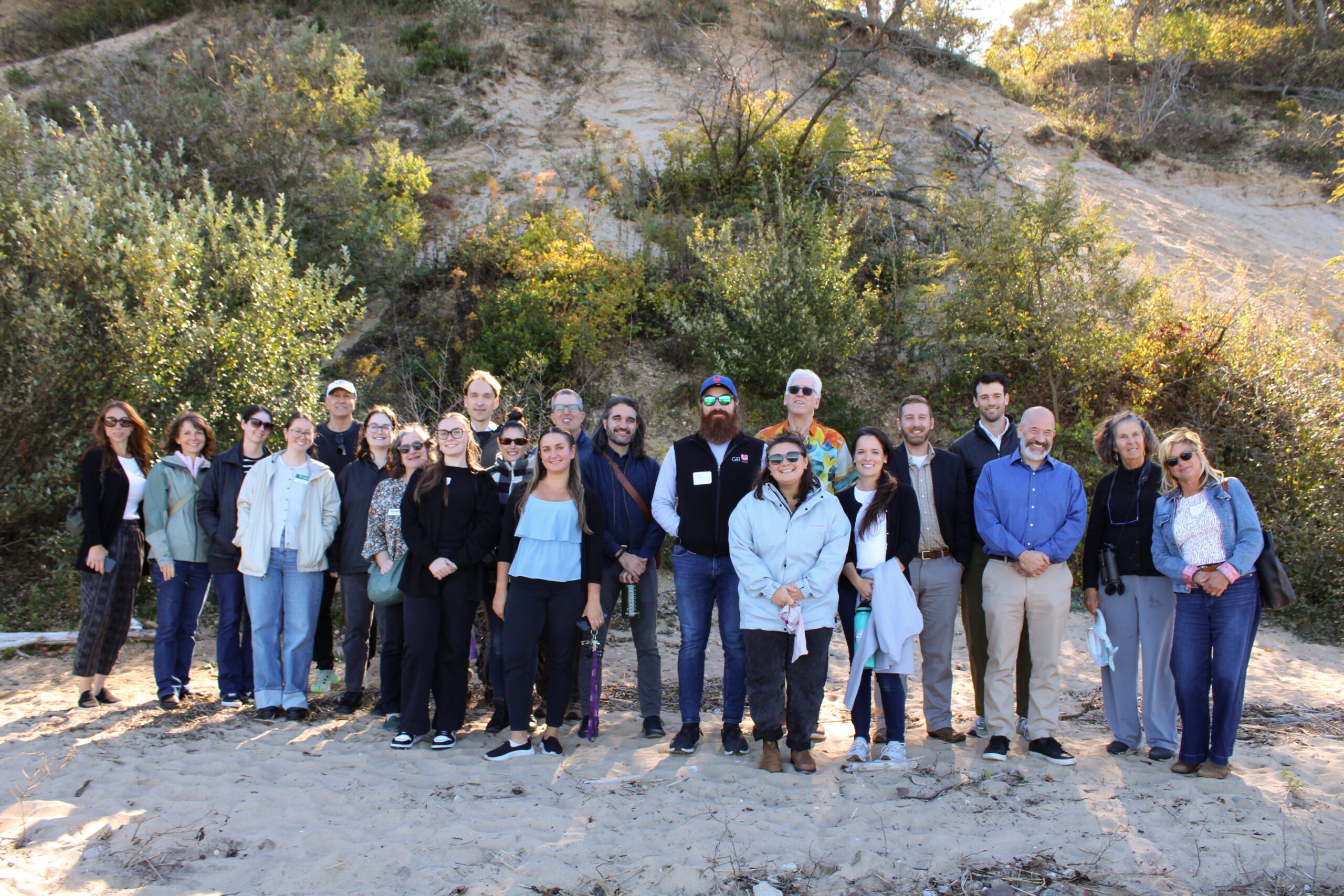
2025 Nassau Coastal Resilience Forum field trip to Sands Point Preserve. Credit: Sumayyah Uddin / NYSG
On October 9, 2025 state and local decision makers, municipal staff, and other interested parties working to address flooding, shoreline erosion and other coastal issues gathered at the Sands Point Preserve Conservancy in Sands Point, NY for the 3rd Annual Nassau County Coastal Resilience Forum. The Forum provided a chance to share information on best practices, discuss challenges, identify opportunities to increase resilience, and enhance coordination across communities. Forum attendees heard updates on State resilience initiatives from agencies like the NYS Department of Environmental Conservation and NYS Division of Homeland Security and Emergency Services, as well as presentations on new resilience tools and resources from Seatuck Environmental Association, the U.S. Geological Survey, New York Sea Grant, Cornell Cooperative Extension of Nassau County, and Nassau County Soil and Water Conservation District. In the afternoon, Forum attendees were given a guided tour of the recent expansions to the bluff stabilization project at the Preserve.
The event was hosted by Long Island Sound Partnership and New York Sea Grant, in partnership with the Sands Point Preserve Conservancy and Nassau and Suffolk County Soil and Water Conservation Districts.

SRC Training
Nassau County Coastal Resilience Forum & Field Trip – 2025
2025 Nassau Coastal Resilience Forum field trip to Sands Point Preserve. Credit: Sumayyah Uddin / NYSG
On October 9, 2025 state and local decision makers, municipal staff, and other interested parties working to address flooding, shoreline erosion and other coastal issues gathered at the Sands Point Preserve Conservancy in Sands Point, NY for the 3rd Annual Nassau County Coastal Resilience Forum. The Forum provided a chance to share information on best practices, discuss challenges, identify opportunities to increase resilience, and enhance coordination across communities. Forum attendees heard updates on State resilience initiatives from agencies like the NYS Department of Environmental Conservation and NYS Division of Homeland Security and Emergency Services, as well as presentations on new resilience tools and resources from Seatuck Environmental Association, the U.S. Geological Survey, New York Sea Grant, Cornell Cooperative Extension of Nassau County, and Nassau County Soil and Water Conservation District. In the afternoon, Forum attendees were given a guided tour of the recent expansions to the bluff stabilization project at the Preserve.
The event was hosted by Long Island Sound Partnership and New York Sea Grant, in partnership with the Sands Point Preserve Conservancy and Nassau and Suffolk County Soil and Water Conservation Districts.
Data
Level of Effort:
NYC Hazard Mitigation Plan
This website contains New York City’s Federal Emergency Management Agency–mandated Hazard Mitigation Plan, which identifies natural hazard risks and vulnerabilities that are common to New York City (NYC) and long-term strategies for reducing them. It also features a Mitigation Actions Database and Map that tracks and records actions that are taken to mitigate risk from the hazards profiled in the Hazard Mitigation Plan.
Data
Level of Effort:
NYC Hazard Mitigation Plan
This website contains New York City’s Federal Emergency Management Agency–mandated Hazard Mitigation Plan, which identifies natural hazard risks and vulnerabilities that are common to New York City (NYC) and long-term strategies for reducing them. It also features a Mitigation Actions Database and Map that tracks and records actions that are taken to mitigate risk from the hazards profiled in the Hazard Mitigation Plan.
Story Map
Level of Effort:
A StoryMap on Hypoxia
Success in the Urban Sea: Breathing Oxygen Back into the Long Island Sound’s Waters
This StoryMap describes how the Long Island Sound (LIS) Partnership has reduced hypoxia and improved nutrient management efforts in Long Island Sound and its watershed.
It includes an explanation of hypoxia, impacts from the region’s history, how LIS Partnership is addressing hypoxia, plans for the future, and how to use this information to inform meaningful action.
Story Map
Level of Effort:
A StoryMap on Hypoxia
Success in the Urban Sea: Breathing Oxygen Back into the Long Island Sound’s Waters
This StoryMap describes how the Long Island Sound (LIS) Partnership has reduced hypoxia and improved nutrient management efforts in Long Island Sound and its watershed.
It includes an explanation of hypoxia, impacts from the region’s history, how LIS Partnership is addressing hypoxia, plans for the future, and how to use this information to inform meaningful action.
Data
Level of Effort:
NYSDEC Division of Water Grants Data Portal
This portal contains the comprehensive dataset of awarded projects for the Water Quality Improvement Project Program (WQIP) and the Non-Agricultural Nonpoint Source Planning and MS4 Mapping Grant (NPG). Data is displayed simultaneously on a map and data table and can be filtered by Grant Program, Applicant, County, Project Type, and Funding Source.
Data
Level of Effort:
NYSDEC Division of Water Grants Data Portal
This portal contains the comprehensive dataset of awarded projects for the Water Quality Improvement Project Program (WQIP) and the Non-Agricultural Nonpoint Source Planning and MS4 Mapping Grant (NPG). Data is displayed simultaneously on a map and data table and can be filtered by Grant Program, Applicant, County, Project Type, and Funding Source.
Funding
: Jun 24 – Jul 31, 2025
Reducing the Threats of Extreme Weather Events
The CO2 Foundation funds innovative smaller-scale projects that can accomplish a lot in a short timeframe, which might otherwise fall through the cracks. They seek proposals to support timely interventions for extreme weather and/or prepare communities for the impacts of a rapidly changing climate system.
Eligible activities may include conferences and workshops, research, communications, and pilot project implementation. Applicants are encouraged to correspond with the Executive Director to discuss current funding priorities before submitting a proposal.
Funding
: Jun 24 – Jul 31, 2025
Reducing the Threats of Extreme Weather Events
The CO2 Foundation funds innovative smaller-scale projects that can accomplish a lot in a short timeframe, which might otherwise fall through the cracks. They seek proposals to support timely interventions for extreme weather and/or prepare communities for the impacts of a rapidly changing climate system.
Funding
: Apr 1 – May 31, 2026
CTDOT State Local Bridge Program
Construction and maintenance of Connecticut’s approximately 4,200 bridges and culverts is the responsibility of the cities and towns who own them. As part of the State’s Infrastructure Renewal Program, the Connecticut Department of Transportation’s the Local Bridge Program provides for State grants to municipalities for the removal, replacement, reconstruction, or rehabilitation of local bridges.
To qualify for state funding, a bridge must carry a certified public road, be municipally owned and/or maintained. The bridge must be considered a deficient bridge and must not have a prior commitment from the state – not withdrawn or expired – to fund the project. See the Local Bridge Program Manual (provided at the link) for detailed guidance.
Funding
: Apr 1 – May 31, 2026
CTDOT State Local Bridge Program
Construction and maintenance of Connecticut’s approximately 4,200 bridges and culverts is the responsibility of the cities and towns who own them. As part of the State’s Infrastructure Renewal Program, the Connecticut Department of Transportation’s the Local Bridge Program provides for State grants to municipalities for the removal, replacement, reconstruction, or rehabilitation of local bridges.
Mapper
Level of Effort:
CTDOT Drainage Network Interactive Map
This interactive map published by the CTDOT in March 2025 allows users to view data layers that make up the state-owned and maintained drainage network across Connecticut. Culvert locations are included, as well as their water source, material components, type of conveyance, diameter, length, last inspection date, and maintenance information. Note that an ArcGIS login is required to access this resource.
Mapper
Level of Effort:
CTDOT Drainage Network Interactive Map
This interactive map published by the CTDOT in March 2025 allows users to view data layers that make up the state-owned and maintained drainage network across Connecticut. Culvert locations are included, as well as their water source, material components, type of conveyance, diameter, length, last inspection date, and maintenance information. Note that an ArcGIS login is required to access this resource.
Resource
Level of Effort:
Culverts and Climate Resilience Fact Sheet
This fact sheet produced by the Connecticut Institute for Resilience and Climate Adaptation (CIRCA) reviews how culverts are defined in Connecticut, explains their connection to climate resilience, provides examples of how Connecticut towns are addressing needs for upgraded culverts, and highlights related resources.
Resource
Level of Effort:
Culverts and Climate Resilience Fact Sheet
This fact sheet produced by the Connecticut Institute for Resilience and Climate Adaptation (CIRCA) reviews how culverts are defined in Connecticut, explains their connection to climate resilience, provides examples of how Connecticut towns are addressing needs for upgraded culverts, and highlights related resources.
Funding
: Jun 25 – Sep 23, 2024
National Culvert Removal, Replacement, & Restoration Grants – FY24 (Year 3)
The Bipartisan Infrastructure Law established the National Culvert Removal, Replacement, and Restoration Grant program (Culvert Aquatic Organism Passage Program) to provide funding for projects that would meaningfully improve or restore passage for anadromous fish (anadromous fish species are born in freshwater such as streams and rivers, spend most of their lives in the marine environment, and migrate back to freshwater to spawn).
Eligible projects include projects to replace, remove, or repair culverts or weirs that would meaningfully improve or restore fish passage for anadromous fish. With respect to weirs, the project may include—infrastructure to facilitate fish passage around or over the weir; and weir improvements.
Funding
: Jun 25 – Sep 23, 2024
National Culvert Removal, Replacement, & Restoration Grants – FY24 (Year 3)
The Bipartisan Infrastructure Law established the National Culvert Removal, Replacement, and Restoration Grant program (Culvert Aquatic Organism Passage Program) to provide funding for projects that would meaningfully improve or restore passage for anadromous fish (anadromous fish species are born in freshwater such as streams and rivers, spend most of their lives in the marine environment, and migrate back to freshwater to spawn).
SRC Training
Land Use Leadership Alliance (LULA) Training Program – Spring 2025
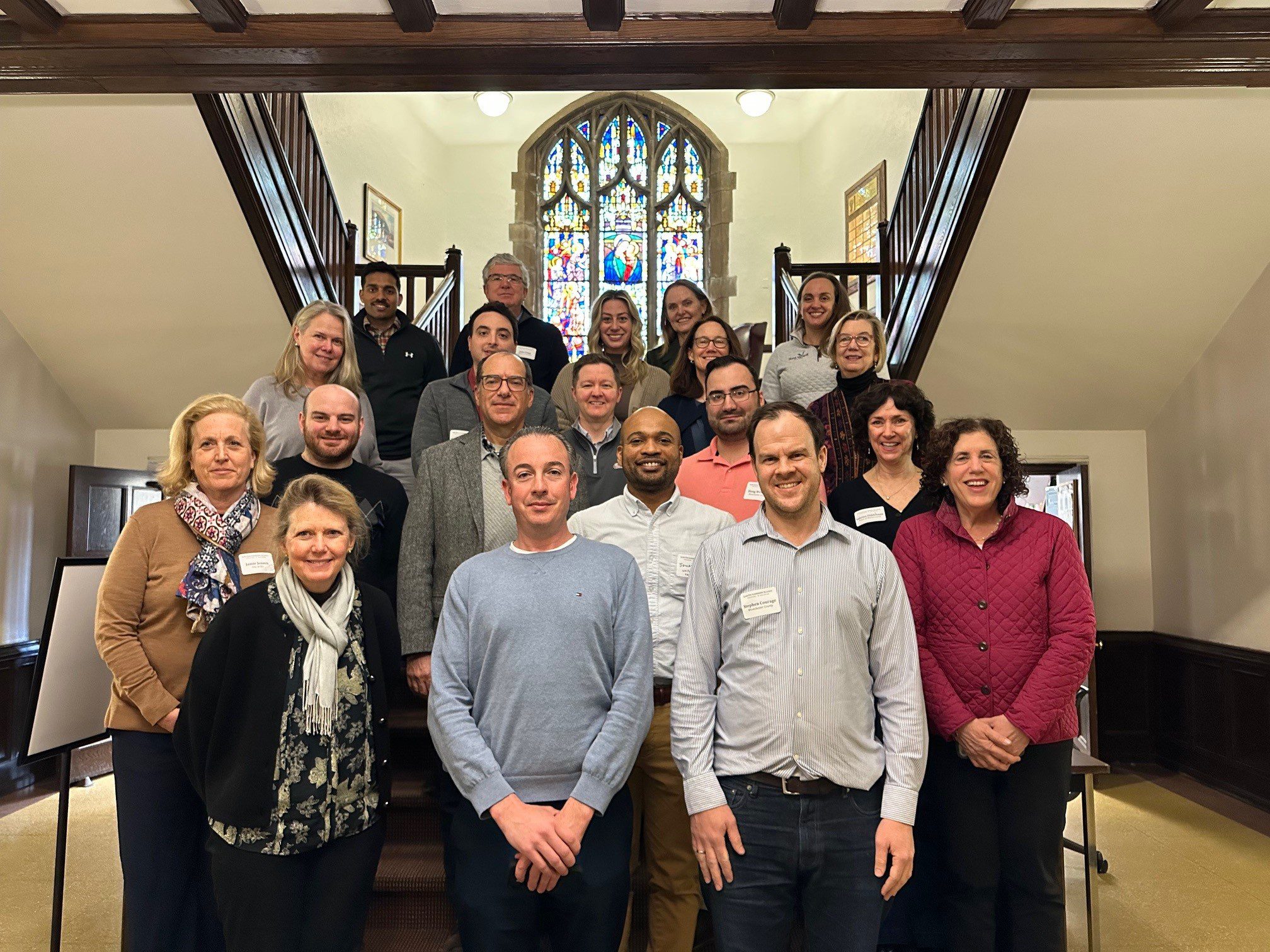
With funding from Long Island Sound Study and support from New York Sea Grant’s Sustainable and Resilient Communities Extension Professionals, Pace University’s Land Use Law Center brought its award-winning Land Use Leadership Alliance Training Program to Westchester municipalities within the Long Island Sound watershed. The training consisted of three full-day workshops held April 1, 8, and 22, 2025 in White Plains, NY to train local leaders on developing balanced strategies for effectively accomplishing policy objectives, particularly focused on land use, flood resilience, and natural resource protection to strengthen community planning and informed decision-making.
22 municipal staff and community leaders, representing 7 different Long Island Sound communities received resilience gap analyses that reviewed their municipality’s current zoning and comprehensive plan language, discussed common issues with their neighbors and built new networks of support, and graduated from the program empowered to plan for a more resilient future for their community and the Long Island Sound region.
If you are interested in learning more and participating in a future LULA training, please email lisresilience@gmail.com.
SRC Training
Land Use Leadership Alliance (LULA) Training Program – Spring 2025
With funding from Long Island Sound Study and support from New York Sea Grant’s Sustainable and Resilient Communities Extension Professionals, Pace University’s Land Use Law Center brought its award-winning Land Use Leadership Alliance Training Program to Westchester municipalities within the Long Island Sound watershed. The training consisted of three full-day workshops held April 1, 8, and 22, 2025 in White Plains, NY to train local leaders on developing balanced strategies for effectively accomplishing policy objectives, particularly focused on land use, flood resilience, and natural resource protection to strengthen community planning and informed decision-making.
22 municipal staff and community leaders, representing 7 different Long Island Sound communities received resilience gap analyses that reviewed their municipality’s current zoning and comprehensive plan language, discussed common issues with their neighbors and built new networks of support, and graduated from the program empowered to plan for a more resilient future for their community and the Long Island Sound region.
If you are interested in learning more and participating in a future LULA training, please email lisresilience@gmail.com.
Case Study
Project
Halesite, NY
Halesite Park Shoreline Restoration
With support from the Long Island Sound Resilience Grant Writing Assistance Program, in December 2024 1653 Foundation was awarded $549,955 from the NYSDEC Water Quality Improvement Project (WQIP) Program to fund the Final design and implementation of habitat improvements and green infrastructure at Halesite Park, NY.
1653 Foundation Inc. will restore degrading shoreline at Halesite Park on the eastern shore of Huntington Harbor. The project will remove a failing seawall to expand shallow water habitat, install an offshore rock sill and oyster reef, and expand salt marsh vegetation, and upland plantings.
LIS Resilience Grant Writing Assistance Program Details:
Grant Writing Consultant: DLB Planning, LLC.
Grant Writing Assistance Award: $9,900
Case Study
Project
Halesite, NY
Halesite Park Shoreline Restoration
With support from the Long Island Sound Resilience Grant Writing Assistance Program, in December 2024 1653 Foundation was awarded $549,955 from the NYSDEC Water Quality Improvement Project (WQIP) Program to fund the Final design and implementation of habitat improvements and green infrastructure at Halesite Park, NY.
1653 Foundation Inc. will restore degrading shoreline at Halesite Park on the eastern shore of Huntington Harbor. The project will remove a failing seawall to expand shallow water habitat, install an offshore rock sill and oyster reef, and expand salt marsh vegetation, and upland plantings.
LIS Resilience Grant Writing Assistance Program Details:
Grant Writing Consultant: DLB Planning, LLC.
Grant Writing Assistance Award: $9,900
GWA Case Study
Project
Mystic, CT
Mystic River Watershed Resilience Action Plan
With support from the Long Island Sound Resilience Grant Writing Assistance (GWA) Program, in December 2024 the Alliance for the Mystic River Watershed was awarded $419,900 from the Long Island Sound Futures Fund to support the project: Developing a Mystic River Watershed Resilience Action Plan Using Equitable Community Engagement, CT.
The project will launch a robust engagement effort and planning process throughout four municipalities and two Tribal Nations within Mystic, Connecticut, in order to initiate efforts to improve the watershed health along the 30.6-square-mile Mystic River Watershed. The project will develop a community- and stakeholder-supported EPA Nine Element watershed-based plan, which will strive to address water quality impairments, community inequities and resilience challenges in the watershed.
LIS Resilience Grant Writing Assistance Program Details:
Grant Writing Consultant: Resilient Land and Water, LLC.
Grant Writing Assistance Award: $9,950

Maggie Favretti, President & Chair Board of Directors, Alliance for the Mystic River Watershed, info@alliancemrw.org
GWA Case Study
Project
Mystic, CT
Mystic River Watershed Resilience Action Plan
With support from the Long Island Sound Resilience Grant Writing Assistance (GWA) Program, in December 2024 the Alliance for the Mystic River Watershed was awarded $419,900 from the Long Island Sound Futures Fund to support the project: Developing a Mystic River Watershed Resilience Action Plan Using Equitable Community Engagement, CT.
The project will launch a robust engagement effort and planning process throughout four municipalities and two Tribal Nations within Mystic, Connecticut, in order to initiate efforts to improve the watershed health along the 30.6-square-mile Mystic River Watershed. The project will develop a community- and stakeholder-supported EPA Nine Element watershed-based plan, which will strive to address water quality impairments, community inequities and resilience challenges in the watershed.
LIS Resilience Grant Writing Assistance Program Details:
Grant Writing Consultant: Resilient Land and Water, LLC.
Grant Writing Assistance Award: $9,950
Case Study
Project
Fairfield, CT
Mill River Wetland Committee’s River-Lab programs in Bridgeport, CT
With support from the Long Island Sound Resilience Grant Writing Assistance (GWA) Program, in 2024 the Mill River Wetland Committee (MRWC) was awarded $26,987 from the Long Island Sound Community Impact Fund to support MRWC to lead the 5th Grade classes (2) at Barnum School in Bridgeport, CT through the Groundwater Study Trip in the fall of 2024 and Water Monitoring training in the spring of 2025.
LIS Resilience Grant Writing Assistance Program Details:
Grant Writing Consultant: CT Grant Writers
Grant Writing Assistance Award: $1,912.50

Case Study
Project
Fairfield, CT
Mill River Wetland Committee’s River-Lab programs in Bridgeport, CT
With support from the Long Island Sound Resilience Grant Writing Assistance (GWA) Program, in 2024 the Mill River Wetland Committee (MRWC) was awarded $26,987 from the Long Island Sound Community Impact Fund to support MRWC to lead the 5th Grade classes (2) at Barnum School in Bridgeport, CT through the Groundwater Study Trip in the fall of 2024 and Water Monitoring training in the spring of 2025.
LIS Resilience Grant Writing Assistance Program Details:
Grant Writing Consultant: CT Grant Writers
Grant Writing Assistance Award: $1,912.50
GWA Case Study
Project
Nassau & Suffolk County, NY
ReWild Long Island Community Gardens Program
With support from the Long Island Sound Resilience Grant Writing Assistance (GWA) Program, in December 2023 ReWild Long Island was awarded $230,300 from the Long Island Sound Futures Fund to fund the project – ReWild Gardens for Long Island Sound: Implementation of an expanded community garden program Long Island within the LISS watershed.
The Community Gardens Program installs native plant gardens with community partners who plant & maintain them. The Summer Program to Fight Hunger and Climate Change supports high school students to plant & tend gardens with local nonprofit partners.
LIS Resilience Grant Writing Assistance Program Details:
Grant Writing Consultant: Elizabeth Skolnick
Grant Writing Assistance Award: $7,500
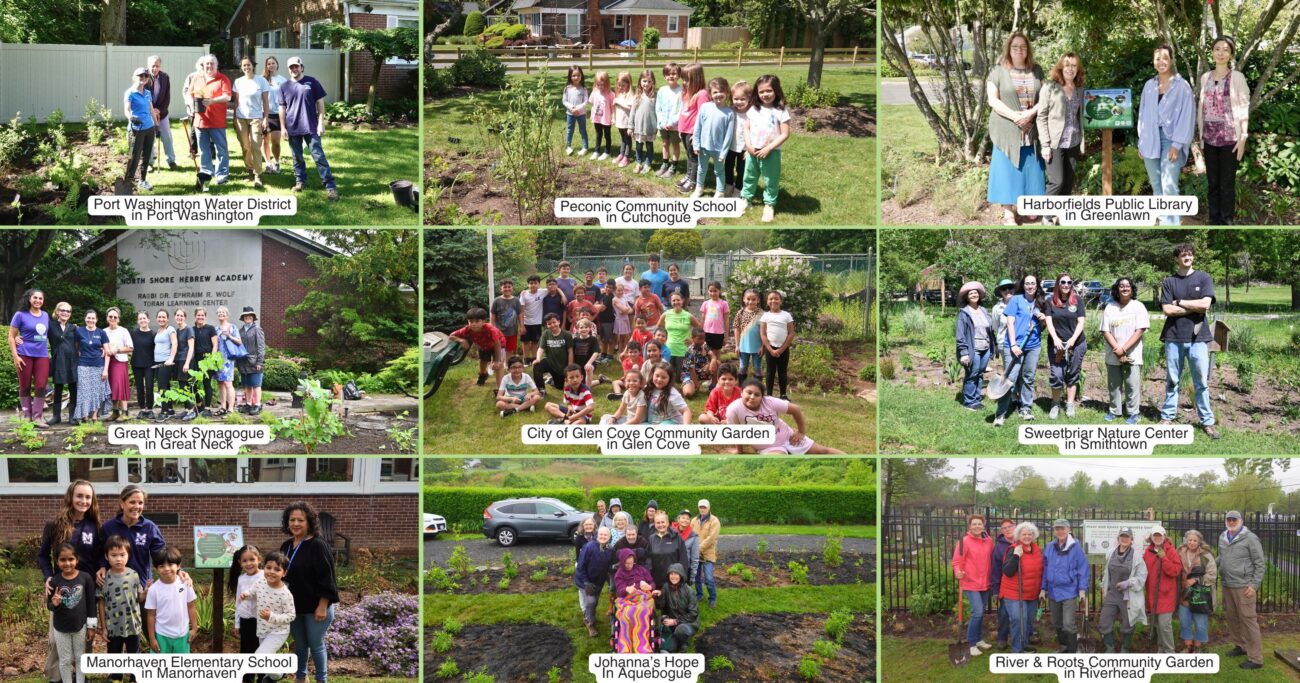
GWA Case Study
Project
Nassau & Suffolk County, NY
ReWild Long Island Community Gardens Program
With support from the Long Island Sound Resilience Grant Writing Assistance (GWA) Program, in December 2023 ReWild Long Island was awarded $230,300 from the Long Island Sound Futures Fund to fund the project – ReWild Gardens for Long Island Sound: Implementation of an expanded community garden program Long Island within the LISS watershed.
The Community Gardens Program installs native plant gardens with community partners who plant & maintain them. The Summer Program to Fight Hunger and Climate Change supports high school students to plant & tend gardens with local nonprofit partners.
LIS Resilience Grant Writing Assistance Program Details:
Grant Writing Consultant: Elizabeth Skolnick
Grant Writing Assistance Award: $7,500
Case Study
Project
Cold Spring Harbor, NY
North Shore Land Alliance Shore Road Sanctuary Habitat Restoration Project
With support from the Long Island Sound Resilience Grant Writing Assistance (GWA) Program, in December 2023, North Shore Land Alliance was awarded $192,969 from the NYSDEC Water Quality Improvement Project (WQIP) Program to fund the implementation of green infrastructure at the North Shore Land Alliance Shore Road Sanctuary in Cold Spring Harbor, NY. The North Shore Land Alliance will install an upland infiltration system to reduce the volume and velocity of stormwater on a 40-acre parcel and replace invasive plants along the shoreline with a native plant community. The project will restore habitat and reduce the amount stormwater and pollutants entering Cold Spring Harbor and Long Island Sound.
LIS Resilience Grant Writing Assistance Program Details:
Grant Writing Consultant: Nelson Pope & Voorhis
Grant Writing Assistance Award: $9,900

Jane Jackson, Director of Stewardship, North Shore Land Alliance, jjackson@northshorelandalliance.org
Case Study
Project
Cold Spring Harbor, NY
North Shore Land Alliance Shore Road Sanctuary Habitat Restoration Project
With support from the Long Island Sound Resilience Grant Writing Assistance (GWA) Program, in December 2023, North Shore Land Alliance was awarded $192,969 from the NYSDEC Water Quality Improvement Project (WQIP) Program to fund the implementation of green infrastructure at the North Shore Land Alliance Shore Road Sanctuary in Cold Spring Harbor, NY. The North Shore Land Alliance will install an upland infiltration system to reduce the volume and velocity of stormwater on a 40-acre parcel and replace invasive plants along the shoreline with a native plant community. The project will restore habitat and reduce the amount stormwater and pollutants entering Cold Spring Harbor and Long Island Sound.
LIS Resilience Grant Writing Assistance Program Details:
Grant Writing Consultant: Nelson Pope & Voorhis
Grant Writing Assistance Award: $9,900
Funding
: Jun 1 – Jul 31, 2026
Minimum request $75K
NYSDOS Smart Growth Community Planning Grant Program
The NYS Department of State (NYSDOS) is soliciting applications from eligible towns, villages, cities, counties, regional planning entities and not-for-profit organizations to support the creation, or modification of comprehensive plans, area plans, or zoning codes to align with smart growth principals. Priorities include Climate Resilience, Housing, Accessible Communities, and Waterfront Development and Revitalization.
Reimbursable Activities: •Preparing the Plan and/or zoning ordinance •Holding and facilitating community forums and public outreach •Coordinating with other governmental entities •SEQR and environmental review •Project management
Funding
: Jun 1 – Jul 31, 2026
Minimum request $75K
NYSDOS Smart Growth Community Planning Grant Program
The NYS Department of State (NYSDOS) is soliciting applications from eligible towns, villages, cities, counties, regional planning entities and not-for-profit organizations to support the creation, or modification of comprehensive plans, area plans, or zoning codes to align with smart growth principals. Priorities include Climate Resilience, Housing, Accessible Communities, and Waterfront Development and Revitalization.
Events
Long Island Sound Study Stewardship Strategy Public Meeting
The Long Island Sound Study will host a series of public meetings to discuss and finalize the Stewardship Strategy. The Strategy aims to provide a framework in support of the 33 Stewardship Areas of the Initiative. The draft of the Strategy will be shared for public comment March 10 – May 9. View the Draft Strategy here. Comments can be submitted to Cayla Sullivan at Sullivan.Cayla@epa.gov.
The last meeting in the series will be held on June 4th 11 am – 1 pm and will summarize the input and ideas for advancing the Stewardship Strategy!
Events
Long Island Sound Study Stewardship Strategy Public Meeting
The Long Island Sound Study will host a series of public meetings to discuss and finalize the Stewardship Strategy. The Strategy aims to provide a framework in support of the 33 Stewardship Areas of the Initiative. The draft of the Strategy will be shared for public comment March 10 – May 9. View the Draft Strategy here. Comments can be submitted to Cayla Sullivan at Sullivan.Cayla@epa.gov.
The last meeting in the series will be held on June 4th 11 am – 1 pm and will summarize the input and ideas for advancing the Stewardship Strategy!
Funding
: Apr 22 – Jun 12, 2026
$1 million to $10 million per project
NYS EFC Green Resiliency Grants (GRG)
The NYS Environmental Facilities Corporation (EFC) Green Resiliency Grants (GRG) help flood-prone communities advance long-term community resilience in implementing transformative stormwater management projects that protect homes, businesses, and public infrastructure. There is $60 million available this round. Funding is made available through the Clean Water, Clean Air, and Green Jobs Environmental Bond Act of 2022.
GRG projects must be capable of capturing, treating, or increasing the time of concentration for a minimum of 2,500 cubic feet of stormwater per 90th percentile rainfall event within a clearly defined drainage area that contributes to a specific water quality or quantity concern.
Funding
: Apr 22 – Jun 12, 2026
$1 million to $10 million per project
NYS EFC Green Resiliency Grants (GRG)
The NYS Environmental Facilities Corporation (EFC) Green Resiliency Grants (GRG) help flood-prone communities advance long-term community resilience in implementing transformative stormwater management projects that protect homes, businesses, and public infrastructure. There is $60 million available this round. Funding is made available through the Clean Water, Clean Air, and Green Jobs Environmental Bond Act of 2022.
Funding
: Oct 1, 2025
$1,000 - $20,000
The Quinnipiac River Fund
The Quinnipiac River Fund, a component fund of The Community Foundation for Greater New Haven, makes grants for projects designed to benefit the environmental quality of the Quinnipiac River, the New Haven Harbor, and surrounding watersheds.
The Quinnipiac River Fund improves the health of the Quinnipiac River by funding projects that provide research, conservation, and advocacy for the river and its surrounding watersheds.
Funding
: Oct 1, 2025
$1,000 - $20,000
The Quinnipiac River Fund
The Quinnipiac River Fund, a component fund of The Community Foundation for Greater New Haven, makes grants for projects designed to benefit the environmental quality of the Quinnipiac River, the New Haven Harbor, and surrounding watersheds.
Funding
: Aug 19, 2026
EPA Water Technical Assistance
EPA WaterTA aims to assist communities with applications for federal funding, quality infrastructure, and reliable water services in partnership with drinking water, wastewater, and stormwater utilities and local government. If your community is facing drinking water, wastewater, or stormwater challenges, you can submit a request for no-cost, direct assistance using the WaterTA Request Form. Please note that WaterTA is not a grant program, nor does it provide direct monetary assistance.
The EPA’s free WaterTA increases access to safe and reliable water and wastewater services for communities nationwide by providing hands-on support to identify water infrastructure or water quality challenges, develop plans to address these challenges, build technical, managerial, and financial capacity, maintain regulatory compliance, prepare application materials to finance water infrastructure projects with public funding, and improve resilience. For example, WaterTA providers can assist with planning, assessment, project development, partnerships and engagement, applying for funding and financing, and program management.
Funding
: Aug 19, 2026
EPA Water Technical Assistance
EPA WaterTA aims to assist communities with applications for federal funding, quality infrastructure, and reliable water services in partnership with drinking water, wastewater, and stormwater utilities and local government. If your community is facing drinking water, wastewater, or stormwater challenges, you can submit a request for no-cost, direct assistance using the WaterTA Request Form. Please note that WaterTA is not a grant program, nor does it provide direct monetary assistance.
Funding
: Apr 17 – Apr 27, 2025
FY26 Congressionally Directed Spending / Community Project Funding (Sen. Blumenthal & Sen. Murphy)
Congressionally Directed Spending requests, also known as Community Project Funding or Earmarks, are funding requests for high-impact, Connecticut-based projects that can be completed with assistance from the federal government. The project must meet the eligibility requirements for at least one of the accounts listed.
Please note, you only need to submit one application for each project and it will be sent to both offices. Requests may be made for the following bills: 1) Agriculture, Rural Development, Food and Drug Administration, and Related Agencies; 2) Commerce, Justice, Science and Related Agencies; 3) Energy and Water Development, and Related Agencies; 4) Financial Services and General Government; 5) Homeland Security; 6) Interior, Environment, and Related Agencies; 7) Labor, Health, and Human Services, Education, and Related Agencies; 8) Transportation, Housing and Urban Development, and Related Agencies; 9) Military Construction and Veteran Affairs.
Funding
: Apr 17 – Apr 27, 2025
FY26 Congressionally Directed Spending / Community Project Funding (Sen. Blumenthal & Sen. Murphy)
Congressionally Directed Spending requests, also known as Community Project Funding or Earmarks, are funding requests for high-impact, Connecticut-based projects that can be completed with assistance from the federal government. The project must meet the eligibility requirements for at least one of the accounts listed.
Events
LISCIF 2025 Annual Learning Exchange
The 2nd Annual Learning Exchange will bring together current and new grant recipients to highlight completed projects benefiting the Long Island Sound estuary. Organizations will share their work, challenges, and successes via breakout sessions. Attendees will also have opportunities to participate in workshops, network, strengthen ties, and build community. This annual event aims to be a knowledge and tech share of projects within a collaborative framework.
The Target Audience includes:
- 2024 and 2025 Long Island Sound Community Impact Fund Subawardees
- Tribal Groups, Organizations, Institutions, and Municipalities located in Connecticut and New York focused on environmental projects in the Long Island Sound estuary
- Coastal conservation, restoration professionals, students, and early career professionals working in environmentally distressed communities
Events
LISCIF 2025 Annual Learning Exchange
The 2nd Annual Learning Exchange will bring together current and new grant recipients to highlight completed projects benefiting the Long Island Sound estuary. Organizations will share their work, challenges, and successes via breakout sessions. Attendees will also have opportunities to participate in workshops, network, strengthen ties, and build community. This annual event aims to be a knowledge and tech share of projects within a collaborative framework.
The Target Audience includes:
- 2024 and 2025 Long Island Sound Community Impact Fund Subawardees
- Tribal Groups, Organizations, Institutions, and Municipalities located in Connecticut and New York focused on environmental projects in the Long Island Sound estuary
- Coastal conservation, restoration professionals, students, and early career professionals working in environmentally distressed communities
Resource
Level of Effort:
How vegetated buffers protect water quality, and a whole lot more
Use this fact sheet to learn about riparian buffers and how they can be a tool for filtering excess nutrients and sediment from runoff, reducing flood impacts, and providing habitat. Learn more about buffers using this fact sheet. Details include what buffers are, why they are important, best practice recommendations, and design considerations.
Resource
Level of Effort:
How vegetated buffers protect water quality, and a whole lot more
Use this fact sheet to learn about riparian buffers and how they can be a tool for filtering excess nutrients and sediment from runoff, reducing flood impacts, and providing habitat. Learn more about buffers using this fact sheet. Details include what buffers are, why they are important, best practice recommendations, and design considerations.
Resource
Level of Effort:
Sound Ideas for Clean Water
Municipalities are encouraged to use the Sound Ideas for Clean Water brochure in their outreach efforts. The website and brochure outline steps that residents can take to reduce stormwater runoff that can cause pollution and flooding. For more information about this campaign, contact the outreach coordinator for your area (listed here).
Resource
Level of Effort:
Sound Ideas for Clean Water
Municipalities are encouraged to use the Sound Ideas for Clean Water brochure in their outreach efforts. The website and brochure outline steps that residents can take to reduce stormwater runoff that can cause pollution and flooding. For more information about this campaign, contact the outreach coordinator for your area (listed here).
Funding
: Oct 1, 2025
Safeguarding Tomorrow Revolving Loan Fund Program
The Safeguarding Tomorrow Revolving Loan Fund (RLF) program is authorized under Section 205 of the Robert T. Stafford Disaster Relief and Emergency Assistance Act to provide capitalization grants to states, eligible federally recognized tribes, territories and the District of Columbia to establish revolving loan funds that provide hazard mitigation assistance for local governments to reduce risks from natural hazards and disasters.
These low interest loans will allow jurisdictions to reduce vulnerability to natural disasters, foster greater community resilience and reduce disaster suffering.
In the inaugural year of the Safeguarding Tomorrow Revolving Loan Fund program, FEMA gave qualified applicants the opportunity to apply for up to $50 million in capitalization grants to create a revolving loan fund. The revolving loan funds that they create will help local governments carry out hazard mitigation projects that reduce disaster risks for homeowners, businesses, nonprofit organizations and communities to help them build climate resilience. Note that: (1) FEMA will not limit or restrict project types beyond the limitations in statute; (2) Loans may be used as a non-federal cost match for another HMA grant application; (3) FEMA will not require entities to submit a benefit-cost analysis.
Funding
: Oct 1, 2025
Safeguarding Tomorrow Revolving Loan Fund Program
The Safeguarding Tomorrow Revolving Loan Fund (RLF) program is authorized under Section 205 of the Robert T. Stafford Disaster Relief and Emergency Assistance Act to provide capitalization grants to states, eligible federally recognized tribes, territories and the District of Columbia to establish revolving loan funds that provide hazard mitigation assistance for local governments to reduce risks from natural hazards and disasters.
These low interest loans will allow jurisdictions to reduce vulnerability to natural disasters, foster greater community resilience and reduce disaster suffering.
Funding
: Aug 19 – Mar 31, 2025
$10,000-$50,000
Suffolk County Soil & Water Conservation District (SCSWCD) Municipal and Community Assistance Programs
This grant opportunity is open to municipalities and non-governmental organizations interested in partnering with SCSWCD to implement a variety of projects focused on improving Suffolk County and its environment. These projects focus on revitalizing and protecting Long Islands ecosystems, waterbodies, ground water and habitats. The goal of this grant is to attract new partners to develop and implement innovative and sustainable solutions for environmental issues.
Any municipality within Suffolk County may apply for up to $50,000 total. This includes townships, villages, or government agencies; joint applicants are encouraged. Non-government agencies such as not for profit organizations, civic associations or community groups are eligible to apply for a $10,000 total award.
Funding
: Aug 19 – Mar 31, 2025
$10,000-$50,000
Suffolk County Soil & Water Conservation District (SCSWCD) Municipal and Community Assistance Programs
This grant opportunity is open to municipalities and non-governmental organizations interested in partnering with SCSWCD to implement a variety of projects focused on improving Suffolk County and its environment. These projects focus on revitalizing and protecting Long Islands ecosystems, waterbodies, ground water and habitats. The goal of this grant is to attract new partners to develop and implement innovative and sustainable solutions for environmental issues.
Funding
: Apr 22 – Jun 12, 2026
Up to $3 million
NYS EFC Green Innovation Grant Program
The NYS Environmental Facilities Corporation (EFC) Green Innovation Grant Program (GIGP) supports projects across New York State that utilize unique EPA-designated green stormwater infrastructure design and create cutting-edge green technologies. Competitive grants are awarded to projects that implement one or more of the following green practices: green stormwater infrastructure, energy efficiency, and water efficiency. There is $15 million available this round. Funding is made available through the Clean Water State Revolving Fund.
Funding
: Apr 22 – Jun 12, 2026
Up to $3 million
NYS EFC Green Innovation Grant Program
The NYS Environmental Facilities Corporation (EFC) Green Innovation Grant Program (GIGP) supports projects across New York State that utilize unique EPA-designated green stormwater infrastructure design and create cutting-edge green technologies. Competitive grants are awarded to projects that implement one or more of the following green practices: green stormwater infrastructure, energy efficiency, and water efficiency. There is $15 million available this round. Funding is made available through the Clean Water State Revolving Fund.
Funding
: Feb 26 – Jun 6, 2025
Minimum grant amount $150,000
Inland Flooding and Local Waterfront Revitalization Program (LWRP) Implementation Projects
Through New York State’s Clean Energy, Clean Water & Green Jobs Bond Act, the Department of State (DOS) is making $15 million available for implementation projects that improve waterfront and watershed resiliency and reduce climate impacts, particularly flooding. Projects should implement a complete or substantially complete LWRP or a complete or substantially complete relevant LWRP Component (including a watershed management plan funded by Department of State). The program prioritizes projects using natural solutions to enhance community resilience while also delivering environmental, economic and social benefits. Eligible applicants are: 1) A village, town, or city located along New York’s coasts or inland waterways 2) A county with the consent and acting on behalf of one or more eligible villages, towns or cities.
Applications must be submitted through the web-based NYS Consolidated Funding Application http://regionalcouncils.ny.gov/.
Funding
: Feb 26 – Jun 6, 2025
Minimum grant amount $150,000
Inland Flooding and Local Waterfront Revitalization Program (LWRP) Implementation Projects
Through New York State’s Clean Energy, Clean Water & Green Jobs Bond Act, the Department of State (DOS) is making $15 million available for implementation projects that improve waterfront and watershed resiliency and reduce climate impacts, particularly flooding. Projects should implement a complete or substantially complete LWRP or a complete or substantially complete relevant LWRP Component (including a watershed management plan funded by Department of State). The program prioritizes projects using natural solutions to enhance community resilience while also delivering environmental, economic and social benefits. Eligible applicants are: 1) A village, town, or city located along New York’s coasts or inland waterways 2) A county with the consent and acting on behalf of one or more eligible villages, towns or cities.
Funding
: Feb 26 – Jun 6, 2025
Minimum grant amount $300,000
Coastal Rehabilitation and Resilience Projects
Through New York State’s Clean Energy, Clean Water & Green Jobs Bond Act, the Department of State (DOS) is making $20 million available for habitat restoration, climate resiliency and risk reduction, and stormwater management projects located within the New York State Coastal areas, areas draining into the New York State Coastal area, and/or areas within the Coastal Nonpoint Source boundary (see map). Projects must be identified or implement goals outlined in state, regional, or local management plans/programs/studies. The program prioritizes projects using natural solutions to enhance community resilience while also delivering environmental, economic and social benefits. Eligible applicants include Municipalities (counties, cities, towns, villages, Indian Nations or Tribes recognized by the state or United States), Not-for-Profits, Soil and Water Conservation Districts, and New York State Agencies and Authorities. Projects may include design and construction, or construction.
Applications must be submitted through the web-based NYS Consolidated Funding Application http://regionalcouncils.ny.gov/.
Funding
: Feb 26 – Jun 6, 2025
Minimum grant amount $300,000
Coastal Rehabilitation and Resilience Projects
Through New York State’s Clean Energy, Clean Water & Green Jobs Bond Act, the Department of State (DOS) is making $20 million available for habitat restoration, climate resiliency and risk reduction, and stormwater management projects located within the New York State Coastal areas, areas draining into the New York State Coastal area, and/or areas within the Coastal Nonpoint Source boundary (see map). Projects must be identified or implement goals outlined in state, regional, or local management plans/programs/studies. The program prioritizes projects using natural solutions to enhance community resilience while also delivering environmental, economic and social benefits. Eligible applicants include Municipalities (counties, cities, towns, villages, Indian Nations or Tribes recognized by the state or United States), Not-for-Profits, Soil and Water Conservation Districts, and New York State Agencies and Authorities. Projects may include design and construction, or construction.
SRC Training
This field trip was part of a Community Resilience Project Showcase leading up to the 2024 Annual SRC Workshop.
Hamden Bioretention Project Tour & Workshop
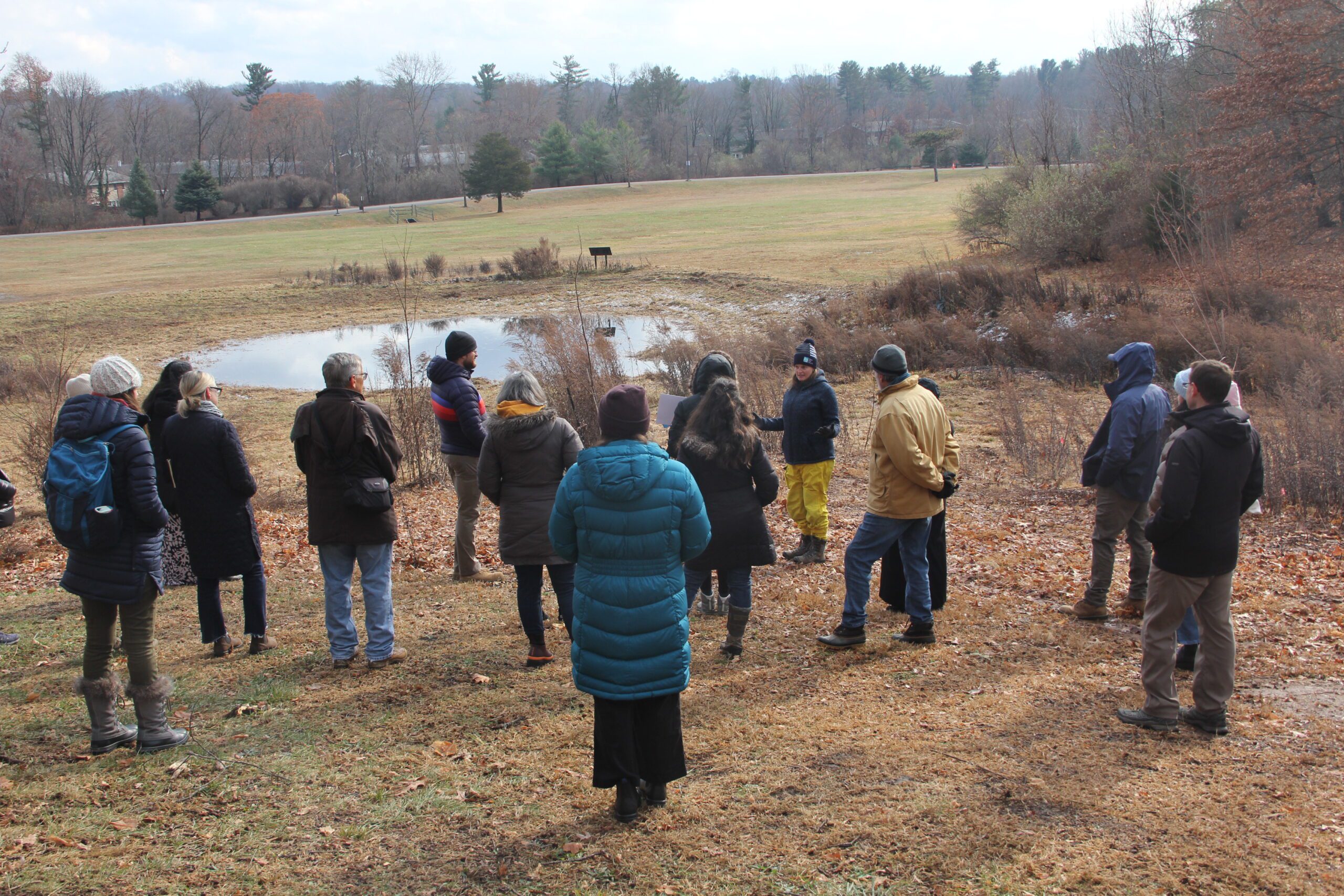 On December 5, 2024, the Sustainable and Resilient Communities (SRC) team of the Long Island Sound Study hosted a field trip featuring the Town of Hamden’s Bioretention Project – the largest municipally owned rain garden in the state! Participants began with a guided tour of the rain garden and bioretention areas at Town Center Park, where they heard from project planners and managers about its history, partnerships, challenges, and maintenance. Following this, participants gathered at the Hamden Government Center for a working lunch and presentations on topics including UConn’s Stormwater Corps, native plants, project engineering, and using nature-based solutions to advance climate resilience goals. The day concluded with a lively group discussion. Special thanks to our partners with the Town of Hamden, Save the Sound, the Hamden Land Trust, and UConn Extension.
Photo credit: Judy Benson



SRC Training
This field trip was part of a Community Resilience Project Showcase leading up to the 2024 Annual SRC Workshop.
Hamden Bioretention Project Tour & Workshop
On December 5, 2024, the Sustainable and Resilient Communities (SRC) team of the Long Island Sound Study hosted a field trip featuring the Town of Hamden’s Bioretention Project – the largest municipally owned rain garden in the state! Participants began with a guided tour of the rain garden and bioretention areas at Town Center Park, where they heard from project planners and managers about its history, partnerships, challenges, and maintenance. Following this, participants gathered at the Hamden Government Center for a working lunch and presentations on topics including UConn’s Stormwater Corps, native plants, project engineering, and using nature-based solutions to advance climate resilience goals. The day concluded with a lively group discussion. Special thanks to our partners with the Town of Hamden, Save the Sound, the Hamden Land Trust, and UConn Extension.
Photo credit: Judy Benson
$75,000 - $350,000
Environmental Justice Thriving Communities Grantmaking Program
EPA has selected Environmental Justice for New England to serve as pass-through entity for the Environmental Justice Thriving Communities Grants for CT, ME, MA, NH, RI, and VT. Thriving Communities subgrants will be distributed to support capacity building in communities affected by environmental or public health issues to eligible applicants. The program aims to reduce the burden of the federal grants application process and distribute federal funds to potential applicants working to address environmental justice issues.
Tier 1 will consist of grants for $150,000 for assessment (one-year project period), Tier 2 will consist of grants for $250,000 for planning (1-2 year project period), and Tier 3 will consist of grants for $350,000 for project development (two-year project period). Preference will be given to projects in which the majority of the funds are going to capacity-limited organizations and groups. Additionally, noncompetitive awards, or "Seed Funds" will be made to capacity-constrained communities and CBOs in a fixed amount of $75,000 each.
$75,000 - $350,000
Environmental Justice Thriving Communities Grantmaking Program
EPA has selected Environmental Justice for New England to serve as pass-through entity for the Environmental Justice Thriving Communities Grants for CT, ME, MA, NH, RI, and VT. Thriving Communities subgrants will be distributed to support capacity building in communities affected by environmental or public health issues to eligible applicants. The program aims to reduce the burden of the federal grants application process and distribute federal funds to potential applicants working to address environmental justice issues.
Report
Level of Effort:
Strategic Flooding Mitigation for Connecticut: Challenges and Solutions
The Connecticut Conference of Municipalities (CCM) recently released a comprehensive report on understanding and addressing the occurrence of local flooding. Developed in collaboration with leading engineering firm Fuss & O’Neill, the study was motivated by the need to address the growing concerns surrounding flood risks across Connecticut. The report evaluates current flood management practices and outlines a series of strategic interventions actionable recommendations to enhance community resilience.
Report
Level of Effort:
Strategic Flooding Mitigation for Connecticut: Challenges and Solutions
The Connecticut Conference of Municipalities (CCM) recently released a comprehensive report on understanding and addressing the occurrence of local flooding. Developed in collaboration with leading engineering firm Fuss & O’Neill, the study was motivated by the need to address the growing concerns surrounding flood risks across Connecticut. The report evaluates current flood management practices and outlines a series of strategic interventions actionable recommendations to enhance community resilience.
SRC Training
3rd Annual SRC Workshop: Session 2 – Resilience Tools
The Long Island Sound Sustainable and Resilient Communities (SRC) Team held our 2024 Annual Workshop virtually as three sessions over two days. Session topics focused on our assistance programs, new regional resilience resources and tools, and a discussion on planning for inundation and different considerations communities may face.
Session 2 – Resilience Tools was held on Tuesday, December 10th from 1:30-3:30 PM. Participants learned about new Resilience Tools being developed and used throughout coastal Long Island Sound.
SRC Training
3rd Annual SRC Workshop: Session 2 – Resilience Tools
The Long Island Sound Sustainable and Resilient Communities (SRC) Team held our 2024 Annual Workshop virtually as three sessions over two days. Session topics focused on our assistance programs, new regional resilience resources and tools, and a discussion on planning for inundation and different considerations communities may face.
Session 2 – Resilience Tools was held on Tuesday, December 10th from 1:30-3:30 PM. Participants learned about new Resilience Tools being developed and used throughout coastal Long Island Sound.
SRC Training
3rd Annual SRC Workshop: Session 1 – SRC Resilience Assistance Programs
The Long Island Sound Sustainable and Resilient Communities (SRC) Team held our 2024 Annual Workshop virtually as three sessions over two days. Session topics focused on our assistance programs, new regional resilience resources and tools, and a discussion on planning for inundation and different considerations communities may face.
Session 1 – SRC Resilience Assistance Programs was held on Tuesday, December 10th from 10-11:30 AM. Participants learned about our Sustainable and Resilient Communities resilience assistance programs and heard from communities who have successfully utilized them to advance resilience project plans, build capacity, and secure competitive grant funding!
SRC Training
3rd Annual SRC Workshop: Session 1 – SRC Resilience Assistance Programs
The Long Island Sound Sustainable and Resilient Communities (SRC) Team held our 2024 Annual Workshop virtually as three sessions over two days. Session topics focused on our assistance programs, new regional resilience resources and tools, and a discussion on planning for inundation and different considerations communities may face.
Session 1 – SRC Resilience Assistance Programs was held on Tuesday, December 10th from 10-11:30 AM. Participants learned about our Sustainable and Resilient Communities resilience assistance programs and heard from communities who have successfully utilized them to advance resilience project plans, build capacity, and secure competitive grant funding!
$45k-100k for 1-year projects; $75k-150K for 2-year projects
Partners for Places – Round 22
Partners for Places aims to enhance local capacity to build equitable and sustainable communities in the United States and Canada. These matching awards support the planning and implementing of urban sustainability and green stormwater infrastructure projects.
Funds may support the: (1) spreading of local Equitable Climate Action and/or Green Stormwater Infrastructure practices; and (2) advancing of opportunities for local government, frontline communities, and place-based funders to build trusting partnerships and develop projects together. Each community partnership must signal its collective priorities and collaborative approaches in the application.
$45k-100k for 1-year projects; $75k-150K for 2-year projects
Partners for Places – Round 22
Partners for Places aims to enhance local capacity to build equitable and sustainable communities in the United States and Canada. These matching awards support the planning and implementing of urban sustainability and green stormwater infrastructure projects.
$200,000-500,000
National Estuary Program Watersheds Grant Program
The NEP Coastal Watersheds Grant Program is a nationally competitive grants program designed to support projects that address urgent and challenging issues threatening the well-being of estuaries within the 28 NEP boundary areas.
This grant program funds projects aimed at addressing the following Congressionally-set priorities: • Loss of key habitats resulting in significant impacts on fisheries and water quality such as seagrass, mangroves, tidal and freshwater wetlands, forested wetlands, kelp beds, shellfish beds, and coral reefs; • Coastal resilience and extreme weather events including flooding and coastal erosion related to sea level rise, changing precipitation, warmer waters, or salt marsh, seagrass, or wetland degradation or loss and accelerated land loss; • Impacts of nutrients and warmer water temperatures on aquatic life and ecosystems, including low dissolved oxygen conditions in estuarine waters; • Stormwater runoff which not only can erode stream banks but can carry nutrients, sediment, and trash into rivers and streams that flow into estuaries; • Recurring harmful algae blooms; • Unusual or unexplained marine mammal mortalities; and • Proliferation or invasion of species that limit recreational uses, threaten wastewater systems, or cause other ecosystem damage.
$200,000-500,000
National Estuary Program Watersheds Grant Program
The NEP Coastal Watersheds Grant Program is a nationally competitive grants program designed to support projects that address urgent and challenging issues threatening the well-being of estuaries within the 28 NEP boundary areas.
SRC Training
Nassau County Coastal Resilience Forum & Field Trip – 2024
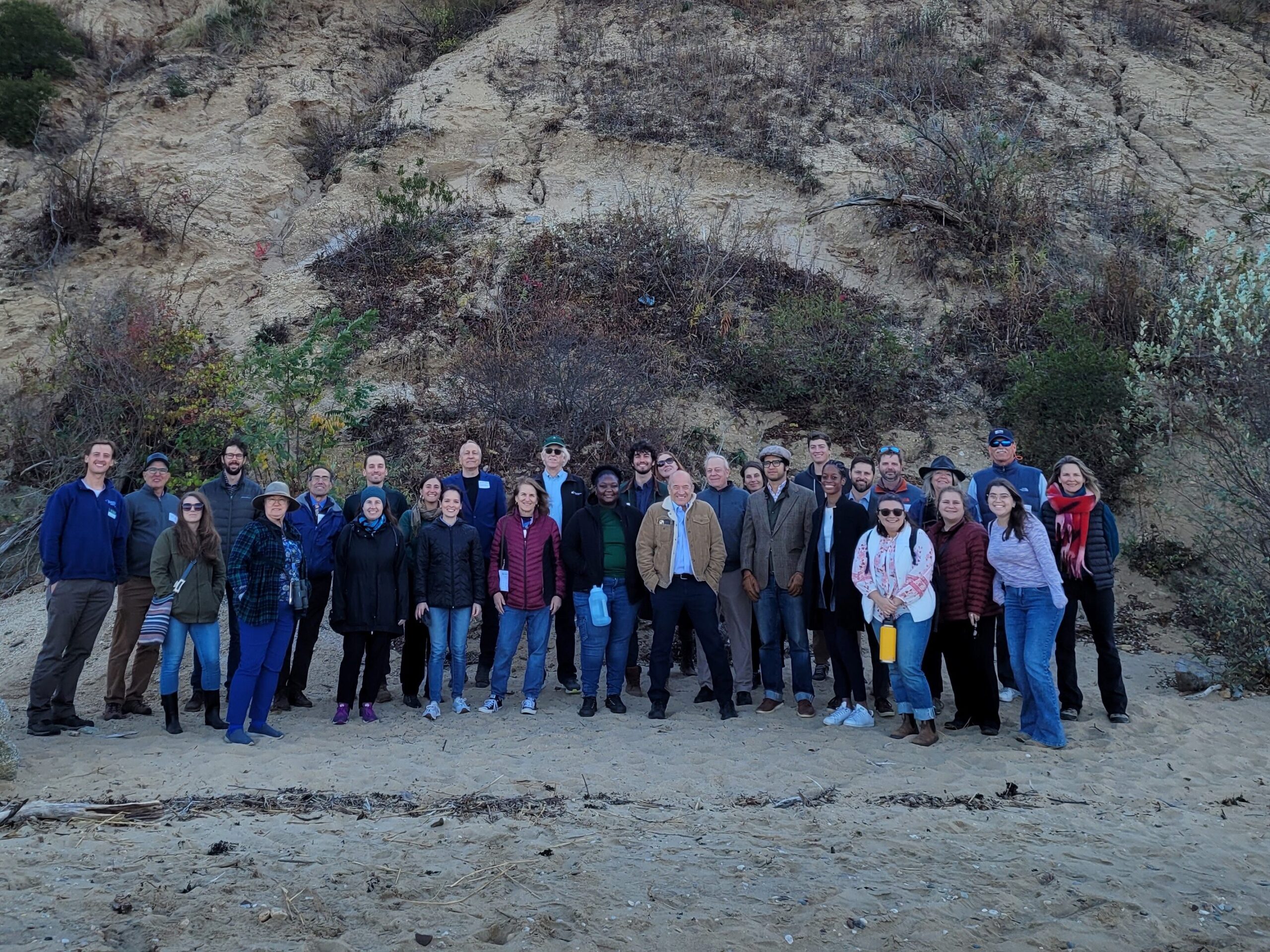
2024 Nassau Coastal Resilience Forum field trip to Sands Point Preserve. Credit: NYSG
On October 28, 2024, state and local decision makers, municipal staff, and other interested parties working to address coastal issues gathered at the Sands Point Preserve Conservancy in Sands Point, NY for the 2nd Annual Nassau County Coastal Resilience Forum to identify opportunities to increase resilience, learn about best practices, and enhance coordination across communities. There were presentations on the Long Island Sound Resilience Resource Hub & Assistance Programs, NYSDEC Office of Climate Change updates, marsh conservation planning, bluff management and restoration, and nature-based solutions to increase shoreline resilience. There was also a guided walking tour of the resilience projects at Sands Point Preserve.
The event is hosted by Long Island Sound Study and New York Sea Grant, in partnership with the Sands Point Preserve Conservancy and Nassau and Suffolk Soil and Water Conservation Districts.
SRC Training
Nassau County Coastal Resilience Forum & Field Trip – 2024
2024 Nassau Coastal Resilience Forum field trip to Sands Point Preserve. Credit: NYSG
On October 28, 2024, state and local decision makers, municipal staff, and other interested parties working to address coastal issues gathered at the Sands Point Preserve Conservancy in Sands Point, NY for the 2nd Annual Nassau County Coastal Resilience Forum to identify opportunities to increase resilience, learn about best practices, and enhance coordination across communities. There were presentations on the Long Island Sound Resilience Resource Hub & Assistance Programs, NYSDEC Office of Climate Change updates, marsh conservation planning, bluff management and restoration, and nature-based solutions to increase shoreline resilience. There was also a guided walking tour of the resilience projects at Sands Point Preserve.
The event is hosted by Long Island Sound Study and New York Sea Grant, in partnership with the Sands Point Preserve Conservancy and Nassau and Suffolk Soil and Water Conservation Districts.
RAISE Grant Program
Rebuilding American Infrastructure with Sustainability and Equity (RAISE) program provides grants for surface transportation infrastructure projects with significant local or regional impact. The eligibility requirements of RAISE allow project sponsors, including state and local governments, counties, Tribal governments, transit agencies, and port authorities, to pursue multi-modal and multi-jurisdictional projects that are more difficult to fund through other grant programs. The RAISE program was previously known as the Better Utilizing Investments to Leverage Development (BUILD) and Transportation Investment Generating Economic Recovery (TIGER) discretionary grants.
Eligible projects for RAISE grants are capital projects including but not limited to: * highway, bridge, or other road projects eligible under title 23, United States Code; * public transportation projects eligible under chapter 53 of title 49, United States Code; * passenger and freight rail transportation projects; * port infrastructure investments; * the surface transportation components of eligible airport projects; * projects to replace or rehabilitate a culvert or prevent stormwater runoff for the purpose of improving habitat for aquatic species while advancing the goals of the RAISE program; * projects investing in surface transportation facilities that are located on Tribal land; and * any other surface transportation infrastructure project that the Secretary considers to be necessary to advance the goals of the program. Planning projects which include planning, preparation, or design (for example - environmental analysis, equity analysis, community engagement, feasibility studies, benefit cost analysis (BCA), and other pre-construction activities) of eligible surface transportation capital projects that will not result in construction with this funding.
RAISE Grant Program
Rebuilding American Infrastructure with Sustainability and Equity (RAISE) program provides grants for surface transportation infrastructure projects with significant local or regional impact. The eligibility requirements of RAISE allow project sponsors, including state and local governments, counties, Tribal governments, transit agencies, and port authorities, to pursue multi-modal and multi-jurisdictional projects that are more difficult to fund through other grant programs. The RAISE program was previously known as the Better Utilizing Investments to Leverage Development (BUILD) and Transportation Investment Generating Economic Recovery (TIGER) discretionary grants.
Events
3rd Annual SRC Workshop: Session 3 – Planning for Inundation
The Long Island Sound Sustainable and Resilient Communities (SRC) Team is excited to announce that for our 2024 Annual Workshop we are holding a series of virtual sessions over two days focused on our assistance programs, new regional resilience resources and tools, and a discussion on planning for inundation and different considerations communities may face.
Session 3 – Planning for Inundation
Join us on Wednesday, December 11th from 10 AM-12 PM to hear from communities and regional entities that are considering different aspects of planning for inundation, including buyout programs, land use policies, and community perspectives on retreat/relocation.
Events
3rd Annual SRC Workshop: Session 3 – Planning for Inundation
The Long Island Sound Sustainable and Resilient Communities (SRC) Team is excited to announce that for our 2024 Annual Workshop we are holding a series of virtual sessions over two days focused on our assistance programs, new regional resilience resources and tools, and a discussion on planning for inundation and different considerations communities may face.
Session 3 – Planning for Inundation
Join us on Wednesday, December 11th from 10 AM-12 PM to hear from communities and regional entities that are considering different aspects of planning for inundation, including buyout programs, land use policies, and community perspectives on retreat/relocation.
Events
3rd Annual SRC Workshop: Session 2 – Resilience Tools
The Long Island Sound Sustainable and Resilient Communities (SRC) Team is excited to announce that for our 2024 Annual Workshop we are holding a series of virtual sessions over two days focused on our assistance programs, new regional resilience resources and tools, and a discussion on planning for inundation and different considerations communities may face.
Session 2 – Resilience Tools
Join us on Tuesday, December 10th from 1:30-3:30 PM to learn about new Resilience Tools being developed and used throughout coastal Long Island Sound!
Events
3rd Annual SRC Workshop: Session 2 – Resilience Tools
The Long Island Sound Sustainable and Resilient Communities (SRC) Team is excited to announce that for our 2024 Annual Workshop we are holding a series of virtual sessions over two days focused on our assistance programs, new regional resilience resources and tools, and a discussion on planning for inundation and different considerations communities may face.
Session 2 – Resilience Tools
Join us on Tuesday, December 10th from 1:30-3:30 PM to learn about new Resilience Tools being developed and used throughout coastal Long Island Sound!
Events
3rd Annual SRC Workshop: Session 1 – SRC Resilience Assistance Programs
The Long Island Sound Sustainable and Resilient Communities (SRC) Team is excited to announce that for our 2024 Annual Workshop we are holding a series of virtual sessions over two days focused on our assistance programs, new regional resilience resources and tools, and a discussion on planning for inundation and different considerations communities may face.
Session 1 – SRC Resilience Assistance Programs
Join us on Tuesday, December 10th from 10-11:30 AM to learn about our Sustainable and Resilient Communities resilience assistance programs and hear from communities who have successfully utilized them to advance resilience project plans, build capacity, and/or secure competitive grant funding!
Events
3rd Annual SRC Workshop: Session 1 – SRC Resilience Assistance Programs
The Long Island Sound Sustainable and Resilient Communities (SRC) Team is excited to announce that for our 2024 Annual Workshop we are holding a series of virtual sessions over two days focused on our assistance programs, new regional resilience resources and tools, and a discussion on planning for inundation and different considerations communities may face.
Session 1 – SRC Resilience Assistance Programs
Join us on Tuesday, December 10th from 10-11:30 AM to learn about our Sustainable and Resilient Communities resilience assistance programs and hear from communities who have successfully utilized them to advance resilience project plans, build capacity, and/or secure competitive grant funding!
Funding
: Aug 26 – Oct 23, 2024
Rooting Resilience: Funding and Technical Assistance for Urban and Community Forestry Projects
The Rooting Resilience Program will provide funding and technical assistance to community-based projects that build resilience and enhance communities’ abilities to plan and carry out forestry projects. This opportunity is available for projects located in federally designated disadvantaged communities, including urban, suburban, and rural communities in the United States and its territories. Special priority will be given to community-led groups that are seeking federal funding for the first time.
This opportunity is for urban and community forestry projects led by: Federally recognized Tribes, Alaska Native Corporations/villages, Tribal organizations, organizations working in Tribal communities, or Community-based non-profits. The Rooting Resilience program will prioritize: (1) Work rooted in community. This includes work proposed by and with support from Tribal or disadvantaged community members who understand, based on lived experience, what approaches will work best for their area; (2) Entities or organizations that are seeking federal pass-through funding for the first time and/or have limited experience receiving charitable funds or grants; (3) Projects that clearly demonstrate the benefits of their proposed activities to their community and their local trees.
Funding
: Aug 26 – Oct 23, 2024
Rooting Resilience: Funding and Technical Assistance for Urban and Community Forestry Projects
The Rooting Resilience Program will provide funding and technical assistance to community-based projects that build resilience and enhance communities’ abilities to plan and carry out forestry projects. This opportunity is available for projects located in federally designated disadvantaged communities, including urban, suburban, and rural communities in the United States and its territories. Special priority will be given to community-led groups that are seeking federal funding for the first time.
Resource
Level of Effort:
Green Stormwater Infrastructure Workbook
This workbook made by Groundwork Bridgeport provides a thorough but accessible introduction to green stormwater infrastructure. The workbook explains the issues that green infrastructure can help solve, introduces several green infrastructure methods, and then provides definitions, explains why each is uses, and details how to build them.
Resource
Level of Effort:
Green Stormwater Infrastructure Workbook
This workbook made by Groundwork Bridgeport provides a thorough but accessible introduction to green stormwater infrastructure. The workbook explains the issues that green infrastructure can help solve, introduces several green infrastructure methods, and then provides definitions, explains why each is uses, and details how to build them.
SRC Training
Suffolk County Coastal Resilience Forum & Field Trip
On October 29, 2024, state and local decision makers, municipal staff, and other interested parties working to address coastal issues gathered at the Dorothy P. Flint 4-H Camp in Riverhead, NY to identify opportunities to increase resilience, learn about best practices, and enhance coordination across communities. There were presentations on the Long Island Sound Resilience Resource Hub, NYSDEC Climate Office updates, marsh conservation planning, bluff management and restoration, and nature-based solutions to increase shoreline resilience. There was also a field trip to Iron Pier Beach/Maidstone Landing to view and learn about a community bluff restoration project.
This event was hosted by Long Island Sound Study and New York Sea Grant, in partnership with Nassau and Suffolk Soil and Water Conservation Districts, Nassau CCE, and Maidstone Landing.

SRC Training
Suffolk County Coastal Resilience Forum & Field Trip
On October 29, 2024, state and local decision makers, municipal staff, and other interested parties working to address coastal issues gathered at the Dorothy P. Flint 4-H Camp in Riverhead, NY to identify opportunities to increase resilience, learn about best practices, and enhance coordination across communities. There were presentations on the Long Island Sound Resilience Resource Hub, NYSDEC Climate Office updates, marsh conservation planning, bluff management and restoration, and nature-based solutions to increase shoreline resilience. There was also a field trip to Iron Pier Beach/Maidstone Landing to view and learn about a community bluff restoration project.
This event was hosted by Long Island Sound Study and New York Sea Grant, in partnership with Nassau and Suffolk Soil and Water Conservation Districts, Nassau CCE, and Maidstone Landing.
Funding
: May 9 – Aug 16, 2024
Climate Change Risk Assessment Technical Assistance for Water Sector Utilities
EPA’s Creating Resilient Water Utilities (CRWU) initiative is offering no-cost climate change risk assessment technical assistance to drinking water, wastewater, and stormwater utilities, as well as other water sector stakeholders. Through this technical assistance process, CRWU will assist approximately 75 water sector utilities / communities in identifying long-term climate change adaptation strategies, as well as potential funding options to implement adaptive measures.
Requesting communities will receive one-on-one no-cost climate change risk assessment support using EPA’s Resilient Strategies Guide, Climate Resilience Evaluation and Awareness Tool, and Climate and Weather Data Maps.
Funding
: May 9 – Aug 16, 2024
Climate Change Risk Assessment Technical Assistance for Water Sector Utilities
EPA’s Creating Resilient Water Utilities (CRWU) initiative is offering no-cost climate change risk assessment technical assistance to drinking water, wastewater, and stormwater utilities, as well as other water sector stakeholders. Through this technical assistance process, CRWU will assist approximately 75 water sector utilities / communities in identifying long-term climate change adaptation strategies, as well as potential funding options to implement adaptive measures.
Funding
: Feb 28 – May 17, 2024
$500,000 min
2024 Transportation Alternatives Program
This program provides funding for a variety of transportation projects such as pedestrian and bicycle facilities; construction of turnouts, overlooks, and viewing areas; community improvements such as historic preservation and vegetation management; environmental mitigation related to stormwater and habitat connectivity; recreational trails; safe routes to school projects; and vulnerable road user safety assessments.
These funds are made available to the State through partnership with the Federal Highway Administration (FHWA). The New Haven Urbanized Area alone is expected to receive $7.3 million between FFY 2026 and FFY 2030. To learn more and apply, please review the program application and solicitation memo attached. Applications must be submitted to Jim Rode at SCRCOG via email: jrode@scrcog.org by May 17, 2024. Project applications will be reviewed and ranked based on criteria provided by CT DOT. A prioritized list will be reviewed and finalized at the Transportation Committee meeting on June 12, 2024. Approval of the prioritized list of projects will be on the Board Meeting agenda on June 26, 2024.
Funding
: Feb 28 – May 17, 2024
$500,000 min
2024 Transportation Alternatives Program
This program provides funding for a variety of transportation projects such as pedestrian and bicycle facilities; construction of turnouts, overlooks, and viewing areas; community improvements such as historic preservation and vegetation management; environmental mitigation related to stormwater and habitat connectivity; recreational trails; safe routes to school projects; and vulnerable road user safety assessments.
Report
Level of Effort:
Zoning Strategies to Reduce Pollution of Inland Waters and Resultant Hypoxia of Long Island Sound
WEST COG developed this riparian zoning publication that is primarily focused on water quality, but also is highly relevant to climate mitigation.
Report
Level of Effort:
Zoning Strategies to Reduce Pollution of Inland Waters and Resultant Hypoxia of Long Island Sound
WEST COG developed this riparian zoning publication that is primarily focused on water quality, but also is highly relevant to climate mitigation.
Funding
: Nov 1 – Mar 31, 2025
$75,000 - $350,000
Thriving Communities Grantmaker Program
EPA has selected Fordham University to serve as pass-through entity for the Thriving Communities Grants for New York, New Jersey, Puerto Rico, and the US Virgin Islands. Thriving Communities subgrants will be distributed to support capacity building in communities affected by environmental or public health issues to eligible applicants. Applications will be accepted on a rolling basis until March 31, 2025.
Grants are available for funding in the following phases: Phase I = Assessment projects for up to $150,000 for a one-year project period Phase II = Planning projects for up to $250,000 for a 1-2 year project period, and Phase III = Project Development projects for up to $350,000 for a two-year project period. $150,000 awards may be made to organizations that offer a plan for engagement, capacity building, or assessment but do not provide a fully itemized budget (fixed amount awards). $250,000 and $350,000 awards must provide an itemized budget as well as a timeline for spending. Preference will be given to projects in which the majority of the funds are going to capacity-limited organizations and groups. Additionally, noncompetitive awards will be made to capacity-constrained communities and CBOs without the submission of an application to the competitive review process. These noncompetitive small subawards will be made in a fixed amount of $75,000 each, designed for ease of access, with a streamlined process that does not require participation in the competitive review process. Awardees will be selected through a participatory process, with fewer reporting requirements compared to competitive grants. Any person or organization in Region 2 may submit a nomination, including self-nominations.
Funding
: Nov 1 – Mar 31, 2025
$75,000 - $350,000
Thriving Communities Grantmaker Program
EPA has selected Fordham University to serve as pass-through entity for the Thriving Communities Grants for New York, New Jersey, Puerto Rico, and the US Virgin Islands. Thriving Communities subgrants will be distributed to support capacity building in communities affected by environmental or public health issues to eligible applicants. Applications will be accepted on a rolling basis until March 31, 2025.
Funding
: Aug 19, 2026
$500 - $1,000
Seed Grants Program
Awards small grants in support of grassroots efforts and community-based environmental work in New England. The Grassroots Fund utilizes participatory grantmaking to move resources to New England grassroots groups working at the intersections of Environmental Justice. The program is geared toward groups who have some experience implementing a project in their community. Grants support groups to deepen their work by further developing a community vision, lowering barriers to participation, identifying new stakeholders, and working to bring more voices and lived experiences into core decision-making processes.
The Seed grant program is geared towards groups launching new projects or starting to significantly change the direction of an existing project. Most often, groups have been working on the project less than a year and usually don't yet have much direct experience with implementing the idea. The Grassroots Fund interprets the word 'environment' broadly and provides funding for a wide range of activities.
Funding
: Aug 19, 2026
$500 - $1,000
Seed Grants Program
Awards small grants in support of grassroots efforts and community-based environmental work in New England. The Grassroots Fund utilizes participatory grantmaking to move resources to New England grassroots groups working at the intersections of Environmental Justice. The program is geared toward groups who have some experience implementing a project in their community. Grants support groups to deepen their work by further developing a community vision, lowering barriers to participation, identifying new stakeholders, and working to bring more voices and lived experiences into core decision-making processes.
Guidance Tool
Level of Effort:
Federal Flood Mitigation Funding Program Cheat Sheet
This resource outlines six different federal mitigation funding programs. It provides an overview of available options and links to learn more information and apply.
Guidance Tool
Level of Effort:
Federal Flood Mitigation Funding Program Cheat Sheet
This resource outlines six different federal mitigation funding programs. It provides an overview of available options and links to learn more information and apply.
Funding
: Mar 11 – Apr 14, 2024
FY25 Congressionally Directed Spending / Community Project Funding (Sen. Blumenthal & Sen. Murphy)
Congressionally Directed Spending requests, also known as Community Project Funding or Earmarks, are funding requests for high-impact, Connecticut-based projects that can be completed with assistance from the federal government. The project must meet the eligibility requirements for at least one of the accounts listed.
Please note, you only need to submit one application for each project and it will be sent to both offices. Requests may be made for the following bills: 1) Agriculture, Rural Development, Food and Drug Administration, and Related Agencies; 2) Commerce, Justice, Science and Related Agencies; 3) Energy and Water Development, and Related Agencies; 4) Financial Services and General Government; 5) Homeland Security; 6) Interior, Environment, and Related Agencies; 7) Labor, Health, and Human Services, Education, and Related Agencies; 8) Transportation, Housing and Urban Development, and Related Agencies.
Funding
: Mar 11 – Apr 14, 2024
FY25 Congressionally Directed Spending / Community Project Funding (Sen. Blumenthal & Sen. Murphy)
Congressionally Directed Spending requests, also known as Community Project Funding or Earmarks, are funding requests for high-impact, Connecticut-based projects that can be completed with assistance from the federal government. The project must meet the eligibility requirements for at least one of the accounts listed.
Funding
: Oct 12 – Dec 15, 2023
$800M total available
FY23 Flood Mitigation Assistance Grant Program – New York
The Flood Mitigation Assistance grant program is a competitive program that provides funding to states, federally recognized Tribal governments, U.S. territories, and local governments. Since the National Flood Insurance Reform Act of 1994 was signed into law, funds are used for projects that reduce or eliminate the risk of repetitive flood damage to buildings insured by the National Flood Insurance Program.
The Flood Mitigation Assistance grant program funds activities and projects, including: - Capability and Capacity Building Activities - Mitigation Plans - Technical Assistance by States to Communities - Project Scoping - Localized Flood Risk Reduction Projects - Individual Flood Mitigation Projects - Management Costs Additional capability and capacity building activities also may be funded, including: - Partnership Development to Conduct Eligible Mitigation Activities - Enhancing Local Floodplain Management - Severe Repetitive Loss/Repetitive Loss Strategy Development - Other Capability and Capacity Building Activities
Funding
: Oct 12 – Dec 15, 2023
$800M total available
FY23 Flood Mitigation Assistance Grant Program – New York
The Flood Mitigation Assistance grant program is a competitive program that provides funding to states, federally recognized Tribal governments, U.S. territories, and local governments. Since the National Flood Insurance Reform Act of 1994 was signed into law, funds are used for projects that reduce or eliminate the risk of repetitive flood damage to buildings insured by the National Flood Insurance Program.
Funding
: Oct 12 – Dec 15, 2023
$1B total available
FY23 Building Resilient Infrastructure and Communities Grants (BRIC) – New York
The Federal Emergency Management Agency (FEMA) Building Resilient Infrastructure and Communities (BRIC) grant program will support states, local communities, tribes and territories as they undertake hazard mitigation projects, reducing the risks they face from disasters and natural hazards. The BRIC program’s guiding principles are to support communities through capability and capacity building, encourage and enable innovation; promote partnerships, enable large projects, maintain flexibility, and provide consistency.
FEMA will provide financial assistance to eligible BRIC applicants for the following activities: • Capability and Capacity-Building activities – activities that enhance the knowledge, skills, and expertise of the current workforce to expand or improve the administration of mitigation assistance. This includes activities in the following sub-categories: building codes, partnerships, project scoping, hazard mitigation planning and planning-related activities, and other activities; • Hazard Mitigation Projects – cost-effective projects designed to increase resilience and public safety; reduce injuries and loss of life; and reduce damage and destruction to property, critical services, facilities, and infrastructure (including natural systems) from a multitude of natural hazards, including drought, wildfire, earthquakes, extreme heat, and the effects of climate change; and • Management Costs – financial assistance to reimburse the recipient and subrecipient for eligible and reasonable indirect costs, direct administrative costs, and other administrative expenses associated with a specific mitigation measure or project in an amount up to 15% of the total amount of the grant award, of which not more than 10% of the total award amount may be used by the recipient and 5% by the subrecipient for such costs generally.
Funding
: Oct 12 – Dec 15, 2023
$1B total available
FY23 Building Resilient Infrastructure and Communities Grants (BRIC) – New York
The Federal Emergency Management Agency (FEMA) Building Resilient Infrastructure and Communities (BRIC) grant program will support states, local communities, tribes and territories as they undertake hazard mitigation projects, reducing the risks they face from disasters and natural hazards. The BRIC program’s guiding principles are to support communities through capability and capacity building, encourage and enable innovation; promote partnerships, enable large projects, maintain flexibility, and provide consistency.
Funding
: Aug 19, 2026
up to $9,950
Long Island Sound Resilience Grant Writing Assistance Program
New York Sea Grant and Connecticut Sea Grant are providing grant preparation and writing capacity to New York and Connecticut communities that are pursuing funding for sustainability and resilience-focused projects. This technical assistance program helps municipalities and community organizations develop successful grant proposals and develop capacity for navigating the funding landscape.
This opportunity is part of a program that is intended to assist with the development of sustainability and resilience focused projects that will impact communities within (or partially within) the Long Island Sound coastal boundary. Awards are reimbursed directly to grant writing contractors.
Funding
: Aug 19, 2026
up to $9,950
Long Island Sound Resilience Grant Writing Assistance Program
New York Sea Grant and Connecticut Sea Grant are providing grant preparation and writing capacity to New York and Connecticut communities that are pursuing funding for sustainability and resilience-focused projects. This technical assistance program helps municipalities and community organizations develop successful grant proposals and develop capacity for navigating the funding landscape.